
[Paper Review] Explanations of Black-Box Models based on Directional Feature Interactions
The paper extends univariate removal-based explanations to bivariate, asymmetric interactions by constructing a directed explanation graph from Shapley value maps, enabling detection of directional and mutual redundancy and outperforming symmetric methods across diverse datasets.
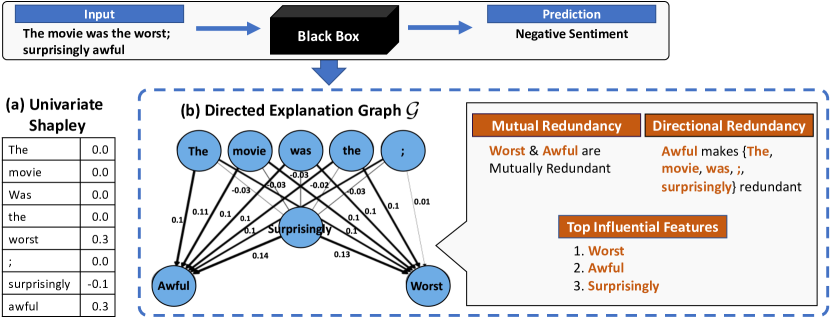
As machine learning algorithms are deployed ubiquitously to a variety of domains, it is imperative to make these often black-box models transparent. Several recent works explain black-box models by capturing the most influential features for prediction per instance; such explanation methods are univariate, as they characterize importance per feature. We extend univariate explanation to a higher-order; this enhances explainability, as bivariate methods can capture feature interactions in black-box models, represented as a directed graph. Analyzing this graph enables us to discover groups of features that are equally important (i.e., interchangeable), while the notion of directionality allows us to identify the most influential features. We apply our bivariate method on Shapley value explanations, and experimentally demonstrate the ability of directional explanations to discover feature interactions. We show the superiority of our method against state-of-the-art on CIFAR10, IMDB, Census, Divorce, Drug, and gene data.
Motivation & Objective
- Motivate the need for explanations that capture feature interactions beyond univariate importances.
- Propose a general method to convert any univariate removal-based explanation into a bivariate, asymmetric explanation map.
- Represent interactions as a directed graph to enable identification of directional/mutual redundancy and influential features.
- Provide theoretical foundations and practical algorithms for analyzing the directed explanation graph in the context of SHAP.
Proposed method
- Define a bivariate explanation map E^2 by applying the univariate utility-based explanation to restricted utilities u_i that fix feature i in the subset.
- Specialize the bivariate map to the SHAP framework to obtain E^2(u) with asymmetry (i.e., E^2(u)_{ij} != E^2(u)_{ji}).
- Represent E^2 as a directed graph G with weights W_G(i,j) = E^2(u)_{ji}, termed the directed explanation graph.
- Introduce and formalize notions of directional redundancy (i -> j with zero weight), mutual redundancy (i and j mutually non-influential), and transitivity in a redundancy graph H derived from G.
- Provide algorithms and definitions to analyze G and H, including PageRank-based ranking and Tarjan’s algorithm for redundant groups.
- Compare two SHAP-based approximation methods (Shapley Sampling S and KernelSHAP) for scalability and accuracy.
Experimental results
Research questions
- RQ1Can directional (asymmetric) feature interactions extracted from SHAP-based explanations reveal information not captured by univariate explanations?
- RQ2How can one formally define and detect directional and mutual redundancy among features in instance-wise explanations?
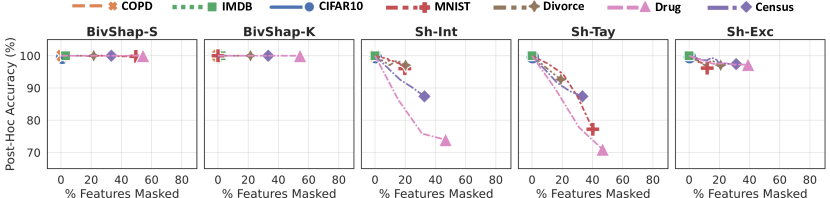
- RQ3Do directed explanation graphs yield better post-hoc accuracy preservation under feature masking and reveal more influential feature groups than symmetric approaches across diverse data modalities?
Key findings
- Directional SHAP extensions yield an asymmetric E^2 that can be represented as a directed graph, uncovering interaction structure not visible in symmetric or univariate methods.
- Analysis of the directed graph identifies sinks as highly influential features when interactions are accounted for, and reveals directional and mutual redundancies among features.
- Experiments across MNIST, CIFAR-10, IMDB, Census, Divorce, Drug, and COPDGene show that Bivariate SHAP (using KernelSHAP and Shapley Sampling) generally improves post-hoc accuracy preservation and offers faster runtimes compared to symmetry-based methods.
- Mutual redundancy groups can be detected via strongly connected components, and their interchangeability can be validated by masking experiments, with GNNExplainer not revealing such redundancy.
- Theoretical results (including a triangle-like bound) imply transitivity of mutual redundancy under SHAP, enabling robust clustering of interchangeable feature groups.
Read this paper
Open the full text in the Nubint reader and ask about any passage as you read.
Read this paper on NubintThis review was generated by AI from the original paper. Please check the paper before citing it.