
[Paper Review] Explicit Correspondence Matching for Generalizable Neural Radiance Fields
MatchNeRF introduces explicit cross-view correspondence matching via group-wise cosine similarity on Transformer-extracted features to provide geometry priors for a generalizable NeRF, achieving state-of-the-art results with as few as two views.
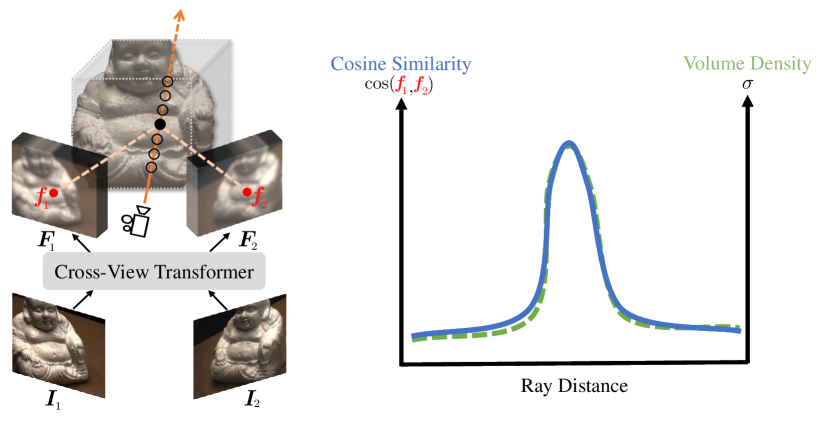
We present a new generalizable NeRF method that is able to directly generalize to new unseen scenarios and perform novel view synthesis with as few as two source views. The key to our approach lies in the explicitly modeled correspondence matching information, so as to provide the geometry prior to the prediction of NeRF color and density for volume rendering. The explicit correspondence matching is quantified with the cosine similarity between image features sampled at the 2D projections of a 3D point on different views, which is able to provide reliable cues about the surface geometry. Unlike previous methods where image features are extracted independently for each view, we consider modeling the cross-view interactions via Transformer cross-attention, which greatly improves the feature matching quality. Our method achieves state-of-the-art results on different evaluation settings, with the experiments showing a strong correlation between our learned cosine feature similarity and volume density, demonstrating the effectiveness and superiority of our proposed method. The code and model are on our project page: https://donydchen.github.io/matchnerf
Motivation & Objective
- Develop a generalizable NeRF that can synthesize novel views of unseen scenes with few input views (as few as two).
- Leverage explicit cross-view correspondence information to provide a geometry prior for NeRF density prediction.
- Avoid reliance on 3D cost volumes by using a correspondence-based prior to improve generalization.
- Demonstrate state-of-the-art performance on standard benchmarks (DTU, Real Forward-Facing, Blender) under 3-view and 2-view settings.
Proposed method
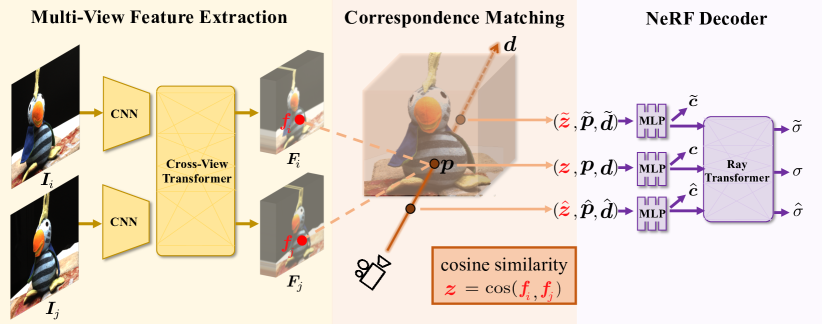
- Extract multi-view image features with a Transformer that models cross-view interactions via pairwise view processing.
- Project a 3D point into each view to sample Transformer features and compute pairwise group-wise cosine similarities as a geometry prior z.
- Aggregate cosine similarities across all view pairs to obtain a view-agnostic z to condition the NeRF decoder.
- Predict color and density with a NeRF decoder that also employs a ray Transformer for cross-point interactions on a ray.
- Train end-to-end with photometric loss without ground-truth geometry.
Experimental results
Research questions
- RQ1Can explicit cross-view feature correspondence provide reliable geometry priors for generalizable NeRFs without 3D cost volumes?
- RQ2Does group-wise cosine similarity of cross-view features improve density prediction and rendering quality over simpler similarity or implicit similarity learning?
- RQ3How does the method perform with varying numbers of input views (2 vs 3) across standard benchmarks?
- RQ4Is the approach robust to reference view selection and capable of generalizing to unseen scenes?
Key findings
- MatchNeRF achieves state-of-the-art results on DTU, Real Forward-Facing, and Blender under 3-view and 2-view settings.
- Explicit group-wise cosine similarity between pairwise Transformer features correlates strongly with volume density, aiding geometry prediction.
- Using both 1/8 and 1/4 resolution features and a ray Transformer yields best performance, with significant gains from cross-attention in the encoder.
- The method is view-agnostic and less sensitive to reference view than cost-volume-based methods (e.g., MVSNeRF).
- MatchNeRF outperforms cost-volume baselines even when those baselines use more input views (e.g., 5–10 views in GPNR settings).
Read this paper
Open the full text in the Nubint reader and ask about any passage as you read.
Read this paper on NubintThis review was generated by AI from the original paper. Please check the paper before citing it.