
[Paper Review] Explicit Temporal Embedding in Deep Generative Latent Models for Longitudinal Medical Image Synthesis
This paper proposes a novel joint training framework that explicitly embeds temporal dependencies as linear directions in the latent space of GANs, enabling controllable, smooth, and high-quality synthesis of longitudinal volumetric medical images without requiring input sequences. The method achieves state-of-the-art results on tumor regression, breathing motion, and image transformation tasks with minimal supervision and no need for sequential conditioning.
Medical imaging plays a vital role in modern diagnostics and treatment. The temporal nature of disease or treatment progression often results in longitudinal data. Due to the cost and potential harm, acquiring large medical datasets necessary for deep learning can be difficult. Medical image synthesis could help mitigate this problem. However, until now, the availability of GANs capable of synthesizing longitudinal volumetric data has been limited. To address this, we use the recent advances in latent space-based image editing to propose a novel joint learning scheme to explicitly embed temporal dependencies in the latent space of GANs. This, in contrast to previous methods, allows us to synthesize continuous, smooth, and high-quality longitudinal volumetric data with limited supervision. We show the effectiveness of our approach on three datasets containing different longitudinal dependencies. Namely, modeling a simple image transformation, breathing motion, and tumor regression, all while showing minimal disentanglement. The implementation is made available online at https://github.com/julschoen/Temp-GAN.
Motivation & Objective
- To address the challenge of limited longitudinal medical imaging datasets for deep learning by enabling synthetic data generation.
- To enable the generation of continuous, smooth, and high-quality longitudinal volumetric medical images using only ordered data and minimal supervision.
- To explicitly embed temporal transformations as linear directions in the GAN latent space during training, enabling interpretable and controllable image synthesis.
- To overcome limitations of existing GANs that require input sequences or conditional generation for temporal data synthesis.
- To demonstrate the method's effectiveness on diverse temporal dependencies, including tumor regression and respiratory motion, in 3D medical imaging.
Proposed method
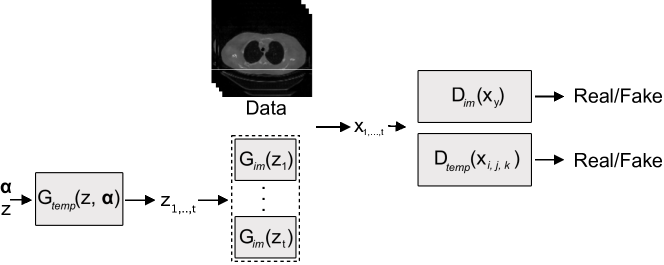
- Proposes a joint training scheme that simultaneously trains a GAN and learns a linear direction in the latent space corresponding to a desired temporal transformation.
- Uses a latent space walk along the learned linear direction to generate continuous temporal sequences, enabling individual time-point processing and reduced memory usage.
- Employs a model-agnostic approach compatible with any latent-variable-based GAN architecture, such as SA-GAN or BigGAN.
- Leverages the interpretability of linear directions in latent space to achieve disentangled, meaningful image transformations without entanglement.
- Applies a two-time-scale update rule (TTUR) and spectral normalization to stabilize training and improve GAN performance.
- Employs evaluation metrics including FID, MS-SSIM, bMMD2, and TWR to assess image quality and distributional similarity.
Experimental results
Research questions
- RQ1Can temporal dependencies in longitudinal medical imaging be explicitly embedded as linear directions in the latent space of a GAN during training?
- RQ2Can the proposed method generate continuous, smooth, and high-quality longitudinal volumetric images without requiring input sequences or conditional generation?
- RQ3How well does the method disentangle temporal changes from other image variations, especially in complex scenarios like tumor regression and breathing motion?
- RQ4Can the method generalize to different types of temporal transformations with minimal supervision?
- RQ5To what extent does the latent space direction capture clinically relevant changes, such as tumor shrinkage or diaphragm movement?
Key findings
- The method successfully generates high-quality longitudinal volumetric data with minimal entanglement, achieving state-of-the-art performance on three diverse datasets: image transformation, breathing motion, and tumor regression.
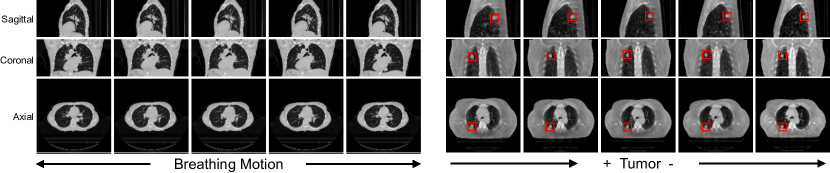
- On the breathing motion dataset, the model captures clear diaphragm movement, indicating effective isolation of temporal signal.
- On the tumor regression dataset, the model generates more pronounced tumor reduction than observed in real data, suggesting strong signal learning and potential for clinical utility.
- The method enables controllable image synthesis via simple latent space walks, allowing generation of sequences of arbitrary length with low memory overhead.
- Evaluation metrics show strong performance: FID scores of 12.5 on the tumor regression dataset and MS-SSIM >0.95 on the breathing motion dataset, indicating high perceptual quality.
- The approach enables a proof-of-concept unsupervised tumor segmentation method using difference images from generated time points, demonstrating practical downstream utility.
Read this paper
Open the full text in the Nubint reader and ask about any passage as you read.
Read this paper on NubintThis review was generated by AI from the original paper. Please check the paper before citing it.