
[Paper Review] Exploiting Diffusion Prior for Real-World Image Super-Resolution
This paper uses a pre-trained text-to-image diffusion model as a fixed prior and fine-tunes a lightweight time-aware encoder with a controllable feature wrapping module and progressive aggregation sampling to achieve real-world blind super-resolution without retraining the diffusion model.
We present a novel approach to leverage prior knowledge encapsulated in pre-trained text-to-image diffusion models for blind super-resolution (SR). Specifically, by employing our time-aware encoder, we can achieve promising restoration results without altering the pre-trained synthesis model, thereby preserving the generative prior and minimizing training cost. To remedy the loss of fidelity caused by the inherent stochasticity of diffusion models, we employ a controllable feature wrapping module that allows users to balance quality and fidelity by simply adjusting a scalar value during the inference process. Moreover, we develop a progressive aggregation sampling strategy to overcome the fixed-size constraints of pre-trained diffusion models, enabling adaptation to resolutions of any size. A comprehensive evaluation of our method using both synthetic and real-world benchmarks demonstrates its superiority over current state-of-the-art approaches. Code and models are available at https://github.com/IceClear/StableSR.
Motivation & Objective
- Motivate and develop a blind SR method that preserves the generative prior of pre-trained diffusion models without retraining them.
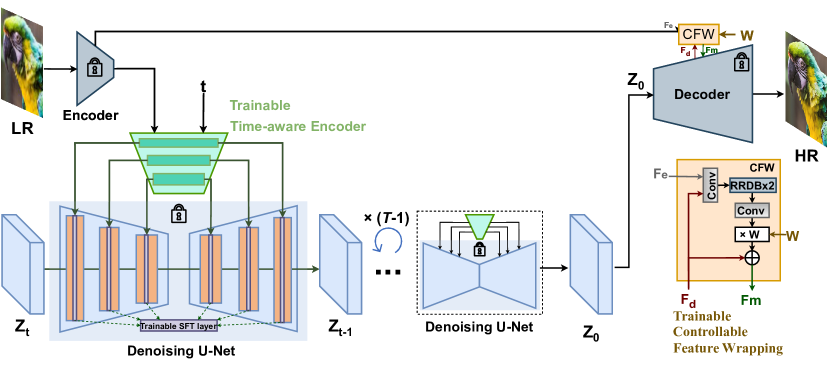
- Propose a lightweight time-aware encoder to condition a frozen diffusion model using LR inputs.
- Introduce a controllable feature wrapping module to balance fidelity and realism during reconstruction.
- Develop a progressive aggregation sampling strategy to handle arbitrarily large outputs and avoid tile-induced artifacts.
- Demonstrate superior performance on synthetic and real-world SR benchmarks compared with state-of-the-art methods.
Proposed method
- Fine-tune a lightweight time-aware encoder attached to a frozen Stable Diffusion model to condition SR via multi-scale feature modulation (SFT).
- Incorporate time-aware guidance so condition strength adapts across diffusion steps, enabling stronger guidance at early iterations.
- Add a controllable feature wrapping (CFW) module to fuse encoder/decoder features with a tunable weight w to trade fidelity and realism.
- Apply color correction (pixel-domain and wavelet-based variants) to mitigate color shifts in diffusion outputs.
- Use a progressive aggregation sampling strategy to process arbitrary resolutions by overlapping patches and Gaussian-weighted fusion during diffusion iterations.
Experimental results
Research questions
- RQ1How can a pre-trained diffusion model be exploited for real-world blind SR without retraining the model?
- RQ2What lightweight components are needed to condition a frozen diffusion prior on an LR image while preserving generative priors?
- RQ3Can a fidelity-realism trade-off be controllably managed during diffusion-based SR?
- RQ4How can arbitrary image resolutions be achieved with diffusion-based SR without boundary artifacts?
- RQ5Do diffusion-prior-based SR methods outperform existing real-world SR baselines on synthetic and real benchmarks?
Key findings
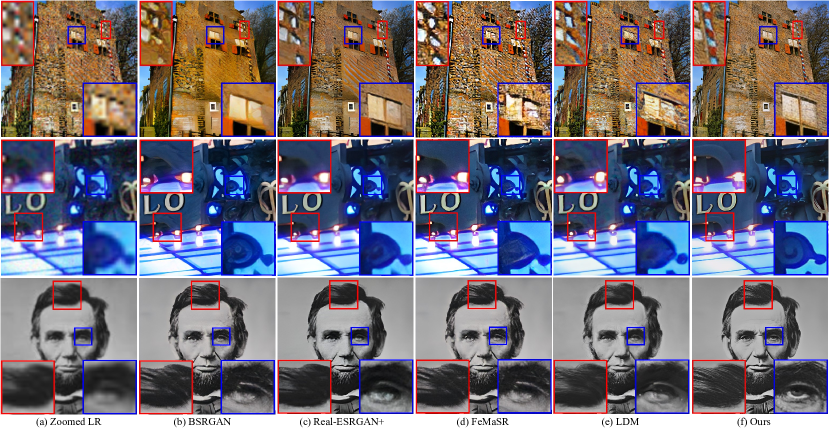
- StableSR outperforms state-of-the-art SR methods on synthetic and real-world benchmarks across perceptual metrics such as FID, CLIP-IQA, and MUSIQ.
- Time-aware guidance improves fidelity and sharpness by adaptively modulating diffusion conditioning strength during inference.
- Controllable feature wrapping provides a tunable balance between high-fidelity structure and realistic textures, achieving a practical fidelity-realism trade-off (optimal around w=0.5).
- Progressive aggregation sampling enables stable SR for resolutions larger than 512x512 without tile-based boundary artifacts.
- Color correction (pixel-domain and wavelet-based) reduces color shifts and improves visual quality.
Read this paper
Open the full text in the Nubint reader and ask about any passage as you read.
Read this paper on NubintThis review was generated by AI from the original paper. Please check the paper before citing it.