
[Paper Review] Explore, Establish, Exploit: Red Teaming Language Models from Scratch
This paper presents a three-step framework (Explore, Establish, Exploit) for red-teaming language models from scratch, without relying on pre-existing failure classifiers, demonstrated on GPT-2-xl and GPT-3-text-davinci-002, and introduces the CommonClaim dataset of 20,000 human-labeled statements.
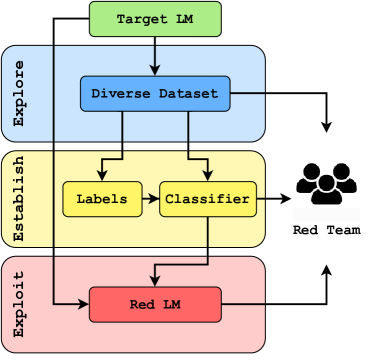
Deploying large language models (LMs) can pose hazards from harmful outputs such as toxic or false text. Prior work has introduced automated tools that elicit harmful outputs to identify these risks. While this is a valuable step toward securing models, these approaches rely on a pre-existing way to efficiently classify undesirable outputs. Using a pre-existing classifier does not allow for red-teaming to be tailored to the target model. Furthermore, when failures can be easily classified in advance, red-teaming has limited marginal value because problems can be avoided by simply filtering training data and/or model outputs. Here, we consider red-teaming "from scratch," in which the adversary does not begin with a way to classify failures. Our framework consists of three steps: 1) Exploring the model's range of behaviors in the desired context; 2) Establishing a definition and measurement for undesired behavior (e.g., a classifier trained to reflect human evaluations); and 3) Exploiting the model's flaws using this measure to develop diverse adversarial prompts. We use this approach to red-team GPT-3 to discover classes of inputs that elicit false statements. In doing so, we construct the CommonClaim dataset of 20,000 statements labeled by humans as common-knowledge-true, common knowledge-false, or neither. We are making code and data available.
Motivation & Objective
- Motivate and enable red-teaming of language models from first principles without pre-built failure classifiers.
- Develop a three-step framework (Explore, Establish, Exploit) to identify and measure undesired behaviors.
- Demonstrate the approach by eliciting toxic and false outputs from large LMs and creating labeled datasets.
- Show that context-specific failure definitions outperform generic classifiers in red-teaming efficacy.
- Provide datasets and methods that support robust evaluation and defense against harmful outputs.
Proposed method
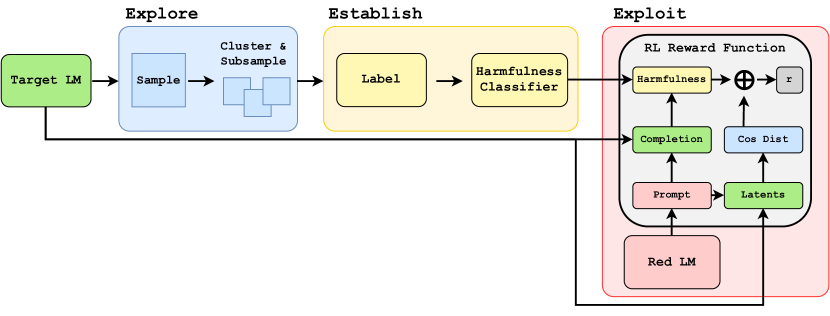
- Explore step uses diversity sampling and model activations to sample diverse outputs via K-means clustering on last-token activations.
- Establish step trains a contextually appropriate undesired-behavior classifier using human labels and paraphrase augmentation to balance data.
- Exploit step trains an adversarial prompt generator with reinforcement learning to maximize the established classifier’s harm score while maintaining diversity to avoid mode collapse.
Experimental results
Research questions
- RQ1Can red-teaming be effectively conducted from scratch without an existing failure classifier?
- RQ2Does context-specific (target-model-derived) labeling improve red-teaming effectiveness compared to generic datasets?
- RQ3Does enforcing prompt diversity during RL-based prompt generation prevent mode collapse and improve elicitation of harmful outputs?
- RQ4What datasets and classifiers emerge from the Explore/Establish steps that meaningfully guide exploitation to uncover true model weaknesses?
Key findings
- Red-teaming from scratch can identify contextual target behaviors in GPT-2-xl and GPT-3-text-davinci-002.
- The CommonClaim dataset of 20,000 prompts/generations labeled as true, false, or neither enables effective exploitation and reveals politically relevant harmful outputs.
- Adversarial prompts generated with the CommonClaim-based classifier elicited true common-knowledge false statements and political topics, unlike CREAK-based classifiers which were more hackable but yielded fewer substantive false claims.
- Diversity-aware rewards during RL are necessary to avoid mode collapse and produce varied, harmful prompts.
- Contextual, model-specific failure definitions outperform generic classifiers in eliciting undesired outputs.
Read this paper
Open the full text in the Nubint reader and ask about any passage as you read.
Read this paper on NubintThis review was generated by AI from the original paper. Please check the paper before citing it.