
[Paper Review] Exploring Causal Learning through Graph Neural Networks: An In-depth Review
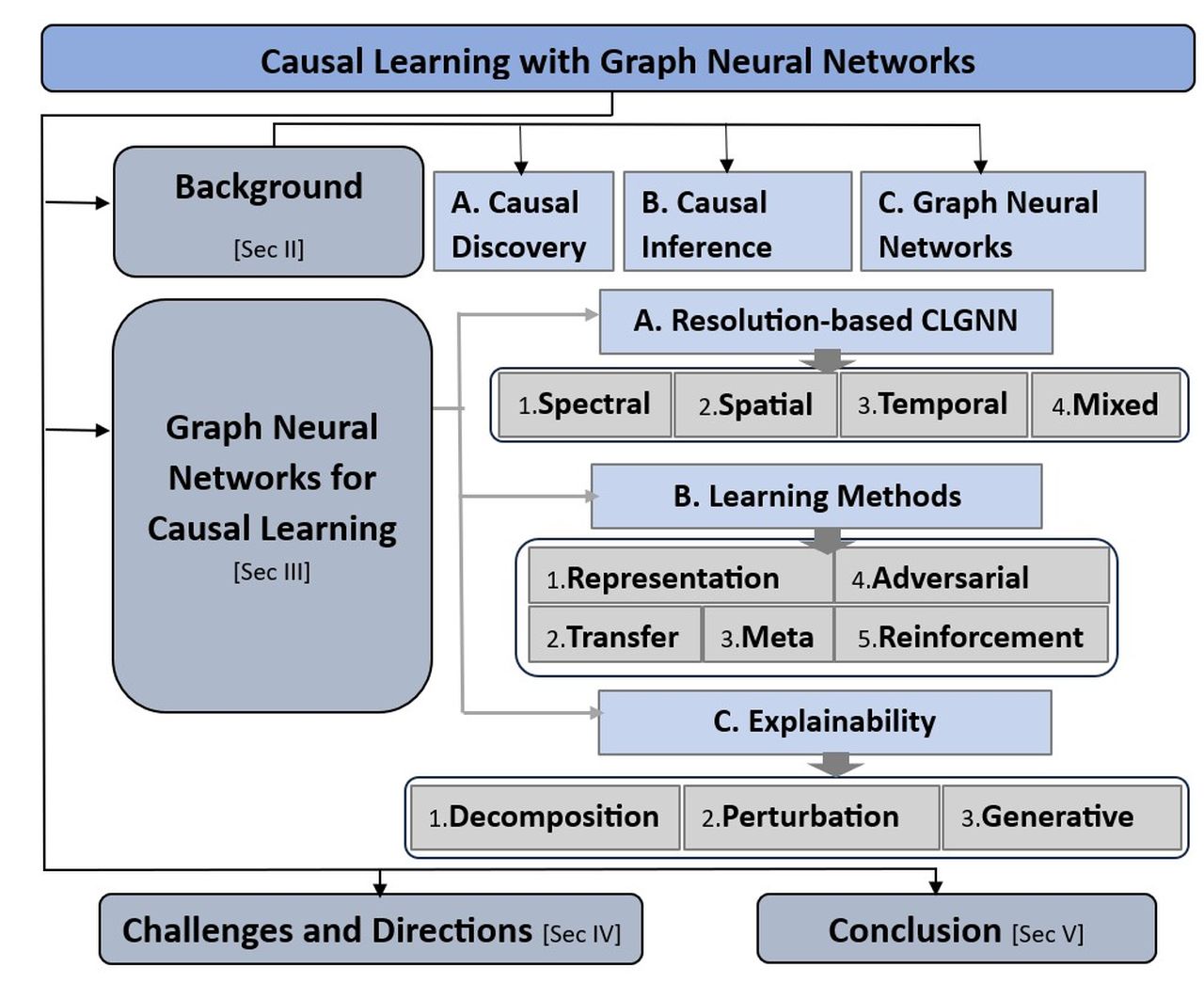
This paper presents a comprehensive review of graph neural networks (GNNs) for causal learning, introducing a novel taxonomy of GNN-based causal methods into resolution-based, learning-based, and explainability-based categories. It synthesizes state-of-the-art techniques, compiles key datasets, and identifies critical challenges and future directions in causal inference, causal discovery, and robust GNN design for causal modeling.
In machine learning, exploring data correlations to predict outcomes is a fundamental task. Recognizing causal relationships embedded within data is pivotal for a comprehensive understanding of system dynamics, the significance of which is paramount in data-driven decision-making processes. Beyond traditional methods, there has been a surge in the use of graph neural networks (GNNs) for causal learning, given their capabilities as universal data approximators. Thus, a thorough review of the advancements in causal learning using GNNs is both relevant and timely. To structure this review, we introduce a novel taxonomy that encompasses various state-of-the-art GNN methods employed in studying causality. GNNs are further categorized based on their applications in the causality domain. We further provide an exhaustive compilation of datasets integral to causal learning with GNNs to serve as a resource for practical study. This review also touches upon the application of causal learning across diverse sectors. We conclude the review with insights into potential challenges and promising avenues for future exploration in this rapidly evolving field of machine learning.
Motivation & Objective
- To address the growing need for causal understanding beyond correlation in machine learning, especially in data-driven decision-making.
- To provide a systematic taxonomy of GNN-based methods for causal learning, categorizing them into resolution-based, learning-based, and explainability-based approaches.
- To compile and curate a comprehensive list of datasets essential for causal learning with GNNs to support reproducible research.
- To identify key challenges in GNN-based causal learning, including adversarial robustness, model explainability, and scalability.
- To outline promising future research directions in dynamic/heterogeneous graphs, causal representation learning, and robust GNN architectures.
Proposed method
- Proposes a novel three-way taxonomy: resolution-based (e.g., structural causal modeling), learning-based (e.g., end-to-end GNNs for causal effect estimation), and explainability-based (e.g., subgraph-level explanation methods).
- Reviews GNN architectures as universal approximators of data, emphasizing their ability to model complex, dynamic, and multi-modal causal relationships through graph representations.
- Integrates traditional causal inference techniques—such as do-calculus, front-door criterion, and instrumental variables—within GNN frameworks to enhance causal effect estimation.
- Examines embedding propagation and message-passing mechanisms in GNNs as core components for capturing causal dependencies across nodes and edges.
- Analyzes the use of skip connections and deeper architectures to mitigate vanishing gradient issues and improve GNN depth and stability.
- Evaluates adversarial robustness and explainability techniques, including softmask learning and topology-aware explanation, while highlighting limitations in preserving discrete adjacency structures.
Experimental results
Research questions
- RQ1How can GNNs be systematically categorized based on their role in causal learning, and what are the distinguishing characteristics of each category?
- RQ2What are the key datasets and benchmark resources that support reproducible research in GNN-based causal learning?
- RQ3What are the primary challenges in applying GNNs to causal inference, including robustness to adversarial attacks and explainability of model decisions?
- RQ4How do GNN-based methods improve upon traditional causal discovery and inference techniques in terms of scalability and generalization?
- RQ5What future research directions are most promising for advancing causal learning in dynamic, heterogeneous, and multi-layered graph structures?
Key findings
- GNNs significantly enhance causal learning by modeling complex, non-linear, and high-dimensional causal relationships through graph-structured data representations.
- The proposed taxonomy of resolution-based, learning-based, and explainability-based GNN methods provides a structured framework for classifying and advancing GNN-based causal learning techniques.
- Existing GNNs for causal learning face challenges in adversarial robustness, particularly under structural and attribute perturbations, necessitating new defense mechanisms.
- Explainability in GNNs remains limited due to the discrete nature of adjacency matrices, making standard explanation techniques like input optimization inapplicable.
- Current explainable GNNs are mostly instance-level and lack model-level interpretability, with no standardized evaluation metrics for graph-level explanations.
- Future GNNs for causal learning require deeper, more flexible architectures and improved handling of dynamic and heterogeneous graph structures to ensure stability and adaptability.

Better researchstarts right now
From reading papers to final review, dramatically reduce your research time.
No credit card · Free plan available
This review was created by AI and reviewed by human editors.