
[Paper Review] Exploring Collaboration Mechanisms for LLM Agents: A Social Psychology View
The paper investigates collaboration mechanisms among multi-agent LLM societies by simulating agents with different traits and thinking patterns, evaluating various strategies on MMLU, MATH, and Chess Move Validity datasets to reveal human-like social behaviors and optimal collaboration patterns.
As Natural Language Processing (NLP) systems are increasingly employed in intricate social environments, a pressing query emerges: Can these NLP systems mirror human-esque collaborative intelligence, in a multi-agent society consisting of multiple large language models (LLMs)? This paper probes the collaboration mechanisms among contemporary NLP systems by melding practical experiments with theoretical insights. We fabricate four unique `societies' comprised of LLM agents, where each agent is characterized by a specific `trait' (easy-going or overconfident) and engages in collaboration with a distinct `thinking pattern' (debate or reflection). Through evaluating these multi-agent societies on three benchmark datasets, we discern that certain collaborative strategies not only outshine previous top-tier approaches, but also optimize efficiency (using fewer API tokens). Moreover, our results further illustrate that LLM agents manifest human-like social behaviors, such as conformity and consensus reaching, mirroring foundational social psychology theories. In conclusion, we integrate insights from social psychology to contextualize the collaboration of LLM agents, inspiring further investigations into the collaboration mechanism for LLMs. We commit to sharing our code and datasets\footnote{\url{https://github.com/zjunlp/MachineSoM}.}, hoping to catalyze further research in this promising avenue.
Motivation & Objective
- Explore how different agent traits (easy-going vs. overconfident) and thinking patterns (debate vs. reflection) affect multi-agent collaboration.
- Evaluate a range of collaborative strategies across three benchmarks to identify effective patterns and token efficiency.
- Investigate whether LLM agent interactions exhibit human-like social dynamics such as conformity or majority rule.
- Provide insights to design more efficient and socially-aware multi-agent AI systems.
Proposed method
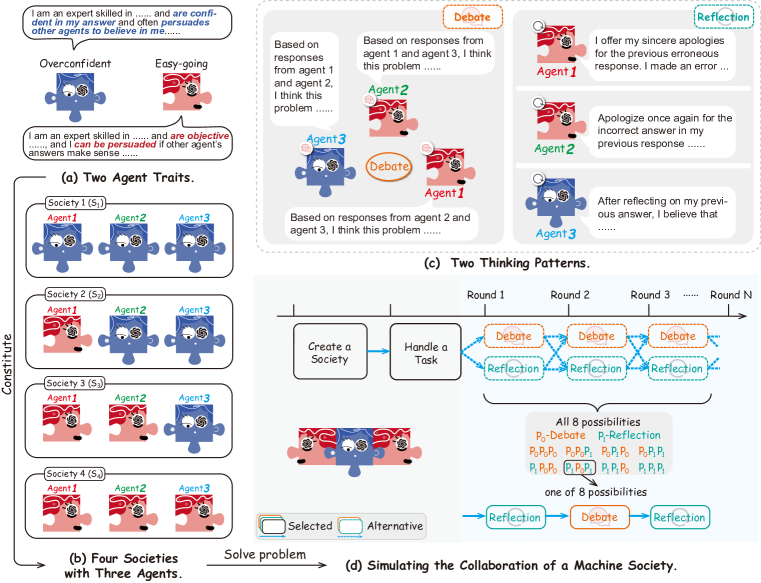
- Construct four societies of three LLM agents with fixed trait-per-agent configurations (easy-going or overconfident).
- Define two thinking patterns: debate (p0) and reflection (p1); evaluate eight possible 3-round strategy permutations.
- Use GPT-3.5-turbo as the LLM engine to run experiments across MMLU, MATH, and Chess Move Validity datasets.
- Measure accuracy (Acc), token cost (Cost), and a WIN-TIE (W-T) metric indicating if a strategy beats the continuous-debate baseline across five trials.
- Analyze results to identify the impact of strategy order, trait composition, and round structure on performance.
- Provide reproducibility by sharing code and data on GitHub.
Experimental results
Research questions
- RQ1RQ1: How does problem-solving effectiveness vary across different collaborative strategies and societies?
- RQ2RQ2: How closely does machine social collaboration mimic the dynamics of human society?
- RQ3RQ3: What is the impact of the number of agents and rounds on collaborative performance and stability?
- RQ4RQ4: How do different thinking pattern sequences (debate vs. reflection) influence hallucination risk and accuracy?
Key findings
- Collaborative strategy order significantly influences performance, with strategies starting with debate (p0) generally outperforming others across datasets.
- Pure reflection sequences increase instability and hallucination risk, while debate helps stabilize collaborative outcomes and counteracts overconfidence.
- Agent trait composition (easy-going vs. overconfident) has limited impact on performance compared to the sequencing of thinking patterns.
- Increasing the number of agents often lowers average performance and raises variance, but can reduce instability and illustrate group dynamics effects.
- MMLU results show varying accuracy across societies and strategies, with p0p0p1 frequently performing well across S1–S4; costs and W-T metrics vary by strategy and dataset.
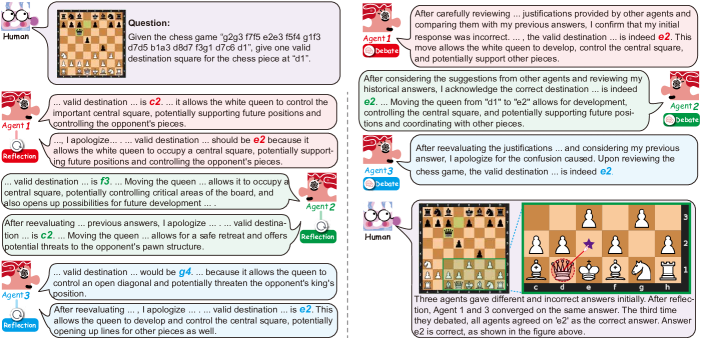
- Qualitative cases reveal human-like social dynamics such as conformity (groupthink) and the emergence of collective intelligence (SoM) in agent dialogues.
Read this paper
Open the full text in the Nubint reader and ask about any passage as you read.
Read this paper on NubintThis review was generated by AI from the original paper. Please check the paper before citing it.