
[论文解读] Exploring Dark Sector Portals with High Intensity Experiments
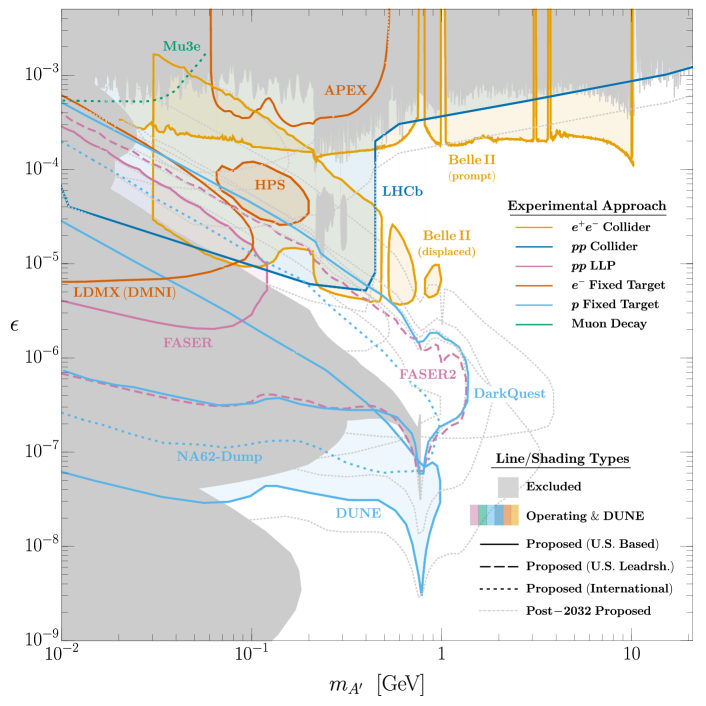
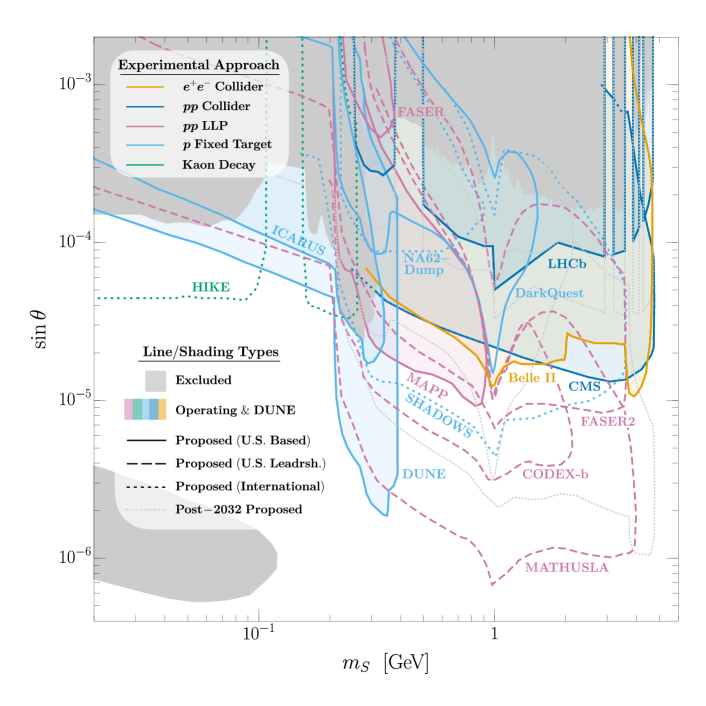
本文提出,高亮度实验——如束流打靶、$e^+e^-$对撞机以及介子/轻子设施——可通过产生和探测轻的、弱耦合的媒介粒子,探测最小暗物质 sector 门户,包括矢量、希格斯、中微子和轴子样粒子(ALP)门户。研究表明,这些实验在媒介粒子质量与耦合常数的广泛范围内均具有广泛的探测灵敏度,能够揭示与暗物质、中微子质量以及强CP问题相关的新的物理学现象。
A broad program of searches at high intensity experiments during the coming decade and beyond will sensitively probe new light mediator particles interacting through the minimal renormalizable vector, Higgs, and neutrino portals as well as higher-dimension axion-like particle portals. These portals may link the visible and dark sectors and play a critical role in many proposed solutions to some of the big open questions in particle physics and cosmology. In this whitepaper, we survey the theoretical and experimental progress, status, and prospects in the study of minimal dark sector portals.
研究动机与目标
- 评估连接可见物质与暗物质 sector 的最小门户相互作用的理论与实验可行性。
- 识别能够通过高亮度实验探测轻媒介粒子的关键实验前沿。
- 绘制现有及未来设施在矢量、希格斯、中微子和 ALP 门户方面的灵敏度覆盖范围。
- 将门户介导的媒介粒子搜索与基本物理问题联系起来:暗物质、中微子质量、重子生成以及强CP问题。
- 为强度前沿的暗物质 sector 物理研究提供未来实验与理论投资的指导。
提出的方法
- 通过包含维度五算符的有效场论,分析可重整化的门户(矢量、希格斯、中微子)以及高阶维度的 ALP 门户。
- 利用多种高亮度设施评估实验灵敏度:$e^+e^-$对撞机、质子/电子束流打靶、固定靶实验,以及基于 LHC 的搜索。
- 应用多种搜索策略:针对即时衰变的峰结构搜索、位移顶点搜索、长寿命粒子衰变,以及缺失动量信号。
- 预测未来实验(如 DarkQuest、FASER、CODEX-b、REDTOP、MATHUSLA、DUNE、LHCb 和 HL-LHC 搭载触发器)的灵敏度。
- 结合跑动重正化群演化,估算紫外尺度的威尔逊系数,并利用 $B$ 介子衰变和 $\Upsilon$ 介子衰变推导约束条件。
- 利用 LHCb、BaBar、Belle 和 Belle II 的约束与预测,优化 ALP 参数空间的覆盖范围,尤其针对 $b \to sa$ 和 $B \to Ka(\gamma\gamma)$ 衰变。
实验结果
研究问题
- RQ1通过最小门户相互作用,高亮度实验对轻媒介粒子的灵敏度覆盖范围如何?
- RQ2矢量、希格斯、中微子和 ALP 门户在可重整化或有效场论框架下,如何连接可见物质与暗物质 sector?
- RQ3哪些实验设施与搜索策略对探测不同媒介粒子质量与耦合强度最为有效?
- RQ4ALP 与光子及胶子的耦合会产生何种约束与发现机遇,特别是在紫外完成与跑动重正化群演化背景下?
- RQ5现有与计划中的实验(如 FASER、MATHUSLA 和 Belle II)如何提升对 ALP 介导的暗物质 sector 物理的探测灵敏度?
主要发现
- 高亮度实验,包括束流打靶和 $e^+e^-$ 对撞机,在广泛的媒介粒子质量与耦合常数范围内,对轻媒介粒子具有广泛的探测灵敏度。
- DarkQuest 的第一阶段与第二阶段,以及 FASER,预计将探测到此前未被覆盖的 ALP 参数空间区域,尤其针对 $m_a \lesssim 1$ GeV 的情况。
- 基于 LHC 的实验,如 LHCb、MATHUSLA 和 DUNE,预计可探测 ALP 与光子及胶子的耦合,灵敏度可达 $g_{a\gamma\gamma} \sim 10^{-10}$ GeV$^{-1}$。
- $B \to Ka(\gamma\gamma)$、$B \to Ka(3\pi)$ 和 $\Upsilon \to \gamma a$ 衰变的约束显著缩小了可行的 ALP 参数空间,尤其在紫外标度约为 1–12 TeV 时更为明显。
- 具有与中微子不耦合(pion-phobic)特性的 ALP 可能解释 $^8$Be 和 $^4$He 核素去激发中的异常现象,暗示其与 QCD 轴子的关联。
- ALP 门户可在 SImp 暗物质模型中实现热化,且大量可行的参数空间可被未来近距 ALP 探测所覆盖。
更好的研究,从现在开始
从阅读论文到最终审阅,大幅缩短您的研究时间。
无需绑定信用卡
本解读由 AI 生成,并经人工编辑审核。