
[Paper Review] Exploring Dense Retrieval for Dialogue Response Selection
This paper proposes DR-BERT, a dense retrieval model for dialogue response selection that combines a dual-encoder architecture with a lightweight interaction layer to achieve state-of-the-art performance while maintaining high inference efficiency. By integrating in-batch contrastive learning, nonparallel domain adaptation, and data augmentation, DR-BERT outperforms strong cross-encoder baselines in both re-rank and full-rank settings, especially when retrieving from large or nonparallel candidate pools.
Recent progress in deep learning has continuously improved the accuracy of dialogue response selection. In particular, sophisticated neural network architectures are leveraged to capture the rich interactions between dialogue context and response candidates. While remarkably effective, these models also bring in a steep increase in computational cost. Consequently, such models can only be used as a re-rank module in practice. In this study, we present a solution to directly select proper responses from a large corpus or even a nonparallel corpus that only consists of unpaired sentences, using a dense retrieval model. To push the limits of dense retrieval, we design an interaction layer upon the dense retrieval models and apply a set of tailor-designed learning strategies. Our model shows superiority over strong baselines on the conventional re-rank evaluation setting, which is remarkable given its efficiency. To verify the effectiveness of our approach in realistic scenarios, we also conduct full-rank evaluation, where the target is to select proper responses from a full candidate pool that may contain millions of candidates and evaluate them fairly through human annotations. Our proposed model notably outperforms pipeline baselines that integrate fast recall and expressive re-rank modules. Human evaluation results show that enlarging the candidate pool with nonparallel corpora improves response quality further.
Motivation & Objective
- To develop an efficient dense retrieval model that directly selects responses from large or nonparallel corpora without relying on a recall-then-rerank pipeline.
- To overcome the computational bottleneck of cross-encoder models, which are accurate but infeasible for large-scale candidate pools.
- To enhance dense retrieval performance by introducing an interaction layer that captures fine-grained context-response interactions with minimal computational cost.
- To validate the model’s effectiveness in realistic full-rank settings using human-annotated evaluations on massive candidate pools.
- To explore the benefits of incorporating nonparallel corpora into training and inference for improved response quality.
Proposed method
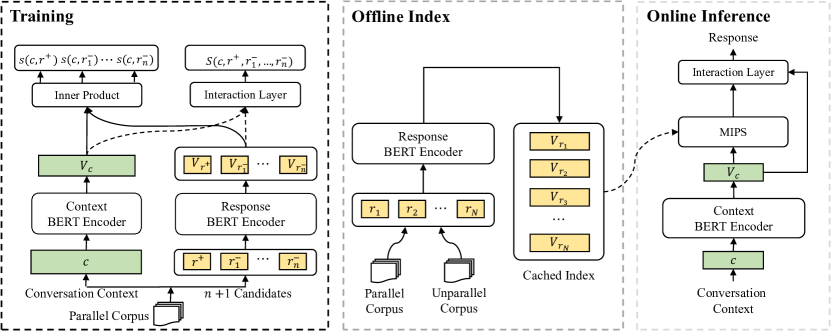
- DR-BERT employs a dual-encoder architecture where context and response are encoded separately, enabling pre-computation and efficient vector search over large candidate pools.
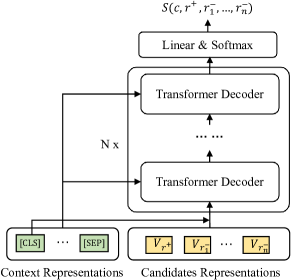
- An interaction layer is introduced after the dual-encoder to refine matching scores by modeling context-response and response-response interactions using pre-computed embeddings.
- The model is trained via multi-task learning, jointly optimizing the dual-encoder and interaction layer with a shared objective.
- In-batch contrastive learning is used to align the semantic space of dialogue contexts and response candidates during pre-training.
- Nonparallel domain adaptive pretraining warms up the BERT encoders on unpaired sentence corpora to improve generalization.
- Data augmentation via positive instance expansion and hard negative sampling increases training data quality and diversity.
Experimental results
Research questions
- RQ1Can a dense retrieval model outperform cross-encoder baselines in dialogue response selection while maintaining high inference efficiency?
- RQ2Does introducing an interaction layer to a dual-encoder model significantly improve matching accuracy with negligible computational overhead?
- RQ3Can nonparallel corpora be effectively leveraged to improve response selection performance in realistic full-rank settings?
- RQ4How does the model perform when retrieving from candidate pools of millions of responses, as opposed to small, pre-selected sets?
- RQ5To what extent do tailored training strategies like in-batch contrastive learning and data augmentation improve model generalization and robustness?
Key findings
- DR-BERT achieves state-of-the-art performance on standard re-rank benchmarks, outperforming strong cross-encoder models like BERT-FP in both NDCG@3 and NDCG@5 metrics.
- In the RRS ranking test set, DR-BERT achieves NDCG@3 = 0.710 and NDCG@5 = 0.783, surpassing all baselines including BERT-FP and SA-BERT BERT-FP.
- The interaction layer adds minimal computational cost, with DR-BERT achieving up to 489.68x faster inference than SMN on a candidate set of 1,000, and outperforming ColBERT in larger candidate sets.
- When the candidate pool size increases, DR-BERT becomes significantly faster than ColBERT, demonstrating superior scalability.
- Human evaluation confirms that using nonparallel corpora for candidate pool expansion improves response quality, validating the model’s real-world applicability.
- The combination of in-batch contrastive learning, nonparallel domain adaptation, and data augmentation leads to consistent performance gains across all evaluation settings.
Better researchstarts right now
From reading papers to final review, dramatically reduce your research time.
No credit card · Free plan available
This review was created by AI and reviewed by human editors.