
[Paper Review] Exploring Image Augmentations for Siamese Representation Learning with Chest X-Rays
This paper investigates optimal image augmentation strategies for Siamese representation learning in chest X-ray analysis, demonstrating that random resized cropping combined with specific augmentations like noise or Sobel filtering yields robust, generalizable representations. These self-supervised representations outperform supervised baselines by up to 20% in zero-shot transfer and linear probing across three large datasets (MIMIC-CXR, CheXpert, VinDr-CXR), showing strong performance on rare and out-of-distribution diseases.
Image augmentations are quintessential for effective visual representation learning across self-supervised learning techniques. While augmentation strategies for natural imaging have been studied extensively, medical images are vastly different from their natural counterparts. Thus, it is unknown whether common augmentation strategies employed in Siamese representation learning generalize to medical images and to what extent. To address this challenge, in this study, we systematically assess the effect of various augmentations on the quality and robustness of the learned representations. We train and evaluate Siamese Networks for abnormality detection on chest X-Rays across three large datasets (MIMIC-CXR, CheXpert and VinDR-CXR). We investigate the efficacy of the learned representations through experiments involving linear probing, fine-tuning, zero-shot transfer, and data efficiency. Finally, we identify a set of augmentations that yield robust representations that generalize well to both out-of-distribution data and diseases, while outperforming supervised baselines using just zero-shot transfer and linear probes by up to 20%. Our code is available at https://github.com/StanfordMIMI/siaug.
Motivation & Objective
- To evaluate the impact of diverse image augmentation strategies on self-supervised representation learning in medical imaging, particularly for chest X-rays.
- To determine whether standard augmentation techniques from natural image self-supervision generalize to medical images.
- To assess the robustness and generalization of learned representations across multiple datasets and downstream tasks.
- To compare the performance of self-supervised representations with supervised baselines under zero-shot, linear probing, and fine-tuning settings.
- To identify a minimal set of augmentations that yield high-performing, generalizable features for rare and out-of-distribution pathologies.
Proposed method
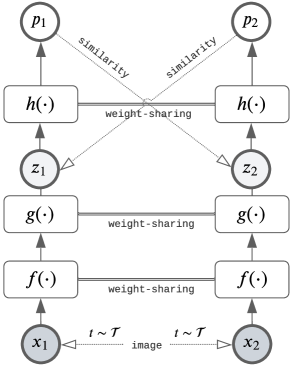
- The study employs a Siamese contrastive learning framework using multiple augmentation pairs to generate positive views of the same chest X-ray.
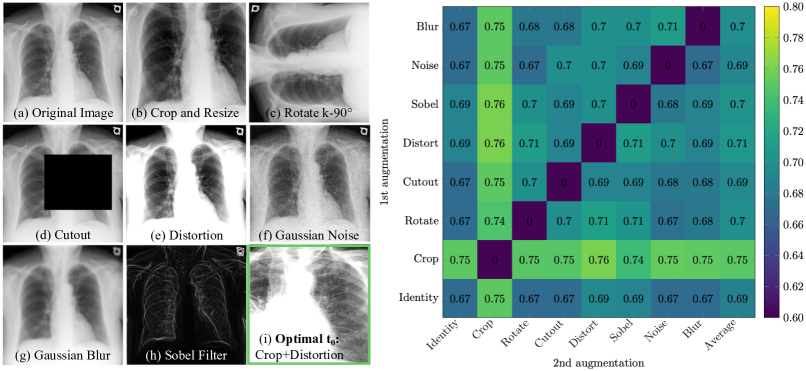
- Pre-training is performed on the MIMIC-CXR dataset using various augmentation combinations, including random resized cropping, noise, Sobel filtering, rotation, and distortion.
- Downstream evaluation is conducted via linear probing, zero-shot transfer, fine-tuning, and data efficiency experiments on MIMIC-CXR, CheXpert, and VinDr-CXR.
- Performance is measured using macro AUROC across multiple pathologies, including common (e.g., Pneumonia) and rare (e.g., Rib Fractures, Tuberculosis) conditions.
- The framework is evaluated under distribution shift and label drift conditions to test robustness.
- Ablation studies compare different augmentation pairs and contrastive learning variants (e.g., SimSiam, SimCLR, MoCo, DINO) to isolate the effect of augmentation choice.
Experimental results
Research questions
- RQ1Which image augmentation strategies yield the most robust and generalizable representations in self-supervised Siamese learning for chest X-rays?
- RQ2How do representations learned with different augmentations compare to supervised baselines in zero-shot and linear probing settings?
- RQ3To what extent do these self-supervised representations generalize to out-of-distribution diseases and datasets?
- RQ4How does the choice of augmentation affect performance on rare pathologies such as Rib Fractures and Tuberculosis?
- RQ5Can self-supervised representations trained on one dataset (e.g., MIMIC-CXR) achieve strong performance on unseen datasets (e.g., VinDr-CXR) without fine-tuning?
Key findings
- Random resized cropping is the most critical augmentation, largely defining optimal performance across all downstream tasks.
- The best augmentation pair (crop & resize with noise or Sobel) achieved up to 20.0% higher AUROC than supervised baselines in zero-shot transfer on internal test sets.
- On external evaluation (VinDr-CXR), the best self-supervised model outperformed supervised baselines by up to 27.0% in zero-shot transfer.
- The learned representations generalized well to rare and unseen pathologies, including Tuberculosis and Rib Fractures, demonstrating robustness to distribution shift.
- Linear probing and fine-tuning with limited data using self-supervised features surpassed the accuracy of fully supervised models trained from scratch.
- The representations showed resilience to label drift and catastrophic forgetting, maintaining performance across varying data distributions.
Read this paper
Open the full text in the Nubint reader and ask about any passage as you read.
Read this paper on NubintThis review was generated by AI from the original paper. Please check the paper before citing it.