
[Paper Review] Exploring LLM Prompting Strategies for Joint Essay Scoring and Feedback Generation
The paper studies prompting strategies for LLMs to jointly score essays and generate feedback, showing that joint scoring and feedback can improve AES, while feedback quality remains high even though scoring has limited impact on feedback.
Individual feedback can help students improve their essay writing skills. However, the manual effort required to provide such feedback limits individualization in practice. Automatically-generated essay feedback may serve as an alternative to guide students at their own pace, convenience, and desired frequency. Large language models (LLMs) have demonstrated strong performance in generating coherent and contextually relevant text. Yet, their ability to provide helpful essay feedback is unclear. This work explores several prompting strategies for LLM-based zero-shot and few-shot generation of essay feedback. Inspired by Chain-of-Thought prompting, we study how and to what extent automated essay scoring (AES) can benefit the quality of generated feedback. We evaluate both the AES performance that LLMs can achieve with prompting only and the helpfulness of the generated essay feedback. Our results suggest that tackling AES and feedback generation jointly improves AES performance. However, while our manual evaluation emphasizes the quality of the generated essay feedback, the impact of essay scoring on the generated feedback remains low ultimately.
Motivation & Objective
- Motivate automatic, individualized feedback to supplement or replace manual teacher feedback in essay writing.
- Explore zero-shot and few-shot prompting strategies for joint essay scoring and feedback generation using LLMs.
- Assess how different prompting designs affect automated essay scoring (AES) performance and feedback helpfulness.
- Investigate whether scoring influences feedback quality and vice versa, and identify the most effective prompt configurations.
Proposed method
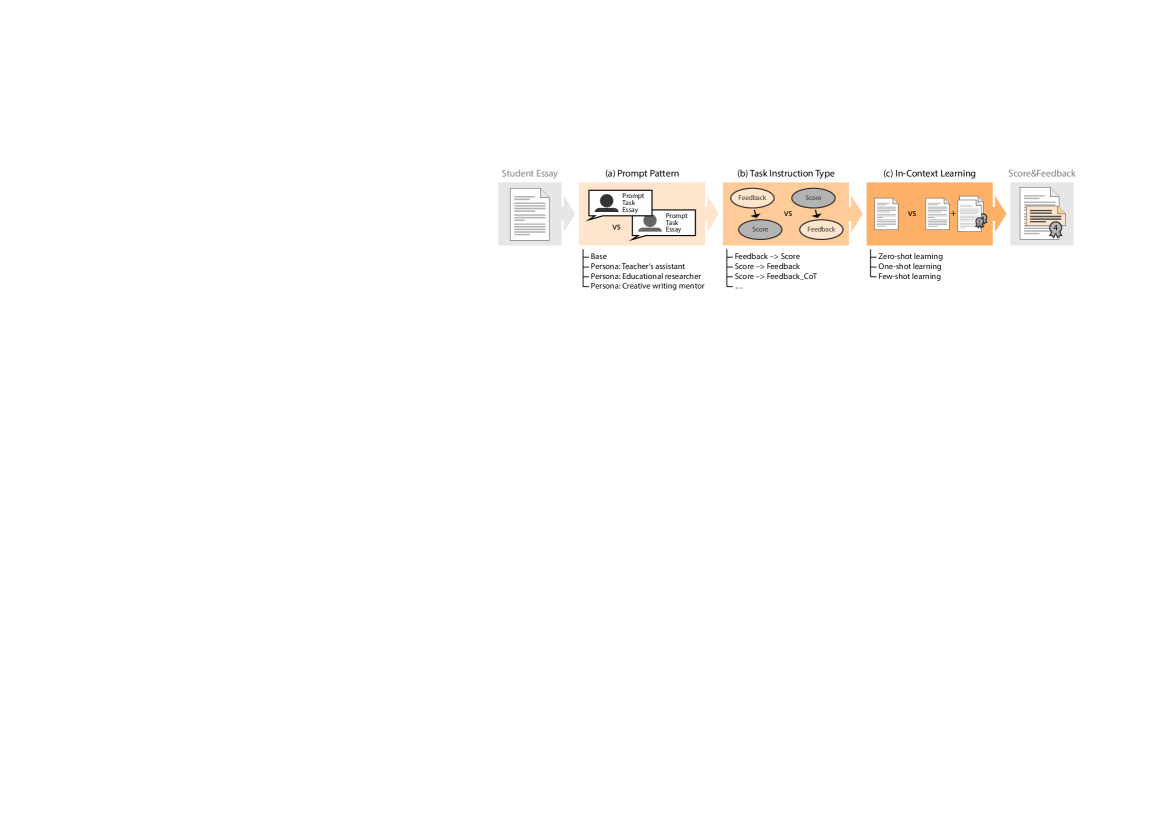
- Systematically vary three prompt aspects: prompt pattern (base vs persona-based), task instruction type (scoring, feedback, or both in sequence), and in-context learning (zero-shot, one-shot, few-shot).
- Use Mistral-7B-Instruct-v0.2 as the primary LLM with greedy decoding to generate scores and feedback in JSON format when possible.
- Compare prompt patterns and task instructions against baselines like AES-Prompt Tao et al. (2022) and R2BERT, under zero-shot and one-shot/few-shot settings.
- Evaluate scoring via quadratic weighted kappa (QWK) on ASAP dataset (8 essay sets) using cross-validation splits.
- Evaluate feedback generation via automatic helpfulness scores from LLMs and manual annotations, comparing persona prompt patterns.
- Investigate the influence of solving scoring and feedback jointly on performance and deemed helpfulness.
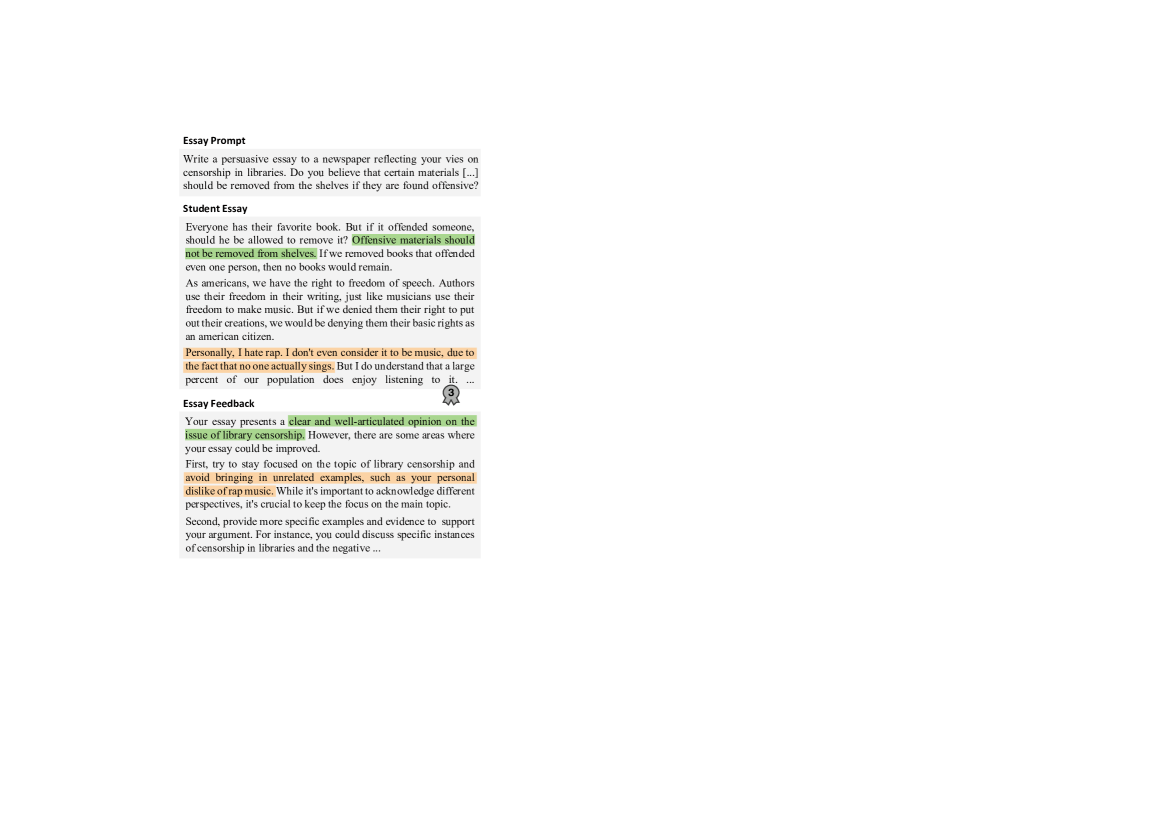
Experimental results
Research questions
- RQ1Can LLMs reliably score essays and generate helpful holistic and trait-specific feedback under zero-shot and few-shot prompting?
- RQ2Does jointly solving essay scoring and feedback generation improve AES performance compared to scoring alone?
- RQ3How do different prompt patterns, task instructions, and in-context learning regimes affect the quality and helpfulness of generated feedback?
Key findings
- Jointly addressing essay scoring and feedback generation improves AES performance on several prompt configurations (highest mean QWK observed in some scoring-focused variations).
- Prompt patterns using persona roles (e.g., educational researcher, teacher’s assistant) generally yield better scoring performance than the base pattern.
- Feedback-first prompting variations (e.g., Feedback → Scoring, or Feedback_dCoT → Scoring) tend to yield higher scoring performance than scoring-first variants.
- For feedback generation, persona-based prompts (especially Educational Researcher and Creative Writing Mentor) yield higher automatic helpfulness scores, with manual evaluation showing feedback is generally perceived as helpful.
- Manual evaluation indicates feedback is helpful for improving student writing, but the impact of scoring on feedback helpfulness is limited.
Read this paper
Open the full text in the Nubint reader and ask about any passage as you read.
Read this paper on NubintThis review was generated by AI from the original paper. Please check the paper before citing it.