
[Paper Review] Exploring OCR Capabilities of GPT-4V(ision) : A Quantitative and In-depth Evaluation
A quantitative, task-wide assessment of GPT-4V(ision)’s OCR abilities across scene text, handwriting, math expressions, tables, and VIE, highlighting strengths on Latin content and limitations in multilingual and complex scenarios.
This paper presents a comprehensive evaluation of the Optical Character Recognition (OCR) capabilities of the recently released GPT-4V(ision), a Large Multimodal Model (LMM). We assess the model's performance across a range of OCR tasks, including scene text recognition, handwritten text recognition, handwritten mathematical expression recognition, table structure recognition, and information extraction from visually-rich document. The evaluation reveals that GPT-4V performs well in recognizing and understanding Latin contents, but struggles with multilingual scenarios and complex tasks. Specifically, it showed limitations when dealing with non-Latin languages and complex tasks such as handwriting mathematical expression recognition, table structure recognition, and end-to-end semantic entity recognition and pair extraction from document image. Based on these observations, we affirm the necessity and continued research value of specialized OCR models. In general, despite its versatility in handling diverse OCR tasks, GPT-4V does not outperform existing state-of-the-art OCR models. How to fully utilize pre-trained general-purpose LMMs such as GPT-4V for OCR downstream tasks remains an open problem. The study offers a critical reference for future research in OCR with LMMs. Evaluation pipeline and results are available at https://github.com/SCUT-DLVCLab/GPT-4V_OCR.
Motivation & Objective
- Assess GPT-4V(ision)’s OCR performance across diverse tasks (STR, HTR, HMER, TSR, VIE).
- Identify strengths and limitations in Latin vs non-Latin content and in complex scenarios.
- Provide guidance on the continued value of specialized OCR models and potential leveraging of LMMs for OCR research.
Proposed method
- Evaluate GPT-4V via a dedicated evaluation pipeline using a web-based interface and carefully designed prompts for each OCR task.
- Use standard OCR benchmarks: STR (CUTE80, SCUT-CTW1500, Total-Text, WordArt, ReCTS, MLT19), HTR (IAM, CASIA-HWDB), HMER (CROHME2014, HME100K), TSR (SciTSR, WTW), VIE (FUNSD, XFUND-zh).
- Assess word-level and end-to-end recognition with WAICS, precision/recall/F1, WER/CER, AR/CR, and 1-NED where applicable.
- Investigate input resolution effects by resizing images and observing recognition performance.
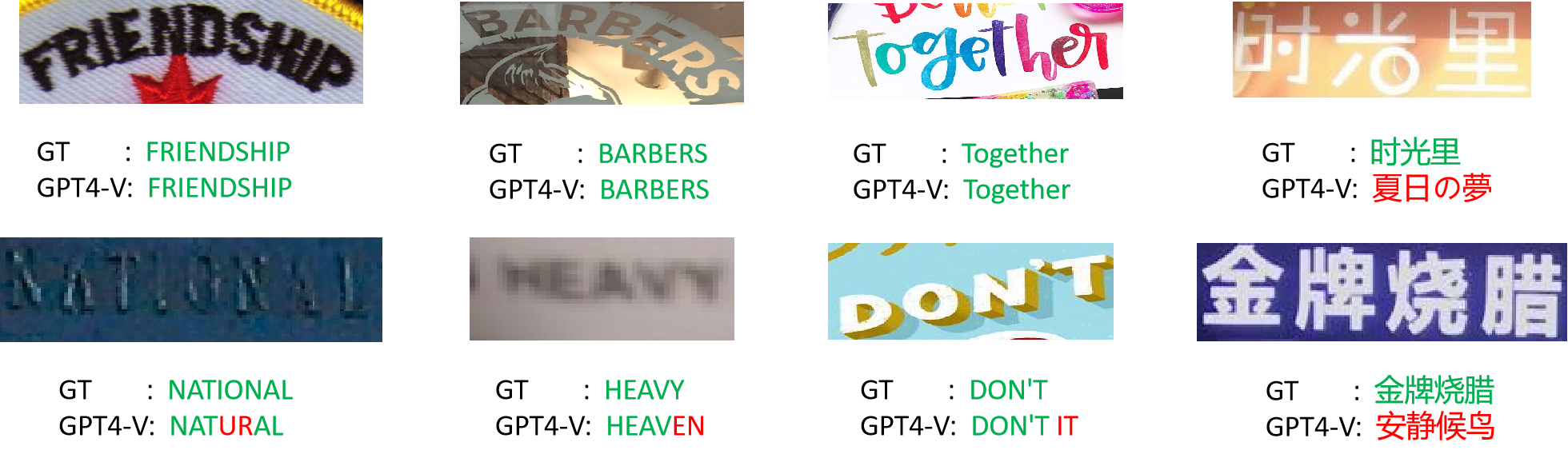
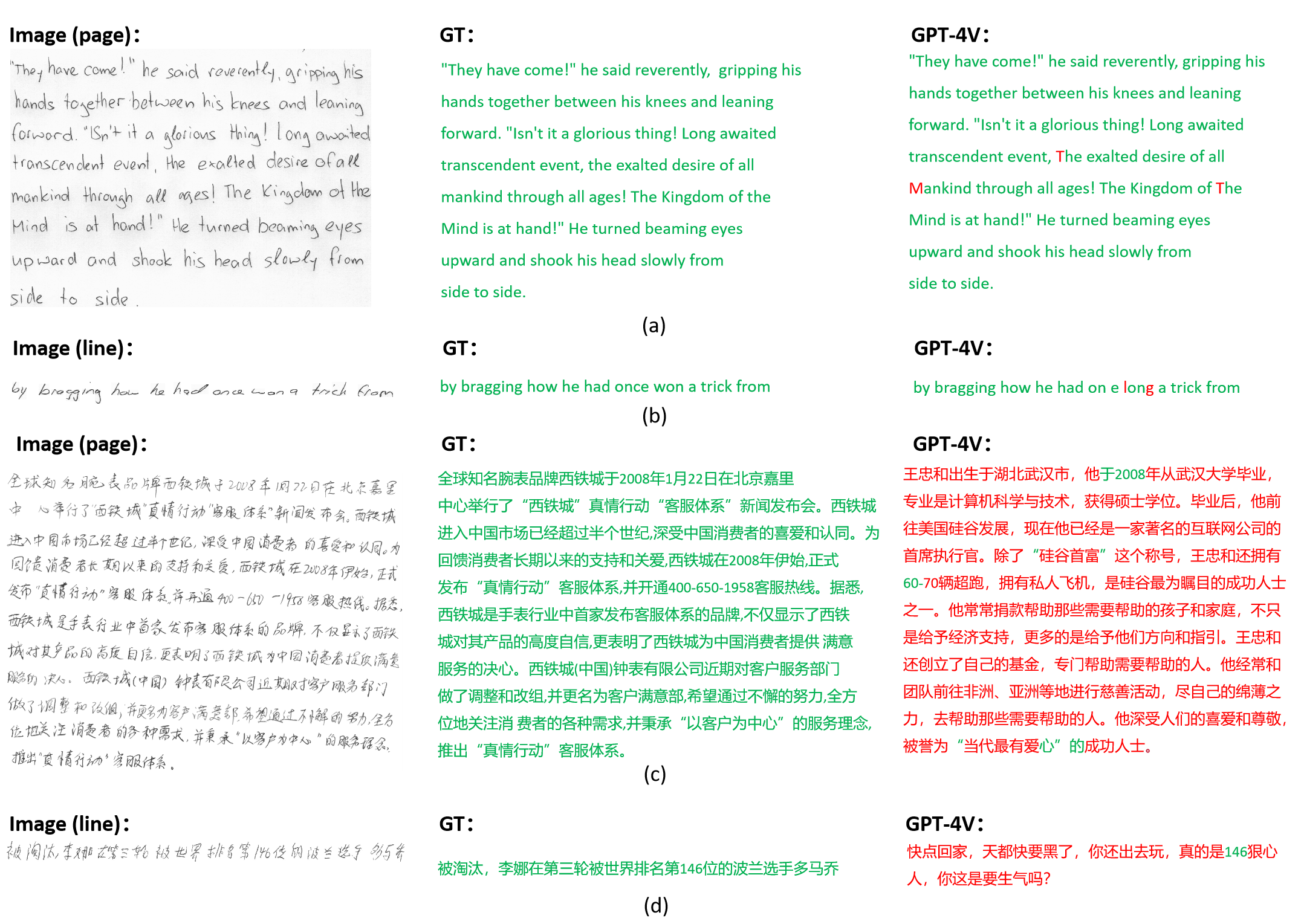
- Highlight qualitative examples to illustrate strengths (Latin content) and weaknesses (multilingual, complex layouts).
- Compare GPT-4V results against state-of-the-art specialized OCR models and discuss implications for downstream OCR tasks.
Experimental results
Research questions
- RQ1How does GPT-4V perform on scene text recognition across English and non-English languages?
- RQ2What are GPT-4V’s capabilities and limitations in handwritten text recognition, including Chinese text?
- RQ3How well does GPT-4V handle handwritten mathematical expression recognition, table structure recognition, and information extraction from visually-rich documents?
- RQ4To what extent can general-purpose LMMs replace or complement specialized OCR models in various tasks?
- RQ5What strategies could enhance GPT-4V’s OCR performance (semantic understanding, fine-tuning, data construction)?
Key findings
- GPT-4V shows strong recognition for Latin/English content but zero accuracy on Chinese scene text in ReCTS.
- English and some non-Latin languages (French, German, Italian) outperform non-Latin alphabets, indicating multilingual OCR limitations.
- Input resolution positively affects recognition performance, with higher resolutions yielding better Precision/Recall/F1 on English subset (MLT19).
- GPT-4V struggles with handwritten text, especially Chinese handwriting and complex scripts, and exhibits hallucinations in Chinese text outputs.
- For HMER, TSR, and VIE tasks, GPT-4V underperforms compared to supervised SOTA, with notable content omission in long tables and difficulty in complex layouts.
- SER and Pair Extraction results show moderate entity-level F1 (SER) and low pair extraction performance, with higher 1-NED indicating alignment challenges; XFUND-zh shows particularly weak results due to limited Chinese character recognition.
Read this paper
Open the full text in the Nubint reader and ask about any passage as you read.
Read this paper on NubintThis review was generated by AI from the original paper. Please check the paper before citing it.