
[Paper Review] Exploring Patch-wise Semantic Relation for Contrastive Learning in Image-to-Image Translation Tasks
This paper proposes a novel contrastive learning framework for image-to-image translation that enhances feature correspondence by modeling patch-wise semantic relations through semantic relation consistency (SRC) regularization and hard negative mining. By decoupling contrastive learning and enforcing consistency in heterogeneous semantic relationships between image patches, the method achieves state-of-the-art performance across single-modal, multi-modal translation, and GAN compression tasks, with significant FID and mIoU improvements.
Recently, contrastive learning-based image translation methods have been proposed, which contrasts different spatial locations to enhance the spatial correspondence. However, the methods often ignore the diverse semantic relation within the images. To address this, here we propose a novel semantic relation consistency (SRC) regularization along with the decoupled contrastive learning, which utilize the diverse semantics by focusing on the heterogeneous semantics between the image patches of a single image. To further improve the performance, we present a hard negative mining by exploiting the semantic relation. We verified our method for three tasks: single-modal and multi-modal image translations, and GAN compression task for image translation. Experimental results confirmed the state-of-art performance of our method in all the three tasks.
Motivation & Objective
- To address the limitation of existing contrastive learning methods in image-to-image translation that ignore diverse semantic relations within images.
- To improve feature correspondence between input and output images by enforcing consistency in patch-wise semantic relationships.
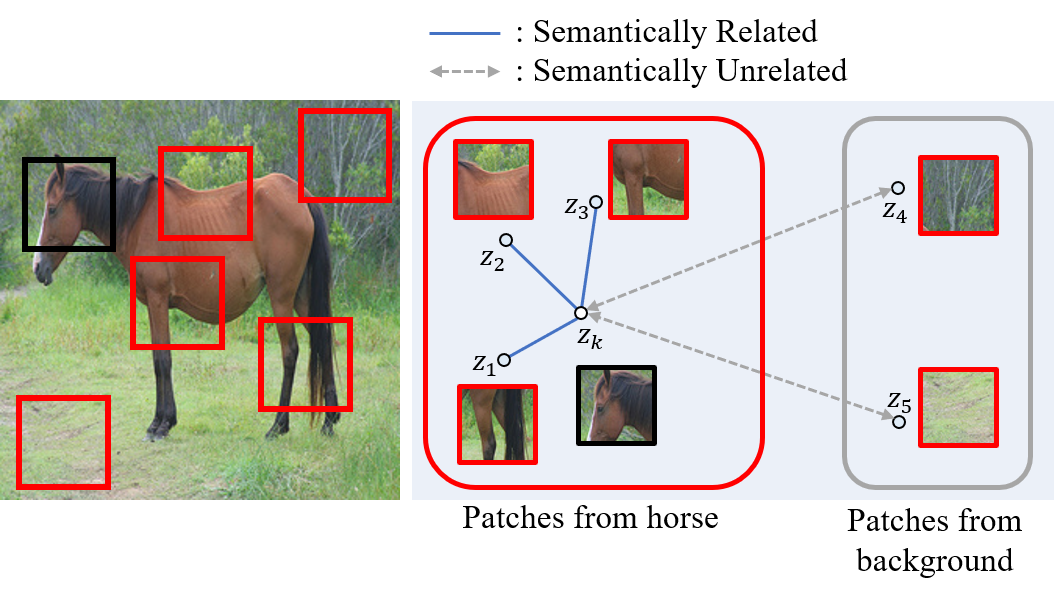
- To develop a hard negative mining strategy based on spatially varying semantic relations to avoid easy negative samples.
- To achieve state-of-the-art performance in one-sided image translation and GAN distillation without relying on cycle-consistency constraints.
Proposed method
- Introduces decoupled contrastive learning (DCE) that separates the contrastive objective from the semantic relation regularization.
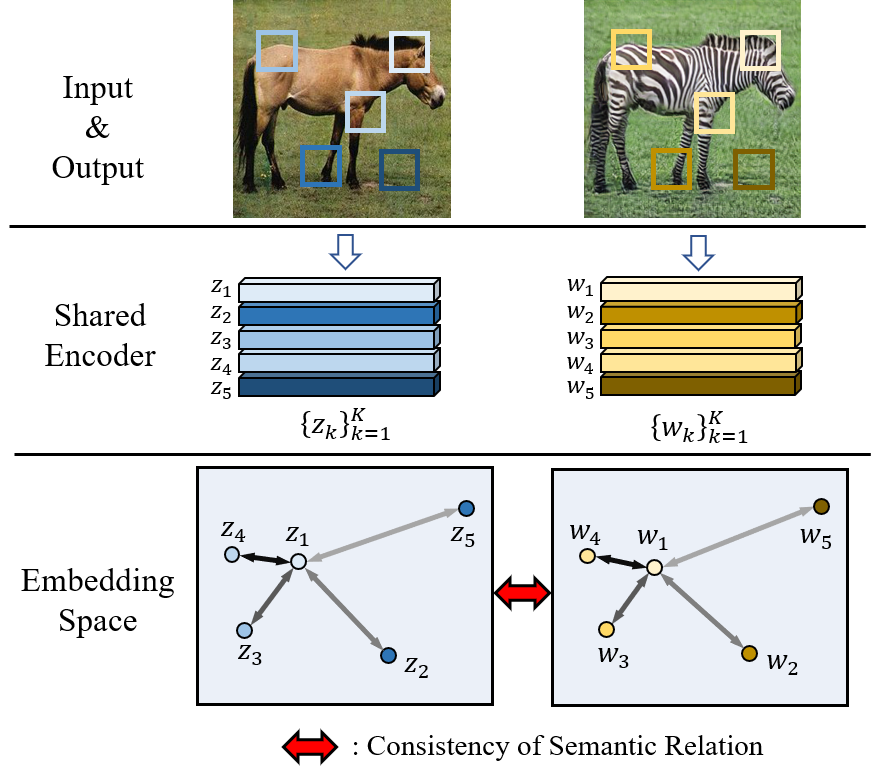
- Proposes semantic relation consistency (SRC) regularization to preserve distributional similarity and spatial semantic structure between image patches across input and output.
- Employs a hard negative mining strategy that selects negatives based on semantic relevance, guided by learned patch-wise relations.
- Uses a curriculum learning scheme to control the hardness of negative samples, improving training stability.
- Applies the method to both image translation and GAN compression, transferring relational knowledge from teacher to student models.
- Leverages feature similarity maps to visualize and validate the consistency of semantic relations before and after translation.
Experimental results
Research questions
- RQ1Can modeling patch-wise semantic relations improve feature correspondence in one-sided image-to-image translation?
- RQ2How does enforcing consistency in heterogeneous semantic relationships affect image translation quality?
- RQ3Can hard negative mining based on semantic relations outperform random or uniform negative sampling in contrastive learning for translation?
- RQ4To what extent can the proposed method improve GAN compression while preserving translation quality?
- RQ5Does the proposed method generalize across single-modal, multi-modal, and GAN distillation tasks?
Key findings
- The proposed method achieves state-of-the-art FID scores of 34.4 on the Horse→Zebra dataset and 46.4 on Cityscapes, outperforming baseline models.
- On the Cityscapes dataset, the compressed student model achieves a higher mIoU (35.6) than the teacher model, indicating improved semantic consistency.
- The ablation study confirms that adding SRC and hard negative mining consistently improves performance, with the full model achieving the best results.
- Visualization of similarity maps shows that SRC enforces consistent semantic patterns between input and output, while hard negative mining focuses on semantically relevant negatives.
- The method reduces model size with minimal loss in performance, achieving lower MACs and #Params than baseline student models while maintaining or improving FID.
- The model generalizes effectively across diverse tasks, including single-modal translation, multi-modal translation, and GAN compression, demonstrating robustness and transferability.
Read this paper
Open the full text in the Nubint reader and ask about any passage as you read.
Read this paper on NubintThis review was generated by AI from the original paper. Please check the paper before citing it.