
[Paper Review] Exploring the Intersection of Large Language Models and Agent-Based Modeling via Prompt Engineering
The paper demonstrates LLM-driven agent simulations (two-agent bargaining and six-agent murder mystery) using prompt engineering, analyzes feasibility, and discusses limitations like context-window bottlenecks.
The final frontier for simulation is the accurate representation of complex, real-world social systems. While agent-based modeling (ABM) seeks to study the behavior and interactions of agents within a larger system, it is unable to faithfully capture the full complexity of human-driven behavior. Large language models (LLMs), like ChatGPT, have emerged as a potential solution to this bottleneck by enabling researchers to explore human-driven interactions in previously unimaginable ways. Our research investigates simulations of human interactions using LLMs. Through prompt engineering, inspired by Park et al. (2023), we present two simulations of believable proxies of human behavior: a two-agent negotiation and a six-agent murder mystery game.
Motivation & Objective
- Motivate combining ABM with LLMs to model human-driven interactions beyond traditional agent rules.
- Introduce LLM-driven simulations by shaping agent personas and prompts to study outcomes.
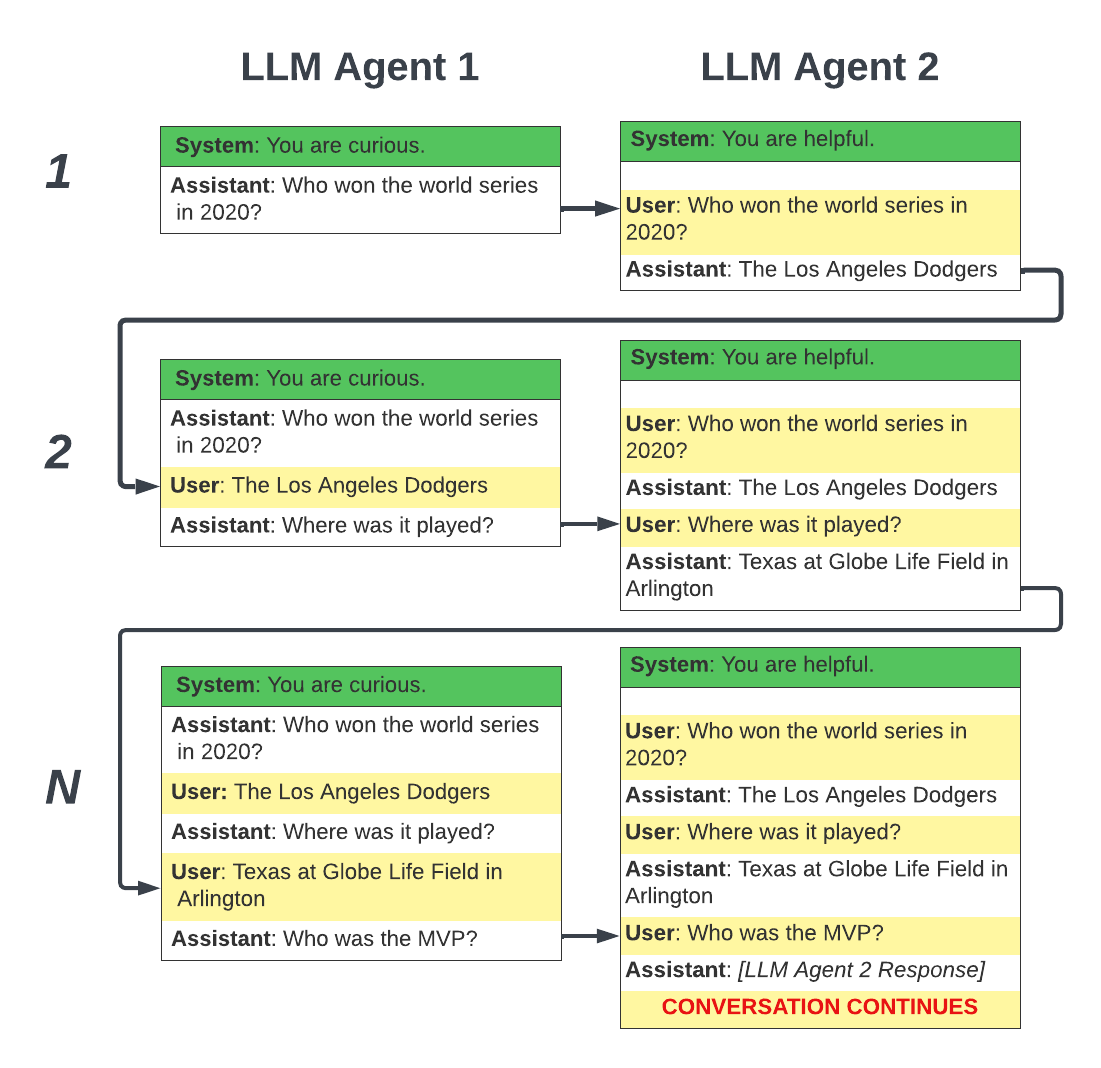
- categorize LLM-driven simulations into one-to-one, one-to-many, and many-to-many.
- Highlight bottlenecks such as 4,096 token context windows and discuss potential improvements.
Proposed method
- Use OpenAI GPT-3.5-turbo for dialog-based LLM agents with defined personas.
- Implement autonomous back-and-forth prompting where agents respond to each other with cumulative conversation history.
- Adopt a round-robin interaction mechanism to sustain dialogue coherence.
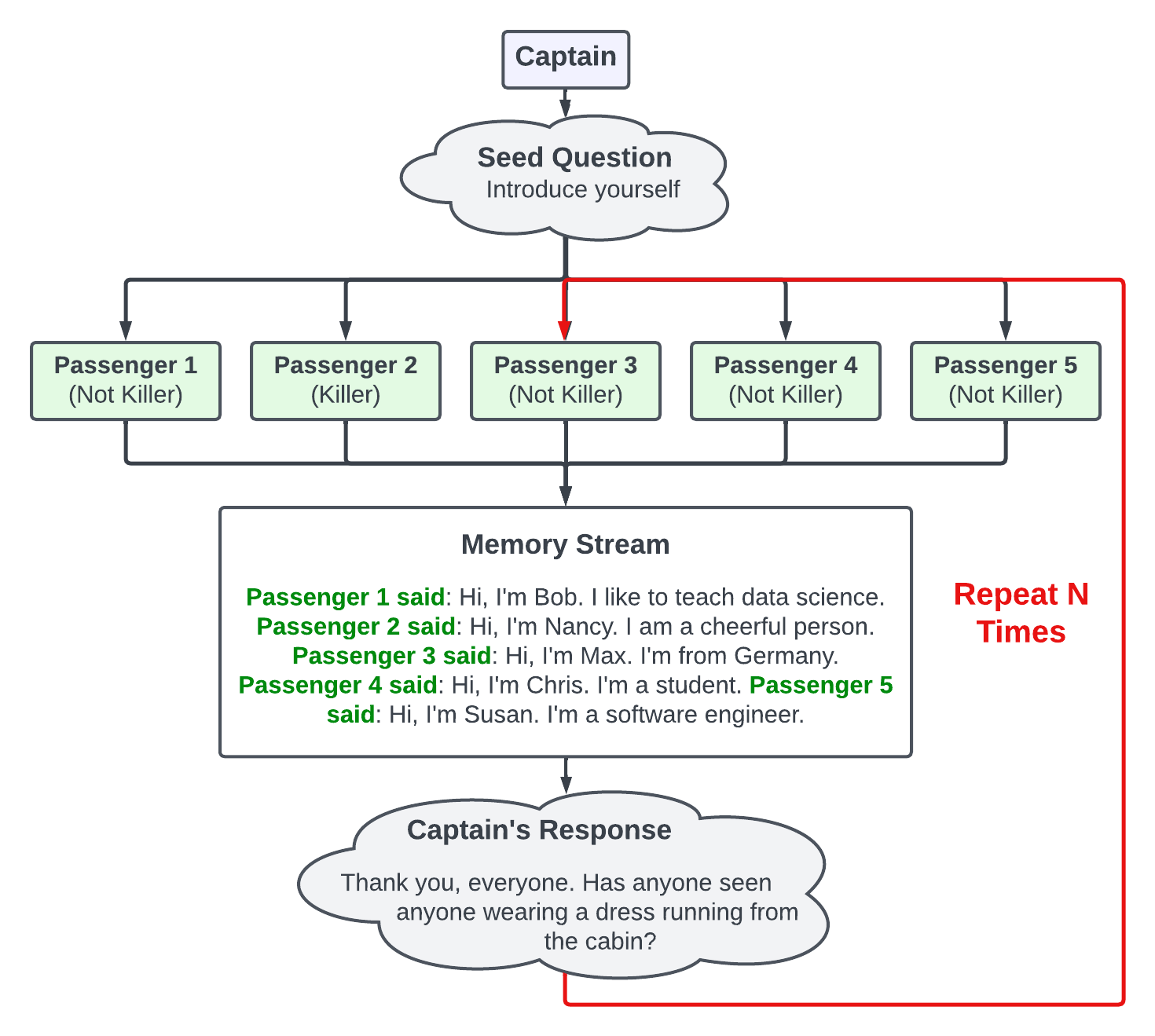
- Utilize a memory stream to preserve context across multiple passenger agents in group simulations.
- Analyze how persona design influences emergent strategies and outcomes.
- Report final prompt token counts and discuss scalability constraints.
Experimental results
Research questions
- RQ1How can prompt engineering enable autonomous LLM agents to simulate believable human interactions?
- RQ2What categories (one-to-one, one-to-many, many-to-many) best describe LLM-driven simulations and what are their limitations?
- RQ3What are the primary bottlenecks (e.g., context window) that limit large-scale, human-realistic LLM simulations?
- RQ4Do persona formulations lead to emergent strategies that differ from explicit objectives?
Key findings
- A two-agent haggling simulation achieved a final price of $25, exceeding a $20 seller target.
- A six-agent murder-mystery simulation demonstrates one-to-many dialogue with a memory stream to maintain context across agents.
- Prompted personas can yield emergent negotiation strategies, such as initial inflation of price by the seller.
- Final prompt token counts in simple scenarios ranged from ~300 to ~600 tokens, well below the 4,096-token limit for gpt-3.5-turbo.
- Three scenario variants show how changing agent objectives alters outcomes (e.g., Sold for over $20 -> $25; Sold for around $20 -> $17; No deal when opposing constraints).
- The study discusses constraints and suggests improvements like longer context windows and memory-stream-enhanced retrieval for larger simulations.
Read this paper
Open the full text in the Nubint reader and ask about any passage as you read.
Read this paper on NubintThis review was generated by AI from the original paper. Please check the paper before citing it.