
[Paper Review] Exploring the Practicality of Federated Learning: A Survey Towards the Communication Perspective
This survey provides a comprehensive analysis of communication efficiency in Federated Learning (FL), proposing strategies like model quantization, sparsification, client selection, and compression techniques to reduce bandwidth and training rounds. It identifies communication overhead as the primary bottleneck in real-world FL deployment and demonstrates that optimizing communication is essential for scalable, privacy-preserving machine learning across edge devices and IoT systems.
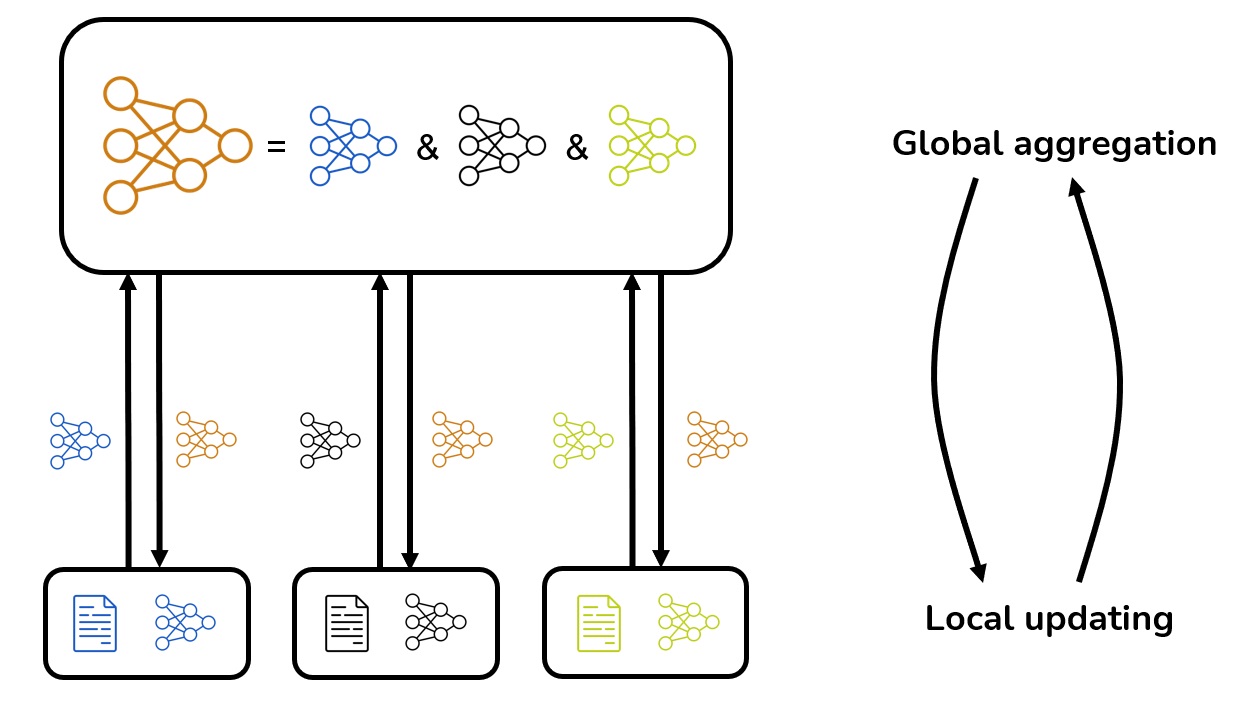
Federated Learning (FL) is a promising paradigm that offers significant advancements in privacy-preserving, decentralized machine learning by enabling collaborative training of models across distributed devices without centralizing data. However, the practical deployment of FL systems faces a significant bottleneck: the communication overhead caused by frequently exchanging large model updates between numerous devices and a central server. This communication inefficiency can hinder training speed, model performance, and the overall feasibility of real-world FL applications. In this survey, we investigate various strategies and advancements made in communication-efficient FL, highlighting their impact and potential to overcome the communication challenges inherent in FL systems. Specifically, we define measures for communication efficiency, analyze sources of communication inefficiency in FL systems, and provide a taxonomy and comprehensive review of state-of-the-art communication-efficient FL methods. Additionally, we discuss promising future research directions for enhancing the communication efficiency of FL systems. By addressing the communication bottleneck, FL can be effectively applied and enable scalable and practical deployment across diverse applications that require privacy-preserving, decentralized machine learning, such as IoT, healthcare, or finance.
Motivation & Objective
- To identify and analyze the root causes of communication inefficiency in federated learning systems, particularly in decentralized, privacy-preserving environments.
- To evaluate existing communication-efficient FL techniques such as model compression, client selection, and adaptive scheduling to reduce data transmission and training rounds.
- To provide a systematic taxonomy and comparative review of state-of-the-art communication-efficient FL methods across diverse application domains.
- To highlight the impact of communication overhead on training speed, energy consumption, and system scalability in real-world FL deployments.
- To outline future research directions for enhancing communication efficiency in FL, including interdisciplinary collaboration across networking, distributed systems, and domain-specific applications.
Proposed method
- Defining communication efficiency using metrics such as total communication time and volume of data exchanged per training round.
- Classifying communication-efficient techniques into categories: model compression (quantization, sparsification, factorization), client selection, and aggregation optimization.
- Surveying advanced FL architectures that minimize round-trip communication, including hierarchical and hierarchical-on-edge designs.
- Analyzing the role of adaptive scheduling and error-resilient protocols in maintaining performance under variable network conditions.
- Evaluating privacy-preserving mechanisms like secure aggregation and federated averaging in conjunction with communication optimization.
- Integrating insights from edge computing, distributed systems, and domain-specific constraints (e.g., healthcare, finance, IoT) to guide practical deployment strategies.
Experimental results
Research questions
- RQ1What are the primary sources of communication inefficiency in federated learning systems, and how do they impact training performance and scalability?
- RQ2How do model compression techniques such as quantization and sparsification reduce communication overhead without significantly degrading model accuracy?
- RQ3What role does client selection play in minimizing communication rounds and improving system efficiency in large-scale FL deployments?
- RQ4How can communication-efficient FL methods be adapted to real-world constraints such as variable bandwidth, latency, and device energy limitations?
- RQ5What future research directions are needed to achieve practical, large-scale deployment of communication-efficient federated learning in production environments?
Key findings
- Communication overhead, particularly in terms of data volume and round-trip latency, is the dominant bottleneck in federated learning, often overshadowing computational costs.
- Techniques like quantization and sparsification can reduce model update sizes by up to 90–95%, significantly decreasing communication costs while preserving model accuracy.
- Client selection strategies such as FedCS can reduce the number of active clients per round by up to 50%, leading to faster convergence and lower network load.
- Model compression via factorization and federated distillation enables efficient knowledge transfer with minimal communication, especially in resource-constrained environments.
- Energy consumption in mobile and IoT devices is substantially reduced through fewer communication rounds and smaller model updates, extending battery life.
- Future communication-efficient FL systems require interdisciplinary integration of networking, distributed systems, and domain-specific requirements to ensure robustness and scalability in real-world applications.
Read this paper
Open the full text in the Nubint reader and ask about any passage as you read.
Read this paper on NubintThis review was generated by AI from the original paper. Please check the paper before citing it.