
[Paper Review] Exploring Wav2vec 2.0 fine-tuning for improved speech emotion recognition
This paper proposes a novel fine-tuning method, P-TAPT, for wav2vec 2.0 to improve speech emotion recognition (SER), leveraging emotion-aware pretraining objectives. By adapting task-adaptive pretraining to predict contextualized emotion states, P-TAPT achieves a 7.4% absolute improvement in unweighted accuracy over state-of-the-art models on the IEMOCAP dataset, especially under low-resource conditions.
While Wav2Vec 2.0 has been proposed for speech recognition (ASR), it can also be used for speech emotion recognition (SER); its performance can be significantly improved using different fine-tuning strategies. Two baseline methods, vanilla fine-tuning (V-FT) and task adaptive pretraining (TAPT) are first presented. We show that V-FT is able to outperform state-of-the-art models on the IEMOCAP dataset. TAPT, an existing NLP fine-tuning strategy, further improves the performance on SER. We also introduce a novel fine-tuning method termed P-TAPT, which modifies the TAPT objective to learn contextualized emotion representations. Experiments show that P-TAPT performs better than TAPT, especially under low-resource settings. Compared to prior works in this literature, our top-line system achieved a 7.4\% absolute improvement in unweighted accuracy (UA) over the state-of-the-art performance on IEMOCAP. Our code is publicly available.
Motivation & Objective
- To address the domain shift between pretraining data (ASR) and SER data, which limits performance of pretrained models.
- To improve speech emotion recognition (SER) performance by fine-tuning wav2vec 2.0 beyond simple fine-tuning or feature extraction.
- To develop a data-efficient, emotion-aware pretraining objective that enhances model generalization, particularly in low-resource settings.
- To investigate whether task-adaptive pretraining (TAPT) and its variant P-TAPT can outperform vanilla fine-tuning and existing SOTA methods on SER.
- To evaluate the effectiveness of P-TAPT in capturing linguistic and emotional content, especially in naturally elicited emotional speech like in IEMOCAP.
Proposed method
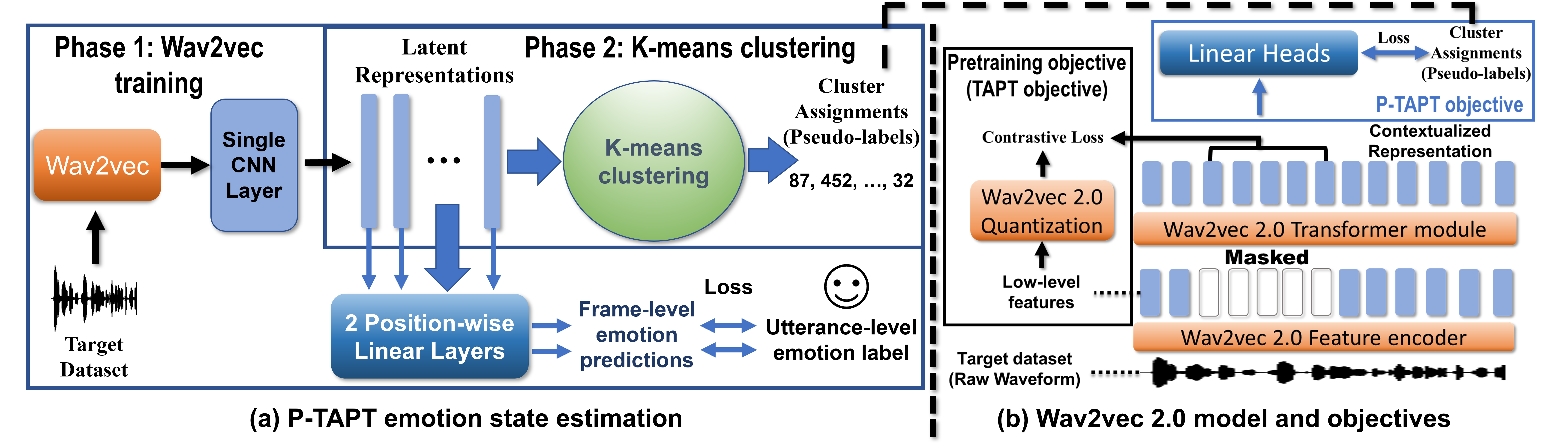
- Proposes vanilla fine-tuning (V-FT) by adding a global average pooling layer and a classifier head on top of wav2vec 2.0's final layer for utterance-level SER.
- Adopts Task Adaptive Pretraining (TAPT) to continue pretraining on the target SER dataset, reducing domain shift between pretraining and fine-tuning data.
- Introduces P-TAPT, a novel method that modifies the TAPT objective to predict pseudo-labeled emotion states from clustered wav2vec 2.0 representations, enabling emotion-aware self-supervised learning.
- Uses a separate CNN with stride 2 to align temporal resolution between wav2vec 2.0 and the emotion state estimation module in P-TAPT.
- Employs a clustering-based method to generate pseudo-labels for emotion states from wav2vec 2.0’s contextualized representations, which are then used to train the model via a contrastive objective.
- Applies the P-TAPT objective during pretraining on the target SER dataset, allowing the model to learn representations that are both speech- and emotion-aware.
Experimental results
Research questions
- RQ1Can vanilla fine-tuning of wav2vec 2.0 outperform existing state-of-the-art models on the IEMOCAP dataset for speech emotion recognition?
- RQ2Does task-adaptive pretraining (TAPT) significantly improve the performance of wav2vec 2.0 on SER, especially when there is a domain shift between pretraining and fine-tuning data?
- RQ3Can a modified pretraining objective in P-TAPT, which predicts emotion states instead of masked audio frames, lead to better performance and data efficiency in low-resource SER settings?
- RQ4How does the performance of P-TAPT compare to TAPT and V-FT across different data sizes, particularly in low-resource scenarios?
- RQ5To what extent does linguistic content in the data (e.g., sentence-specific emotions) affect model performance, and can P-TAPT better capture such patterns than TAPT?
Key findings
- Vanilla fine-tuning (V-FT) of wav2vec 2.0 achieves 69.9% unweighted accuracy (UA) on IEMOCAP, outperforming prior SOTA methods that used wav2vec 2.0 as a feature extractor.
- Task adaptive pretraining (TAPT) improves performance to 73.5% UA on IEMOCAP, demonstrating the effectiveness of domain adaptation in reducing domain shift.
- The proposed P-TAPT method achieves 74.3% UA on IEMOCAP, representing a 7.4% absolute improvement over the previous SOTA performance.
- P-TAPT shows superior data efficiency: the ratio of P-TAPT’s improvement over V-FT to TAPT’s improvement over V-FT is 65.0% at 0.5 hours of training data, indicating greater benefit in low-resource settings.
- On the SAVEE dataset, TAPT outperforms V-FT by 8.8% in UA, and P-TAPT further improves performance to 70.9% UA, though the improvement over TAPT is smaller due to strong linguistic-emotion correlation.
- The pretraining loss on LibriSpeech (32.04) is significantly lower than on IEMOCAP (55.42), confirming the presence of domain shift, which motivates the use of TAPT and P-TAPT.
Read this paper
Open the full text in the Nubint reader and ask about any passage as you read.
Read this paper on NubintThis review was generated by AI from the original paper. Please check the paper before citing it.