
[Paper Review] Exploring wav2vec 2.0 on speaker verification and language identification
This paper explores the application of wav2vec 2.0 for speaker verification (SV) and language identification (LID) using self-supervised pre-training. It demonstrates that wav2vec 2.0 learns discriminative speaker and language representations even without task-specific pre-training, achieving a new state-of-the-art EER of 3.61% on VoxCeleb1 for SV and 3.47% on full-length AP17-OLR for LID, with a unified multi-task model reducing parameters while maintaining strong performance.
Wav2vec 2.0 is a recently proposed self-supervised framework for speech representation learning. It follows a two-stage training process of pre-training and fine-tuning, and performs well in speech recognition tasks especially ultra-low resource cases. In this work, we attempt to extend self-supervised framework to speaker verification and language identification. First, we use some preliminary experiments to indicate that wav2vec 2.0 can capture the information about the speaker and language. Then we demonstrate the effectiveness of wav2vec 2.0 on the two tasks respectively. For speaker verification, we obtain a new state-of-the-art result, Equal Error Rate (EER) of 3.61% on the VoxCeleb1 dataset. For language identification, we obtain an EER of 12.02% on 1 second condition and an EER of 3.47% on full-length condition of the AP17-OLR dataset. Finally, we utilize one model to achieve the unified modeling by the multi-task learning for the two tasks.
Motivation & Objective
- To investigate whether wav2vec 2.0's self-supervised pre-training can capture speaker and language information useful for downstream tasks.
- To evaluate the effectiveness of wav2vec 2.0 fine-tuned on speaker verification and language identification tasks.
- To reduce model complexity and training cost by applying multi-task learning to jointly optimize SV and LID with a single unified model.
- To demonstrate that problem-agnostic pre-training on large-scale unlabeled speech can yield strong representations for speaker and language-related tasks.
Proposed method
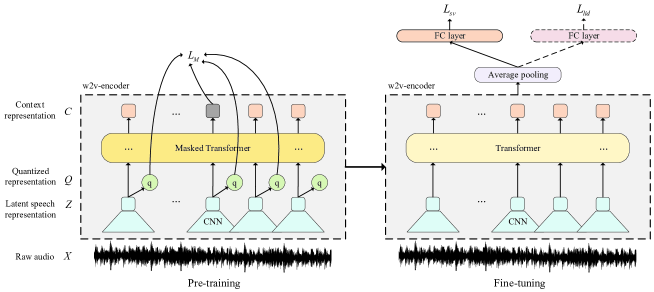
- Pre-train a wav2vec 2.0 model using contrastive predictive coding on large-scale unlabeled speech, with a CNN encoder, Transformer context network, and vector-quantized codebooks.
- Extract context representations from the pre-trained w2v-encoder and visualize them using t-SNE to assess speaker and language discriminability.
- Fine-tune the pre-trained w2v-encoder with a task-specific head (fully connected layer) for speaker verification on VoxCeleb1 and for language identification on AP17-OLR.
- Implement a multi-task learning setup by adding two parallel classification heads on top of the shared w2v-encoder for simultaneous SV and LID prediction, with a weighted loss function.
- Use a learning rate warm-up and linear decay schedule during fine-tuning, with initial weight freezing for the encoder to stabilize training.
- Evaluate performance using Equal Error Rate (EER) on test sets and compare with baselines such as i-vector + PLDA and TDNN.
Experimental results
Research questions
- RQ1Can wav2vec 2.0's self-supervised pre-training learn discriminative representations for speaker and language without task-specific supervision?
- RQ2How does wav2vec 2.0 perform on speaker verification and language identification compared to existing SOTA methods?
- RQ3Can a single unified model trained via multi-task learning effectively handle both speaker verification and language identification with reduced parameters?
- RQ4Does pre-training mitigate overfitting in low-resource settings for language identification?
Key findings
- The pre-trained wav2vec 2.0 model achieves a new state-of-the-art EER of 3.61% on the VoxCeleb1 dataset for speaker verification.
- For language identification, the model achieves an EER of 12.02% on the 1-second condition and 3.47% on the full-length condition of the AP17-OLR dataset.
- Visualizations confirm that the lower layers of the pre-trained model exhibit stronger speaker and language discriminability, even without task-specific pre-training.
- The multi-task learning model achieves EERs of 4.18% on SV and 4.88% on LID, demonstrating effective unified modeling with fewer parameters than separate models.
- Fine-tuning from a pre-trained model significantly reduces overfitting compared to training from scratch, especially in low-resource settings for LID.
- The performance gap between pre-trained and non-pre-trained models on LID is substantial, indicating strong benefits from self-supervised pre-training.
Read this paper
Open the full text in the Nubint reader and ask about any passage as you read.
Read this paper on NubintThis review was generated by AI from the original paper. Please check the paper before citing it.