
[Paper Review] Exposing Provenance Metadata Using Different RDF Models
This paper evaluates five RDF provenance models—N-ary, Singleton Property, Nanopublication, and their cardinal assertion variants—for representing life science relations and their provenance metadata. Using a large, integrated dataset of chemical-gene-disease relations, it demonstrates that cardinal assertions significantly reduce query execution time by eliminating redundant triples, though optimal performance varies by RDF store, indicating no single model is universally best across systems.
A standard model for exposing structured provenance metadata of scientific assertions on the Semantic Web would increase interoperability, discoverability, reliability, as well as reproducibility for scientific discourse and evidence-based knowledge discovery. Several Resource Description Framework (RDF) models have been proposed to track provenance. However, provenance metadata may not only be verbose, but also significantly redundant. Therefore, an appropriate RDF provenance model should be efficient for publishing, querying, and reasoning over Linked Data. In the present work, we have collected millions of pairwise relations between chemicals, genes, and diseases from multiple data sources, and demonstrated the extent of redundancy of provenance information in the life science domain. We also evaluated the suitability of several RDF provenance models for this crowdsourced data set, including the N-ary model, the Singleton Property model, and the Nanopublication model. We examined query performance against three commonly used large RDF stores, including Virtuoso, Stardog, and Blazegraph. Our experiments demonstrate that query performance depends on both RDF store as well as the RDF provenance model.
Motivation & Objective
- To assess the impact of different RDF provenance models on query performance and graph size in life science knowledge graphs.
- To address the problem of provenance metadata redundancy in integrated biomedical datasets containing millions of pairwise relations.
- To evaluate whether cardinal assertion models can reduce computational overhead in evidence-based hypothesis generation.
- To compare the performance of N-ary, Singleton Property, and Nanopublication models with and without cardinal assertions across three major RDF stores.
- To inform the design of a standardized, efficient, and interoperable provenance model for the Semantic Web in biomedical research.
Proposed method
- Collected and normalized 1.5 million pairwise relations between chemicals, genes, and diseases from 14 life science databases using standardized identifiers (CIDs, GIDs, UMLS CUIs).
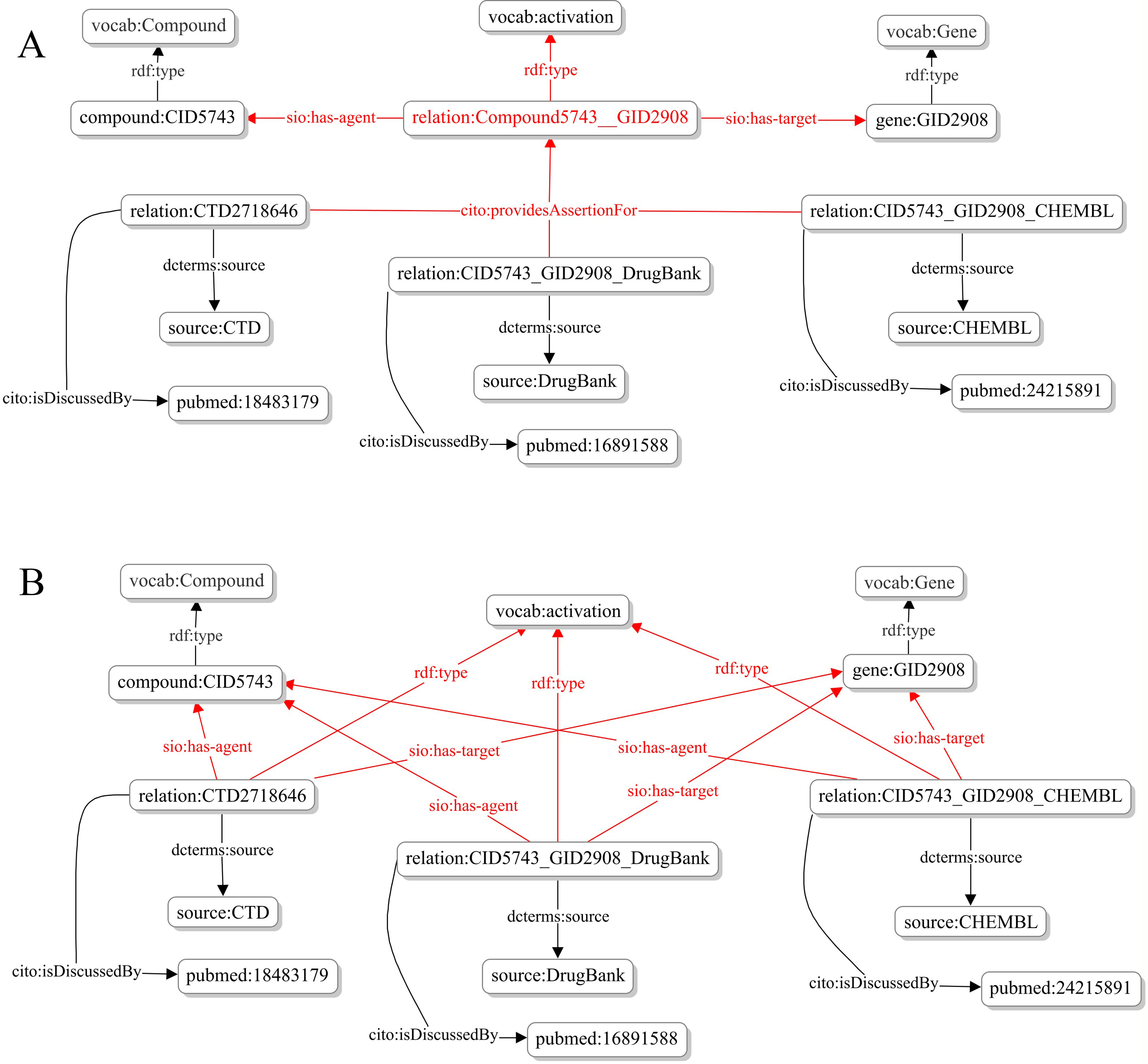
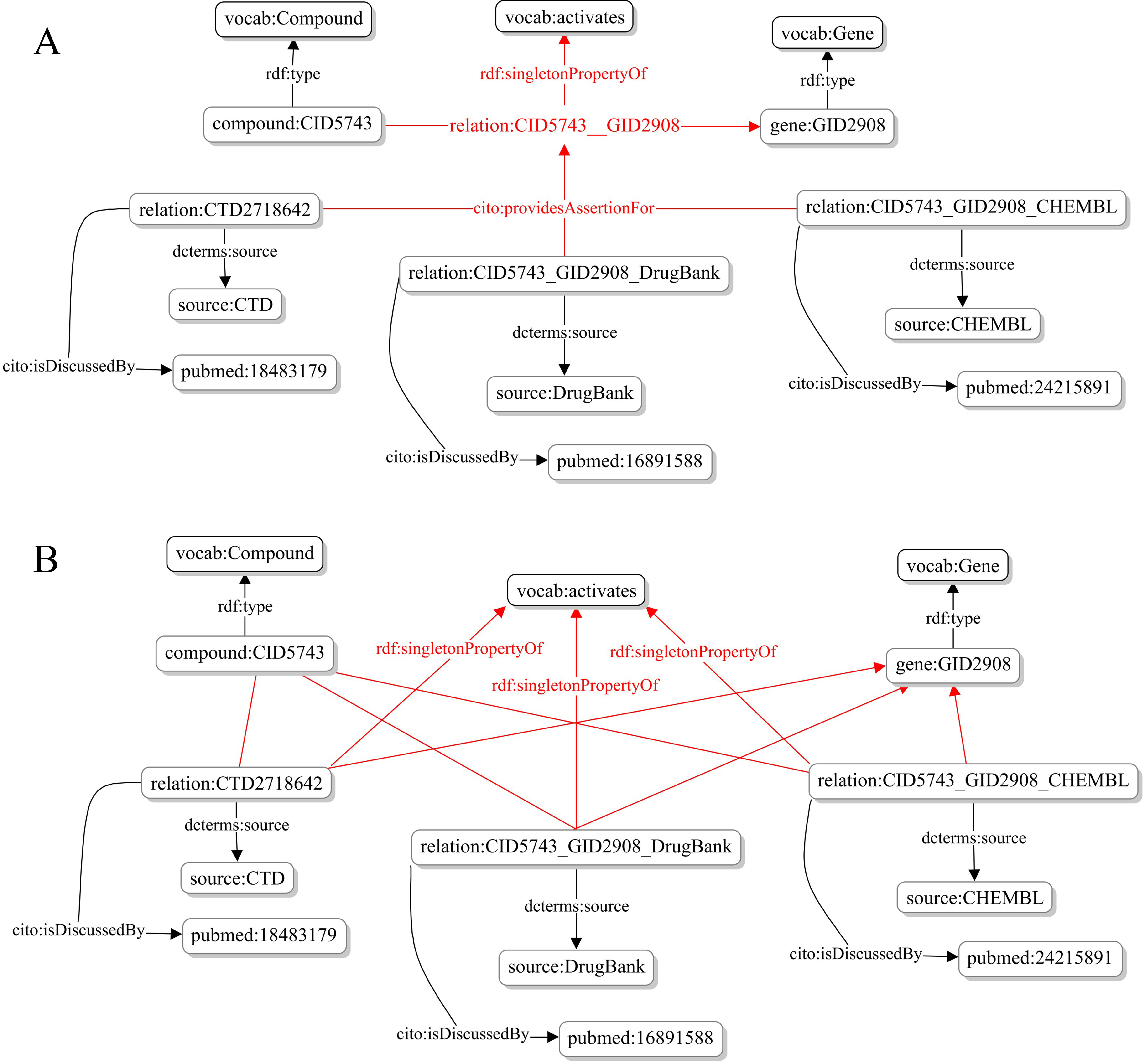
- Implemented five RDF provenance models: N-ary, Singleton Property, and Nanopublication models, both with and without cardinal assertions using cito:providesAssertionFor to link assertions to evidence.
- Generated RDF graphs for each model and measured graph size and query execution time on three RDF stores: Virtuoso, Stardog, and Blazegraph.
- Designed four SPARQL queries (Q1–Q4) targeting different aspects of provenance and relation traversal to evaluate performance under varying workloads.
- Used statistical analysis to compare average execution times and standard deviations across models and stores, focusing on performance differences with and without cardinal assertions.
Experimental results
Research questions
- RQ1How does the inclusion of cardinal assertions affect the size of RDF graphs representing provenance metadata in life science datasets?
- RQ2Which RDF provenance model—N-ary, Singleton Property, or Nanopublication—delivers the best query performance across different RDF stores?
- RQ3To what extent does provenance metadata redundancy impact query execution time in large-scale biomedical knowledge graphs?
- RQ4Does the performance advantage of cardinal assertions vary across different RDF store systems (Virtuoso, Stardog, Blazegraph)?
- RQ5Can a standardized, non-redundant provenance model improve scalability and efficiency in evidence-based knowledge discovery?
Key findings
- The N-ary model without cardinal assertions had the slowest query performance, with Q1 taking 269.854 ± 99.266 seconds in Virtuoso, while the cardinal assertion variant (Model III) reduced this to 0.665 ± 0.263 seconds.
- In Blazegraph, the Nanopublication model (Model V) achieved the fastest average query time for Q4 at 0.732 ± 0.133 seconds, significantly outperforming the N-ary model (83.384 ± 1.612 seconds).
- For Q3, the SP model with cardinal assertion (Model IV) achieved the fastest performance in Blazegraph (0.465 ± 0.054 seconds), while the N-ary model with cardinal assertion (Model III) was fastest in Virtuoso (3.075 ± 0.243 seconds).
- The cardinal assertion model reduced computational overhead in graph traversal by eliminating redundant triples, especially in conjunctive queries that perform Cartesian products.
- Query performance varied significantly by RDF store: Virtuoso favored the Nanopublication model, Stardog preferred the SP model with cardinal assertions, and Blazegraph performed best with the Nanopublication model.
- Despite performance differences, the models with and without cardinal assertions showed comparable performance when provenance restrictions were applied, suggesting that cardinal assertions are most beneficial in unfiltered or broad search scenarios.
Read this paper
Open the full text in the Nubint reader and ask about any passage as you read.
Read this paper on NubintThis review was generated by AI from the original paper. Please check the paper before citing it.