
[Paper Review] Extract, Define, Canonicalize: An LLM-based Framework for Knowledge Graph Construction
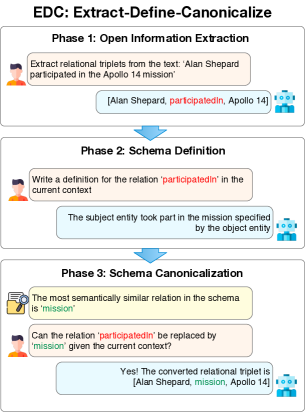
EDC is a three-phase LLM-driven framework for knowledge graph construction that opens with open information extraction, then defines a schema, and finally canonicalizes triplets either to a pre-defined schema or to a self-generated one, enhanced by a retrieval-augmented schema retriever.
In this work, we are interested in automated methods for knowledge graph creation (KGC) from input text. Progress on large language models (LLMs) has prompted a series of recent works applying them to KGC, e.g., via zero/few-shot prompting. Despite successes on small domain-specific datasets, these models face difficulties scaling up to text common in many real-world applications. A principal issue is that, in prior methods, the KG schema has to be included in the LLM prompt to generate valid triplets; larger and more complex schemas easily exceed the LLMs' context window length. Furthermore, there are scenarios where a fixed pre-defined schema is not available and we would like the method to construct a high-quality KG with a succinct self-generated schema. To address these problems, we propose a three-phase framework named Extract-Define-Canonicalize (EDC): open information extraction followed by schema definition and post-hoc canonicalization. EDC is flexible in that it can be applied to settings where a pre-defined target schema is available and when it is not; in the latter case, it constructs a schema automatically and applies self-canonicalization. To further improve performance, we introduce a trained component that retrieves schema elements relevant to the input text; this improves the LLMs' extraction performance in a retrieval-augmented generation-like manner. We demonstrate on three KGC benchmarks that EDC is able to extract high-quality triplets without any parameter tuning and with significantly larger schemas compared to prior works. Code for EDC is available at https://github.com/clear-nus/edc.
Motivation & Objective
- Motivate automated knowledge graph construction (KGC) from general text using LLMs without relying on small pre-defined schemas.
- Decompose KGC into three phases—open information extraction, schema definition, and schema canonicalization—to reduce prompts' context window constraints.
- Enable both Target Alignment (pre-defined large schema) and Self Canonicalization (automatic schema creation) settings.
- Introduce a trained Schema Retriever to retrieve schema components relevant to input text and improve extraction quality.
- Demonstrate EDC and EDC+R on three benchmarks with favorable results and no parameter tuning in the extraction phase.
Proposed method
- Three-phase EDC framework: (i) Open Information Extraction to produce triplets without schema constraints, (ii) Schema Definition to generate natural language definitions for induced schema components, (iii) Schema Canonicalization to map triplets to a canonical form either via Target Alignment or Self Canonicalization.
- Use LLMs to justify extractions via explanations and to derive definitions used for canonicalization.
- Represent canonicalization as vector similarity search over embedded schema definitions, followed by LLM-based verification of feasible transformations.
- Refinement (EDC+R) adds a retrieval-augmented hint during extraction, merging candidate entities/relations from prior iterations and a trained Schema Retriever to guide OIE.
- Schema Retriever is a fine-tuned E5-mistral-7b-instruct model trained with text-definition relation pairs to project text and schema into a shared vector space for relevance scoring.
- Iterate refinement up to one additional pass, leveraging hints to improve extraction quality.
Experimental results
Research questions
- RQ1Can an LLM-based three-phase pipeline produce high-quality KGC without a predefined small schema?
- RQ2How does post-hoc canonicalization affect triplet quality and redundancy when aligning to an existing schema vs. self-generated schemas?
- RQ3Does a retrieval-augmented schema retriever improve extraction performance across datasets with large or evolving schemas?
- RQ4What are the trade-offs in using Target Alignment vs. Self Canonicalization for real-world KGC with large schema types?
Key findings
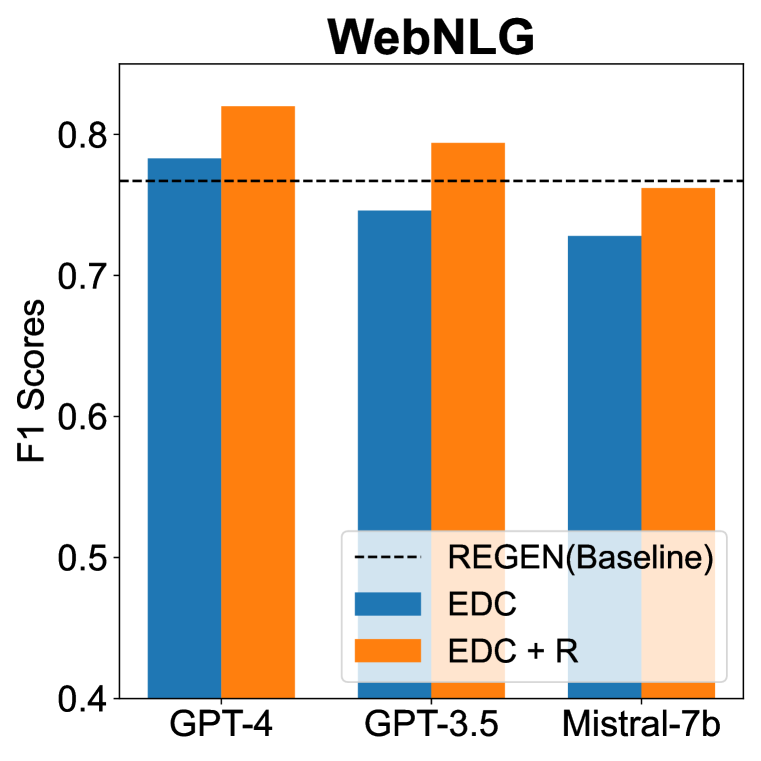
- EDC outperforms state-of-the-art baselines in Target Alignment and Self Canonicalization across three KGC benchmarks without parameter tuning.
- A single refinement iteration (EDC+R) consistently improves performance across tested LLMs.
- The Schema Retriever significantly boosts performance, enabling finer-grained relations (e.g., campus vs. location) that the OIE stage may miss.
- Self Canonicalization yields concise, less redundant schemas and higher precision compared to CESI baselines in human evaluation.
- Practical evaluation shows open KG triplets are correct but may be overly expansive relative to exhaustive reference sets, highlighting dataset annotation differences.
Read this paper
Open the full text in the Nubint reader and ask about any passage as you read.
Read this paper on NubintThis review was generated by AI from the original paper. Please check the paper before citing it.