
[Paper Review] Extract the Knowledge of Graph Neural Networks and Go Beyond it: An Effective Knowledge Distillation Framework
This paper proposes a knowledge distillation framework that transfers knowledge from any pretrained Graph Neural Network (GNN) teacher model into a lightweight, interpretable student model composed of learnable label propagation and feature transformation modules. The student model outperforms its teacher across seven GNN architectures on five benchmark datasets, achieving consistent accuracy gains of 1.4% to 4.7% by leveraging both structural and feature-based inductive biases alongside distilled GNN knowledge.
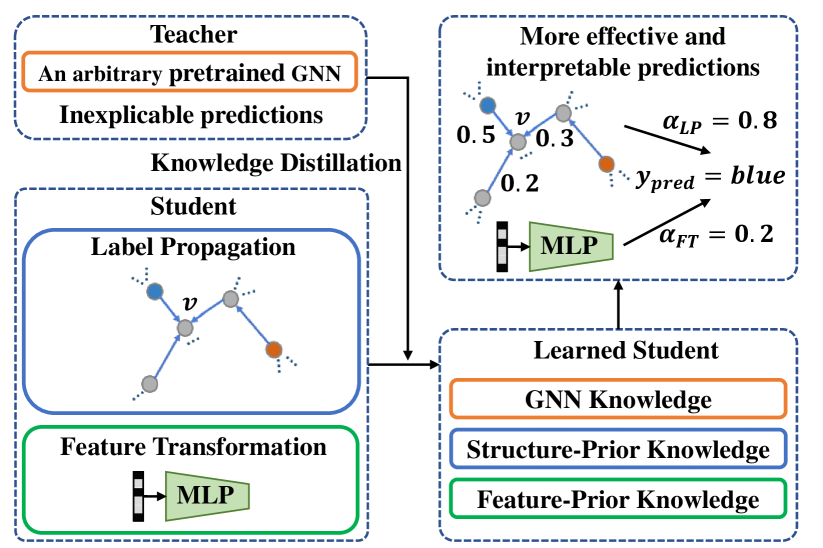
Semi-supervised learning on graphs is an important problem in the machine learning area. In recent years, state-of-the-art classification methods based on graph neural networks (GNNs) have shown their superiority over traditional ones such as label propagation. However, the sophisticated architectures of these neural models will lead to a complex prediction mechanism, which could not make full use of valuable prior knowledge lying in the data, e.g., structurally correlated nodes tend to have the same class. In this paper, we propose a framework based on knowledge distillation to address the above issues. Our framework extracts the knowledge of an arbitrary learned GNN model (teacher model), and injects it into a well-designed student model. The student model is built with two simple prediction mechanisms, i.e., label propagation and feature transformation, which naturally preserves structure-based and feature-based prior knowledge, respectively. In specific, we design the student model as a trainable combination of parameterized label propagation and feature transformation modules. As a result, the learned student can benefit from both prior knowledge and the knowledge in GNN teachers for more effective predictions. Moreover, the learned student model has a more interpretable prediction process than GNNs. We conduct experiments on five public benchmark datasets and employ seven GNN models including GCN, GAT, APPNP, SAGE, SGC, GCNII and GLP as the teacher models. Experimental results show that the learned student model can consistently outperform its corresponding teacher model by 1.4% - 4.7% on average. Code and data are available at https://github.com/BUPT-GAMMA/CPF
Motivation & Objective
- To address the limited utilization of structural and feature-based inductive biases in complex GNN models.
- To develop a generalizable knowledge distillation framework compatible with any pretrained GNN teacher.
- To improve semi-supervised node classification accuracy beyond state-of-the-art GNNs by combining prior knowledge with distilled GNN knowledge.
- To enhance model interpretability by designing a student model with transparent, modular components.
- To enable effective few-shot learning by maintaining performance under low-label regimes.
Proposed method
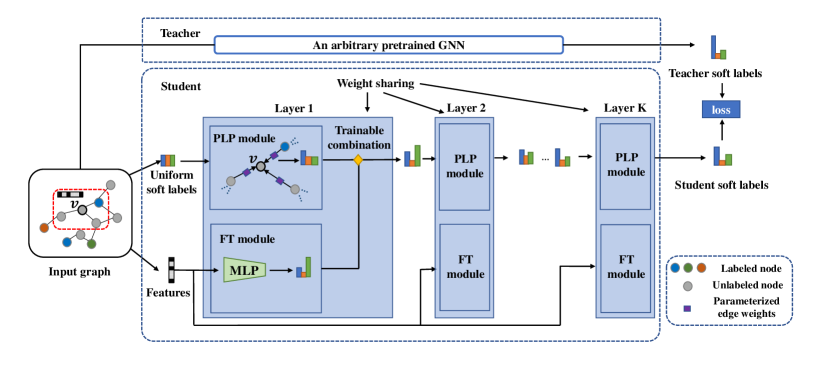
- The student model is a trainable combination of parameterized label propagation (LP) and a two-layer Multi-layer Perceptron (MLP) for feature transformation (FT), encoding structure-based and feature-based priors, respectively.
- Knowledge distillation is performed by matching the soft labels predicted by the GNN teacher model using a cross-entropy loss on the student's output.
- The balance between LP and FT components is controlled by a learnable attention-like parameter α_v per node, enabling adaptive fusion of structural and feature information.
- Node confidence scores c_v are introduced to weight the influence of each node during label propagation, improving robustness to noisy or diverse neighborhoods.
- The student model is trained end-to-end using a hybrid loss combining knowledge distillation and standard cross-entropy supervision.
- The framework is evaluated using seven GNNs (GCN, GAT, SAGE, APPNP, SGC, GCNII, GLP) as teachers across five public datasets.
Experimental results
Research questions
- RQ1Can a student model that explicitly encodes structure-based and feature-based inductive biases outperform its GNN teacher in semi-supervised node classification?
- RQ2How effectively can knowledge distillation transfer knowledge from diverse GNN architectures into a unified, interpretable student model?
- RQ3To what extent does the proposed framework improve performance under low-label settings (few-shot learning)?
- RQ4How do the learned balance parameters α_v and confidence scores c_v reflect the model’s interpretability and decision-making process?
- RQ5Can the student model generalize across different GNN teachers and datasets while maintaining consistent performance gains?
Key findings
- The proposed student model consistently outperforms all seven GNN teacher models on five benchmark datasets, achieving average accuracy gains of 1.4% to 4.7%.
- The model achieves significant improvements even under low-label regimes, with gains of 4.9%, 4.5%, 3.2%, and 2.1% for 5, 10, 20, and 50 labeled nodes per class, respectively.
- Case studies show that nodes with high α_v values are more likely to have neighbors with the same predicted label, indicating strong reliance on label propagation.
- Nodes with high confidence scores c_v tend to have fewer neighbors and more consistent label predictions, suggesting robustness to neighborhood diversity.
- Nodes with low α_v or c_v values are associated with diverse or conflicting neighbor labels, confirming the model’s sensitivity to neighborhood homogeneity.
- The framework demonstrates strong robustness and generalization across multiple GNN architectures and dataset types, validating its effectiveness as a universal distillation framework.
Read this paper
Open the full text in the Nubint reader and ask about any passage as you read.
Read this paper on NubintThis review was generated by AI from the original paper. Please check the paper before citing it.