
[Paper Review] Extracting Low-/High- Frequency Knowledge from Graph Neural Networks and Injecting it into MLPs: An Effective GNN-to-MLP Distillation Framework
This paper proposes FF-G2M, a novel GNN-to-MLP distillation framework that extracts and injects both low- and high-frequency knowledge from pre-trained GNNs into student MLPs using spectral-domain factorization. By addressing the information drowning problem—where high-frequency knowledge is overwhelmed during distillation—FF-G2M improves performance by 12.6% over vanilla MLPs and outperforms teacher GNNs by 2.6% on average across six datasets.
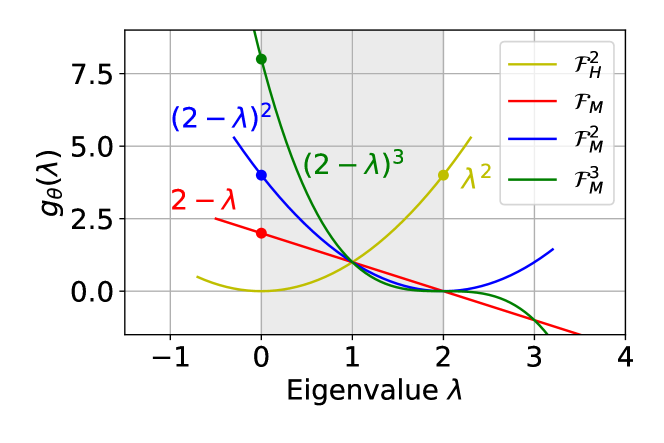
Recent years have witnessed the great success of Graph Neural Networks (GNNs) in handling graph-related tasks. However, MLPs remain the primary workhorse for practical industrial applications due to their desirable inference efficiency and scalability. To reduce their gaps, one can directly distill knowledge from a well-designed teacher GNN to a student MLP, which is termed as GNN-to-MLP distillation. However, the process of distillation usually entails a loss of information, and ``which knowledge patterns of GNNs are more likely to be left and distilled into MLPs?" becomes an important question. In this paper, we first factorize the knowledge learned by GNNs into low- and high-frequency components in the spectral domain and then derive their correspondence in the spatial domain. Furthermore, we identified a potential information drowning problem for existing GNN-to-MLP distillation, i.e., the high-frequency knowledge of the pre-trained GNNs may be overwhelmed by the low-frequency knowledge during distillation; we have described in detail what it represents, how it arises, what impact it has, and how to deal with it. In this paper, we propose an efficient Full-Frequency GNN-to-MLP (FF-G2M) distillation framework, which extracts both low-frequency and high-frequency knowledge from GNNs and injects it into MLPs. Extensive experiments show that FF-G2M improves over the vanilla MLPs by 12.6% and outperforms its corresponding teacher GNNs by 2.6% averaged over six graph datasets and three common GNN architectures.
Motivation & Objective
- To address the gap between the high accuracy of GNNs and the inference efficiency of MLPs in industrial applications.
- To investigate why existing GNN-to-MLP distillation methods underperform, particularly the loss of high-frequency knowledge.
- To develop a distillation framework that preserves both low- and high-frequency knowledge patterns from GNNs to enhance student MLP performance.
- To formally identify and resolve the 'information drowning' problem, where high-frequency knowledge is overshadowed by low-frequency knowledge during distillation.
Proposed method
- Factorize GNN-learned knowledge into low- and high-frequency components using graph signal processing in the spectral domain.
- Derive spatial-domain correspondences of low- and high-frequency components to enable distillation into MLPs.
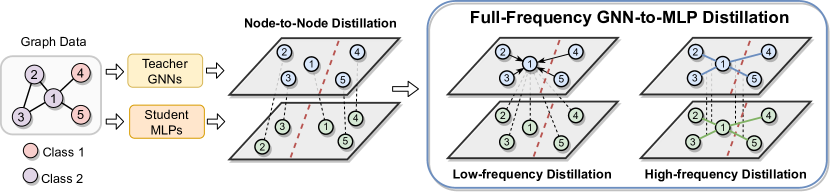
- Design two distinct distillation losses: Low-Frequency Distillation (LFD) to preserve neighborhood smoothing, and High-Frequency Distillation (HFD) to maintain pairwise node distance differences.
- Combine LFD and HFD into a unified Full-Frequency GNN-to-MLP (FF-G2M) framework that jointly optimizes both knowledge types.
- Use mean cosine similarity and KL-divergence as evaluation metrics to quantify low- and high-frequency knowledge retention.
- Train student MLPs using knowledge distillation with both LFD and HFD losses, enabling full-frequency knowledge transfer without message-passing latency.
Experimental results
Research questions
- RQ1What types of knowledge (low- vs. high-frequency) are most vulnerable to loss during GNN-to-MLP distillation?
- RQ2How does the 'information drowning' problem—where high-frequency knowledge is overwhelmed by low-frequency knowledge—arise and affect distillation performance?
- RQ3Can jointly distilling both low- and high-frequency components lead to better-performing student MLPs than existing methods?
- RQ4What is the relative contribution of low- versus high-frequency knowledge to overall model performance in GNN-to-MLP distillation?
- RQ5Is there a way to preserve both types of knowledge without reintroducing data dependency or latency in the student model?
Key findings
- The proposed FF-G2M framework improves performance by 12.6% over vanilla MLPs and outperforms its corresponding teacher GNNs by 2.6% on average across six graph datasets.
- High-frequency knowledge is often lost in standard distillation due to information drowning, where low-frequency patterns dominate the distillation process.
- Low-frequency distillation (LFD) alone outperforms GLNN on all six datasets, demonstrating its effectiveness in capturing graph topology-induced smoothing.
- High-frequency distillation (HFD) alone improves performance over vanilla MLPs but plays a secondary, auxiliary role compared to LFD.
- Jointly using LFD and HFD in FF-G2M leads to complementary gains, with the full model significantly outperforming both individual components and baseline methods.
- Visualization and metric analysis confirm that FF-G2M successfully preserves both neighborhood proximity (low-frequency) and relative node position differences (high-frequency), unlike GLNN or vanilla MLPs.
Read this paper
Open the full text in the Nubint reader and ask about any passage as you read.
Read this paper on NubintThis review was generated by AI from the original paper. Please check the paper before citing it.