
[Paper Review] F$^{2}$-NeRF: Fast Neural Radiance Field Training with Free Camera Trajectories
F2-NeRF introduces perspective warping within a grid-based NeRF to support arbitrary free camera trajectories in unbounded scenes, enabling training in minutes.
This paper presents a novel grid-based NeRF called F2-NeRF (Fast-Free-NeRF) for novel view synthesis, which enables arbitrary input camera trajectories and only costs a few minutes for training. Existing fast grid-based NeRF training frameworks, like Instant-NGP, Plenoxels, DVGO, or TensoRF, are mainly designed for bounded scenes and rely on space warping to handle unbounded scenes. Existing two widely-used space-warping methods are only designed for the forward-facing trajectory or the 360-degree object-centric trajectory but cannot process arbitrary trajectories. In this paper, we delve deep into the mechanism of space warping to handle unbounded scenes. Based on our analysis, we further propose a novel space-warping method called perspective warping, which allows us to handle arbitrary trajectories in the grid-based NeRF framework. Extensive experiments demonstrate that F2-NeRF is able to use the same perspective warping to render high-quality images on two standard datasets and a new free trajectory dataset collected by us. Project page: https://totoro97.github.io/projects/f2-nerf.
Motivation & Objective
- Motivate fast neural radiance field training for unbounded scenes with arbitrary camera trajectories.
- Develop a general space-warping scheme enabling efficient grid-based NeRF for free trajectories.
- Achieve high-quality novel view synthesis with a scalable, adaptive space subdivision and hash-grid representation.
Proposed method
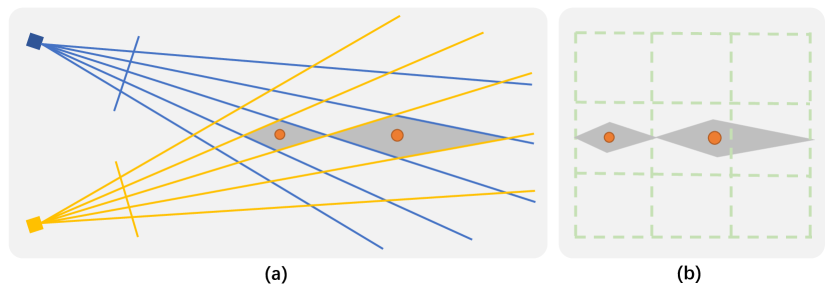
- Propose a perspective warping function F(x)=M G(x) to map unbounded space to a bounded warp space using PCA on camera projections.
- Subdivide space with an octree to align warp regions with visible cameras.
- Build a multi-resolution hash-grid representation in the common warp space across leaf regions with leaf-specific hashing to reduce conflicts.
- Use perspective sampling to sample along rays in warp space, improving sampling efficiency and convergence.
- Train with a color reconstruction loss plus disparity and total-variation regularizers.
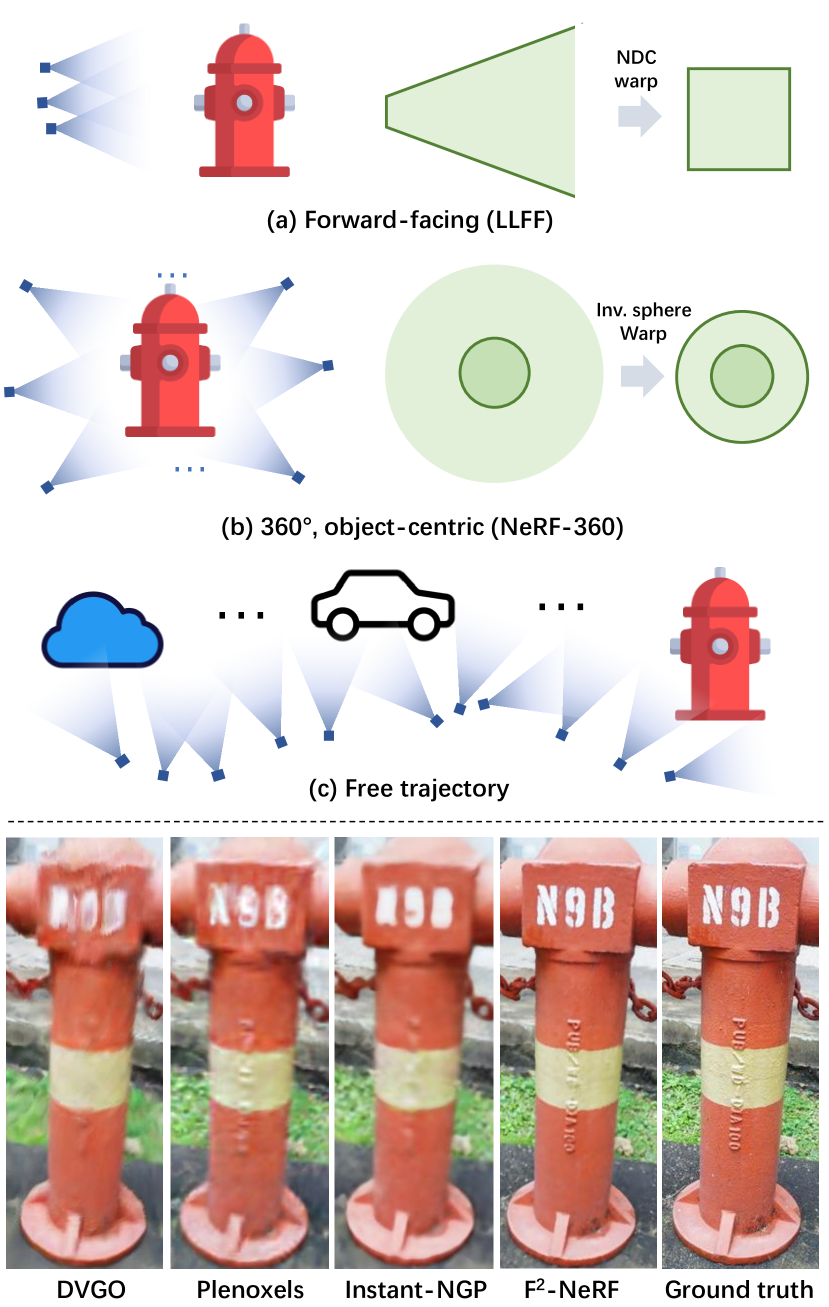
Experimental results
Research questions
- RQ1Can perspective warping handle arbitrary free camera trajectories in unbounded scenes within a fast grid-based NeRF framework?
- RQ2How does adaptive space subdivision and per-leaf warping influence rendering quality and training efficiency on unbounded datasets?
- RQ3Does perspective warping generalize across forward-facing, 360-degree object-centric, and free-trajectory datasets?
- RQ4What are the quantitative gains of F2-NeRF over existing fast-NeRF baselines on unbounded trajectory data?
Key findings
- F2-NeRF achieves high-quality rendering on unbounded datasets with free trajectories using about 12 minutes of training on a 2080Ti GPU.
- On the Free dataset, F2-NeRF attains PSNR 26.32, SSIM 0.779, LPIPS 0.276, outperforming other fast NeRF methods.
- Perspective warping consistently outperforms inverse sphere warping and no-warp ablations, with the best results when combined with perspective sampling.
- F2-NeRF maintains compatibility and competitive quality across forward-facing (LLFF) and 360-degree (NeRF-360-V2) datasets.
- The method demonstrates that a shared warp space with per-leaf hashed features can reduce conflicts while preserving fast training speeds.
Read this paper
Open the full text in the Nubint reader and ask about any passage as you read.
Read this paper on NubintThis review was generated by AI from the original paper. Please check the paper before citing it.