
[Paper Review] Face Aging via Diffusion-based Editing
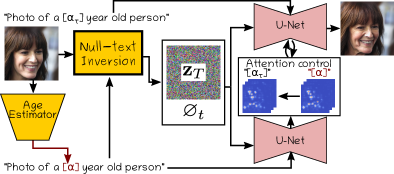
This paper proposes FADING, the first diffusion-based method for face aging that leverages large-scale language-image diffusion models to generate realistic age transformations. By specializing a pre-trained diffusion model via age-aware fine-tuning, inverting the input image to latent noise, and applying text-guided attention control with dual prompts, FADING achieves superior aging accuracy, attribute preservation, and image quality across diverse age ranges and challenging conditions.
In this paper, we address the problem of face aging: generating past or future facial images by incorporating age-related changes to the given face. Previous aging methods rely solely on human facial image datasets and are thus constrained by their inherent scale and bias. This restricts their application to a limited generatable age range and the inability to handle large age gaps. We propose FADING, a novel approach to address Face Aging via DIffusion-based editiNG. We go beyond existing methods by leveraging the rich prior of large-scale language-image diffusion models. First, we specialize a pre-trained diffusion model for the task of face age editing by using an age-aware fine-tuning scheme. Next, we invert the input image to latent noise and obtain optimized null text embeddings. Finally, we perform text-guided local age editing via attention control. The quantitative and qualitative analyses demonstrate that our method outperforms existing approaches with respect to aging accuracy, attribute preservation, and aging quality.
Motivation & Objective
- To address the limitations of existing face aging methods that rely solely on biased, limited-scale facial datasets.
- To leverage the rich semantic and visual prior of large-scale text-to-image diffusion models for more robust and generalizable face aging.
- To enable accurate aging across large age gaps and under challenging conditions such as occlusions and extreme poses.
- To disentangle age-related attributes from identity-preserving features like gender and facial expression.
- To develop a method that outperforms state-of-the-art GAN-based approaches in aging quality, realism, and attribute fidelity.
Proposed method
- Specialize a pre-trained diffusion model using age-aware fine-tuning to disentangle age from age-irrelevant features such as gender and identity.
- Invert the input face image into latent noise using a well-chosen inversion technique to preserve structural details.
- Generate optimized null text embeddings from the inverted latent representation to guide editing.
- Perform localized age editing via attention control using a dual-prompt scheme: one specifying the source age and one the target age.
- Employ enhanced prompts incorporating semantic attributes (e.g., 'woman', 'smiling') to improve attention targeting and attribute preservation.
- Use initial age estimation as a guide in the editing prompt to prevent model drift and ensure meaningful age progression.
Experimental results
Research questions
- RQ1Can large-scale text-to-image diffusion models be effectively specialized for the task of face aging, beyond general-purpose image editing?
- RQ2How does age-aware fine-tuning improve disentanglement of age from identity-irrelevant attributes such as gender and expression?
- RQ3To what extent does the dual-prompt editing scheme with attention control enhance aging accuracy and structural fidelity?
- RQ4Can enhanced prompts incorporating semantic attributes improve both attribute preservation and aging realism?
- RQ5How does the inclusion of initial age information in the editing prompt affect the model's ability to generate meaningful age transformations?
Key findings
- FADING achieves the lowest Fréchet Inception Distance (FID) and KID scores (0.660 × 100) among compared methods, indicating superior image quality and distributional similarity.
- The method reduces age prediction error (MAE) to 9.162 years, outperforming the training-free baseline (9.830) and single-prompt variant (8.781), demonstrating improved aging accuracy.
- Attribute preservation is significantly enhanced: gender consistency reaches 84.10%, surpassing the training-free baseline (79.90%) and single-prompt variant (81.95%).
- The dual-prompt scheme reduces blurriness and improves structural alignment, with KID scores dropping from 0.707 to 0.660 when using both prompts.
- Ablation studies confirm that enhanced prompts and initial age guidance are critical: removing them increases MAE by 4.543 and KID by 0.504, indicating degraded performance.
- Qualitative results show minimal artifacts and improved realism, especially in challenging regions like the mouth and facial contours, even under large age gaps.
![Figure 2 : Qualitative comparison with state-of-the-art methods on CelebA-HQ. Images for the other approaches are extracted from [ Gomez-Trenado et al.(2022)Gomez-Trenado, Lathuilière, Mesejo, and Cordón ] .](https://ar5iv.labs.arxiv.org/html/2309.11321/assets/images/celebA_all.png)
Better researchstarts right now
From reading papers to final review, dramatically reduce your research time.
No credit card · Free plan available
This review was created by AI and reviewed by human editors.