
[Paper Review] Face Recognition in the age of CLIP & Billion image datasets
This paper evaluates CLIP models as zero-shot face recognizers using the CelebA dataset and LAION-5B's KNN index, finding that larger models do not consistently improve accuracy. It demonstrates that CLIP-based retrieval engines can function as unintended face recognition systems, raising privacy and legal concerns under biometric laws like BIPA.
CLIP (Contrastive Language-Image Pre-training) models developed by OpenAI have achieved outstanding results on various image recognition and retrieval tasks, displaying strong zero-shot performance. This means that they are able to perform effectively on tasks for which they have not been explicitly trained. Inspired by the success of OpenAI CLIP, a new publicly available dataset called LAION-5B was collected which resulted in the development of open ViT-H/14, ViT-G/14 models that outperform the OpenAI L/14 model. The LAION-5B dataset also released an approximate nearest neighbor index, with a web interface for search & subset creation. In this paper, we evaluate the performance of various CLIP models as zero-shot face recognizers. Our findings show that CLIP models perform well on face recognition tasks, but increasing the size of the CLIP model does not necessarily lead to improved accuracy. Additionally, we investigate the robustness of CLIP models against data poisoning attacks by testing their performance on poisoned data. Through this analysis, we aim to understand the potential consequences and misuse of search engines built using CLIP models, which could potentially function as unintentional face recognition engines.
Motivation & Objective
- To assess the zero-shot face recognition performance of CLIP models on the CelebA dataset.
- To investigate whether increasing CLIP model size improves face recognition accuracy.
- To evaluate the robustness of CLIP models against data poisoning attacks using Fawkes and LowKey perturbations.
- To examine the potential for CLIP-powered search engines to function as unintended face recognition systems.
- To explore legal and ethical implications of using CLIP embeddings for biometric identification under laws like BIPA.
Proposed method
- Fine-tuned and evaluated ViT-B/32, ViT-L/14, ViT-H/14, and ViT-G/14 CLIP models on the CelebA dataset for top-1 and top-5 face recognition accuracy.
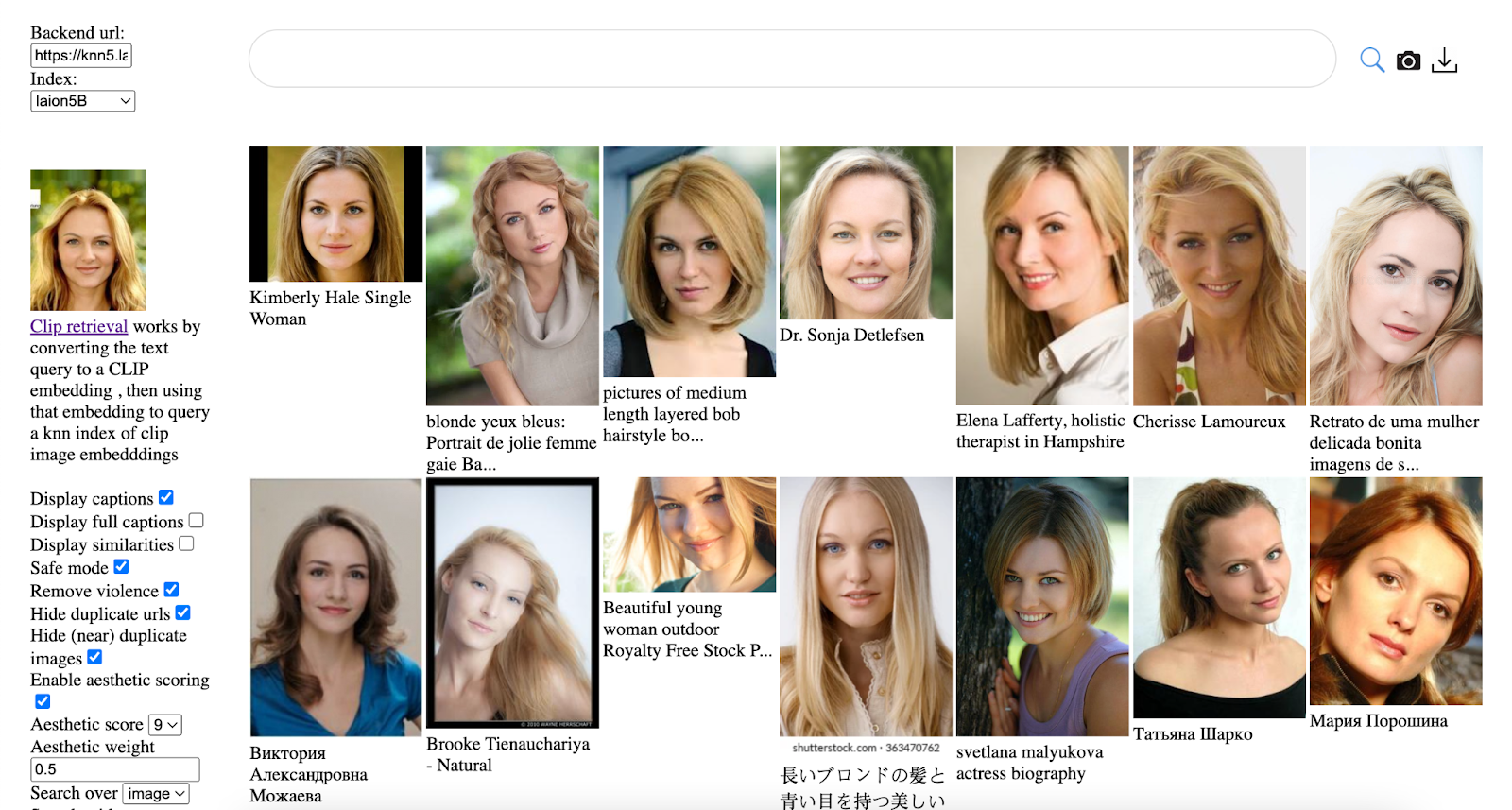
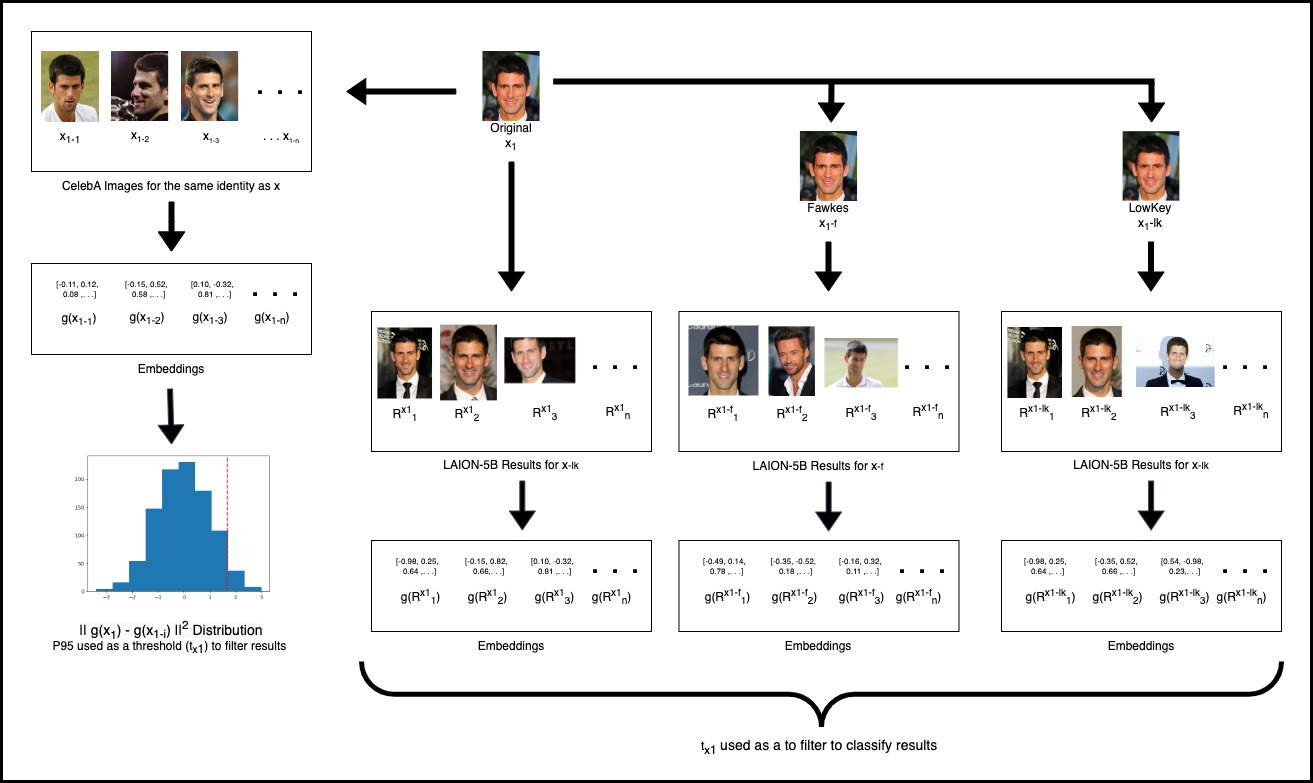
- Used the LAION-5B KNN index to perform image retrieval with original, Fawkes-perturbed, and LowKey-perturbed images.
- Set retrieval parameters including aesthetic score (9), aesthetic weight (0.5), modality (image), and number of results (50).
- Filtered results to include only those with L2 distance between CLIP embeddings below a threshold, ensuring identity consistency.
- Compared the number of valid results (≥3) across original, Fawkes, and LowKey versions to assess perturbation resilience.
- Evaluated the performance of the face-recognition Python library as a benchmark for comparison.
Experimental results
Research questions
- RQ1How well do CLIP models perform as zero-shot face recognizers on the CelebA dataset?
- RQ2Does increasing the size of CLIP models lead to improved face recognition accuracy?
- RQ3How robust are CLIP models to data poisoning attacks using Fawkes and LowKey perturbations?
- RQ4To what extent can CLIP-based retrieval systems function as unintended face recognition engines?
- RQ5What are the legal and ethical implications of using CLIP embeddings for biometric identification under laws like BIPA?
Key findings
- The ViT-L/14 model achieved the highest top-1 face recognition accuracy among CLIP models at 80.95%, still below the 87.61% of the face-recognition Python library.
- The ViT-H/14 model achieved the highest top-5 accuracy among CLIP models at 89.88%, compared to 92.27% for the face-recognition library.
- Face recognition accuracy did not monotonically increase with model size; performance initially improved then declined with larger models.
- Of 728 images that returned ≥3 valid results with the original image, 612 (84.07%) also returned at least one valid result with Fawkes-perturbed images.
- 566 out of 728 images (77.75%) returned at least one valid result with LowKey-perturbed images, indicating partial robustness to perturbations.
- 543 images (74.59%) returned at least one valid result with both Fawkes and LowKey perturbations, showing that perturbations do not fully disrupt retrieval.
Read this paper
Open the full text in the Nubint reader and ask about any passage as you read.
Read this paper on NubintThis review was generated by AI from the original paper. Please check the paper before citing it.