
[Paper Review] Facial Affect Recognition based on Transformer Encoder and Audiovisual Fusion for the ABAW5 Challenge
The paper presents a Transformer Encoder-based multimodal framework with an Affine Module to fuse audio and visual features for all four ABAW5 sub-challenges, achieving state-of-the-art results on VA, Expr, AU, and ERI tasks.
In this paper, we present our solutions for the 5th Workshop and Competition on Affective Behavior Analysis in-the-wild (ABAW), which includes four sub-challenges of Valence-Arousal (VA) Estimation, Expression (Expr) Classification, Action Unit (AU) Detection and Emotional Reaction Intensity (ERI) Estimation. The 5th ABAW competition focuses on facial affect recognition utilizing different modalities and datasets. In our work, we extract powerful audio and visual features using a large number of sota models. These features are fused by Transformer Encoder and TEMMA. Besides, to avoid the possible impact of large dimensional differences between various features, we design an Affine Module to align different features to the same dimension. Extensive experiments demonstrate that the superiority of the proposed method. For the VA Estimation sub-challenge, our method obtains the mean Concordance Correlation Coefficient (CCC) of 0.6066. For the Expression Classification sub-challenge, the average F1 Score is 0.4055. For the AU Detection sub-challenge, the average F1 Score is 0.5296. For the Emotional Reaction Intensity Estimation sub-challenge, the average pearson's correlations coefficient on the validation set is 0.3968. All of the results of four sub-challenges outperform the baseline with a large margin.
Motivation & Objective
- Motivate robust facial affect recognition in-the-wild across multiple tasks (VA, Expr, AU, ERI).
- Leverage diverse audio and visual features from sota models to improve performance.
- Introduce an Affine Module to align heterogeneous feature dimensions before fusion.
- Apply a Transformer Encoder (and TEMMA for ERI) to model temporal dynamics.
- Demonstrate superior performance over baselines across all four ABAW5 sub-challenges.
Proposed method
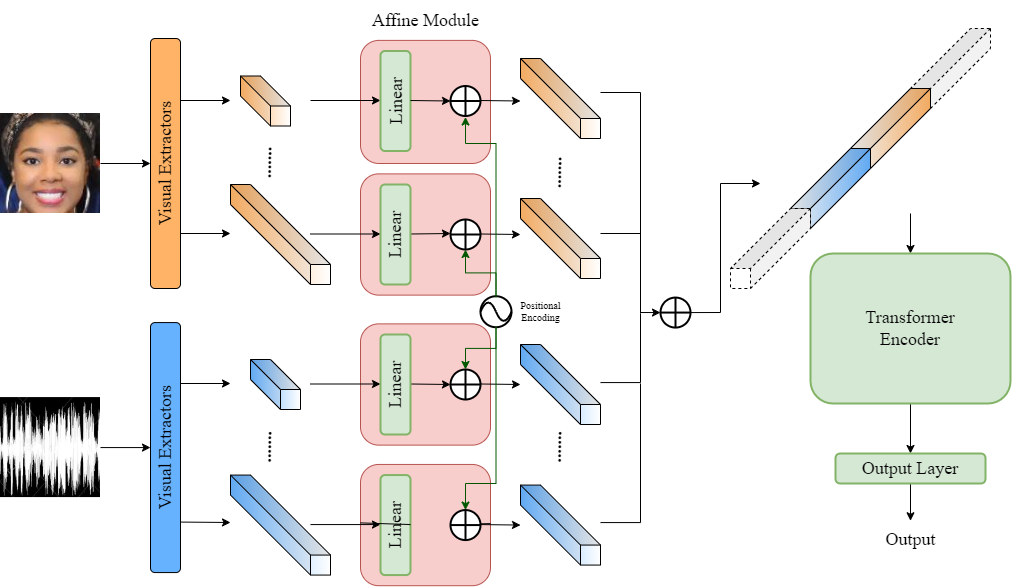
- Extract audio features using multiple audio encoders (IS09, VGGish, eGeMAPS, DeepSpectrum, CNN14).
- Extract visual features from multiple architectures (EAC, ResNet18, POSTER, POSTER2, FAU, OPENFace FAU).
- Align heterogeneous feature dimensions with an Affine Module and add positional encoding.
- Concatenate affine-aligned features and model temporal relations with a Transformer Encoder (and TEMMA for ERI).
- Decode predictions with task-specific output layers and optimize with task-appropriate losses (MSE for VA/ERI, CE for Expr, weighted asymmetric loss for AU).
- Pre-train visual extractors on RAF-DB and AffectNet; train and evaluate on ABAW5 datasets (Aff-Wild2 variants and Hume-Reaction).
Experimental results
Research questions
- RQ1Can multimodal audio-visual features fused via a Transformer-based encoder improve performance across all ABAW5 sub-challenges?
- RQ2What is the impact of aligning heterogeneous feature dimensions with an Affine Module on fusion effectiveness?
- RQ3Does TEMMA-based temporal modeling offer gains for ERI estimation compared to a standard Transformer encoder?
- RQ4Which feature combinations yield the best validation performance for VA, Expr, AU, and ERI tasks?
Key findings
- For VA estimation, the best single feature is POSTER2 (Mean=0.5836) and the best multi-feature combination (ResNet18+POSTER2+FAU) achieves Mean=0.5585, with the best overall Mean 0.6066 when combining EAC, ResNet18, POSTER2, and VGGish.
- VA validation mean CCC of 0.6066 demonstrates strong improvement over baselines.
- Expr classification achieves its best F1 score with POSTER2 alone (0.4055) and improves with combining ResNet18 and POSTER2 (0.3957–0.4055 range).
- AU detection achieves higher F1 scores with POSTER2 and FAU features (0.5296) than baselines, indicating effective multimodal fusion.
- ERI estimation shows best PCC when combining ResNet18 with DeepSpectrum (0.3968), indicating complementary audio-visual cues.
- Across ABAW5, all four sub-challenges outperform baselines by substantial margins.
Read this paper
Open the full text in the Nubint reader and ask about any passage as you read.
Read this paper on NubintThis review was generated by AI from the original paper. Please check the paper before citing it.