
[Paper Review] FactKB: Generalizable Factuality Evaluation using Language Models Enhanced with Factual Knowledge
FactKB proposes a factuality evaluation model that enhances language models with factual knowledge from external knowledge bases to improve robustness and generalizability in detecting factual errors in summaries. By pretraining on entity-specific facts, auxiliary evidence, and compositional knowledge walks, FactKB achieves state-of-the-art performance across in-domain and out-of-domain benchmarks, significantly outperforming prior methods in detecting entity and relation errors.
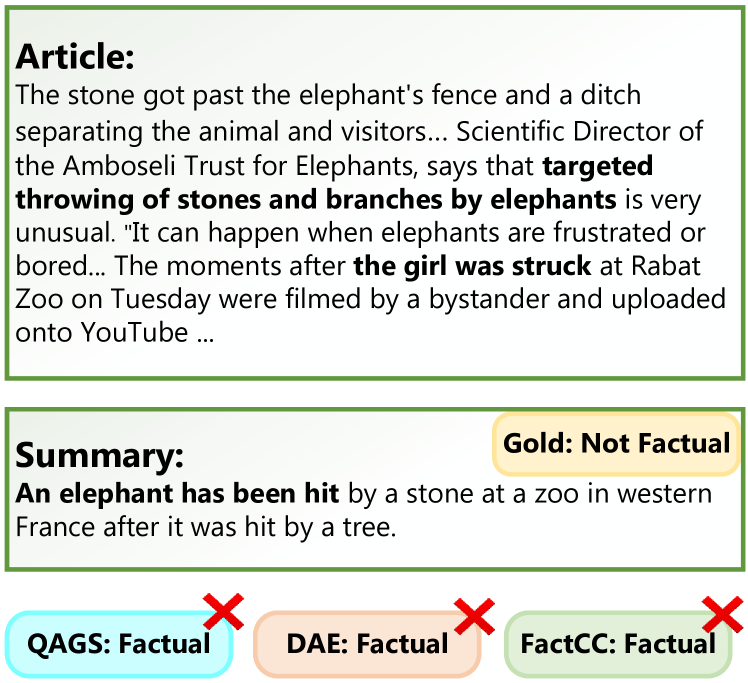
Evaluating the factual consistency of automatically generated summaries is essential for the progress and adoption of reliable summarization systems. Despite recent advances, existing factuality evaluation models are not robust, being especially prone to entity and relation errors in new domains. We propose FactKB, a simple new approach to factuality evaluation that is generalizable across domains, in particular with respect to entities and relations. FactKB is based on language models pretrained using facts extracted from external knowledge bases. We introduce three types of complementary factuality pretraining objectives based on direct entity facts, facts grounded in auxiliary knowledge about entities, and facts constructed compositionally through knowledge base walks. The resulting factuality evaluation model achieves state-of-the-art performance on two in-domain news summarization benchmarks as well as on three out-of-domain scientific literature datasets. Further analysis of FactKB shows improved ability to detect erroneous entities and relations in summaries and is robust and generalizable across domains.
Motivation & Objective
- To address the lack of robustness in existing factuality evaluation models, especially in detecting semantic frame errors involving entities and relations.
- To improve generalizability across domains by leveraging external knowledge bases to enhance language model representations.
- To develop a lightweight, reusable framework for factuality evaluation that works across diverse domains and language models.
- To reduce reliance on synthetic, in-domain training data that limits generalization to out-of-domain or low-resource settings.
Proposed method
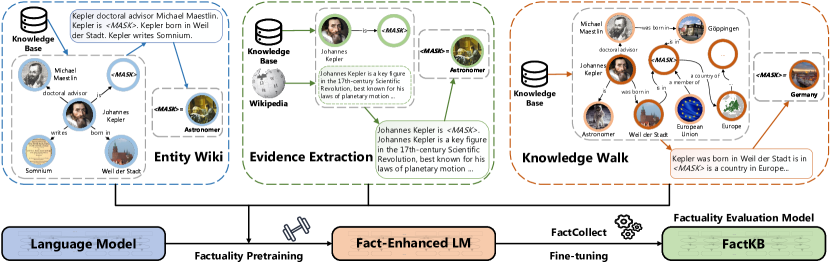
- Pretrain a language model using three complementary factuality pretraining objectives: entity wiki, evidence extraction, and knowledge walks.
- Use entity wiki facts to improve direct entity understanding by masking and predicting entity names in factual statements.
- Apply evidence extraction to incorporate supporting context from surrounding text to enhance factual grounding.
- Construct compositional facts via knowledge base walks to improve reasoning over multi-hop relations between entities.
- Fine-tune the fact-enhanced language model on factual error detection datasets to produce the final FactKB model.
- Integrate factual knowledge from external KBs (e.g., Wikidata) to improve entity and relation representations without requiring domain-specific fine-tuning.
Experimental results
Research questions
- RQ1Can language models pre-trained with factual knowledge from external knowledge bases generalize better to out-of-domain factuality evaluation tasks?
- RQ2How does incorporating entity-specific facts, auxiliary evidence, and compositional knowledge walks improve detection of semantic frame errors in summaries?
- RQ3Does FactKB outperform existing factuality evaluation models on both in-domain and out-of-domain benchmarks?
- RQ4To what extent does FactKB improve detection of erroneous entities and relations compared to baseline models?
- RQ5Can the factuality pretraining approach be applied effectively across different language models and knowledge bases?
Key findings
- FactKB achieves state-of-the-art performance on the in-domain FactCollect benchmark, improving balanced accuracy by 2–7 points over baselines.
- On the FRANK benchmark, FactKB improves correlation with human judgments by 10–12 points, especially excelling in detecting semantic frame errors.
- In out-of-domain settings, FactKB outperforms existing methods by 3–5 balanced accuracy points across three scientific and biomedical summarization datasets.
- FactKB demonstrates strong robustness and generalizability, maintaining high performance on unseen domains without domain-specific adaptation.
- The model shows improved detection of erroneous entities and relations, as validated through qualitative and quantitative analysis on error types.
- FactKB is compatible with various pre-trained language models and knowledge bases, offering a lightweight and extensible framework for factuality evaluation.
Read this paper
Open the full text in the Nubint reader and ask about any passage as you read.
Read this paper on NubintThis review was generated by AI from the original paper. Please check the paper before citing it.