
[Paper Review] FactPICO: Factuality Evaluation for Plain Language Summarization of Medical Evidence
FactPICO introduces a factuality benchmark for plain-language summaries of RCT abstracts, evaluates multiple LLMs and factuality metrics, and reveals challenges balancing simplicity and factual accuracy in medical text simplification.
Plain language summarization with LLMs can be useful for improving textual accessibility of technical content. But how factual are these summaries in a high-stakes domain like medicine? This paper presents FactPICO, a factuality benchmark for plain language summarization of medical texts describing randomized controlled trials (RCTs), which are the basis of evidence-based medicine and can directly inform patient treatment. FactPICO consists of 345 plain language summaries of RCT abstracts generated from three LLMs (i.e., GPT-4, Llama-2, and Alpaca), with fine-grained evaluation and natural language rationales from experts. We assess the factuality of critical elements of RCTs in those summaries: Populations, Interventions, Comparators, Outcomes (PICO), as well as the reported findings concerning these. We also evaluate the correctness of the extra information (e.g., explanations) added by LLMs. Using FactPICO, we benchmark a range of existing factuality metrics, including the newly devised ones based on LLMs. We find that plain language summarization of medical evidence is still challenging, especially when balancing between simplicity and factuality, and that existing metrics correlate poorly with expert judgments on the instance level.
Motivation & Objective
- Motivate accessible plain-language summaries of medical evidence while prioritizing factual accuracy in high-stakes domains.
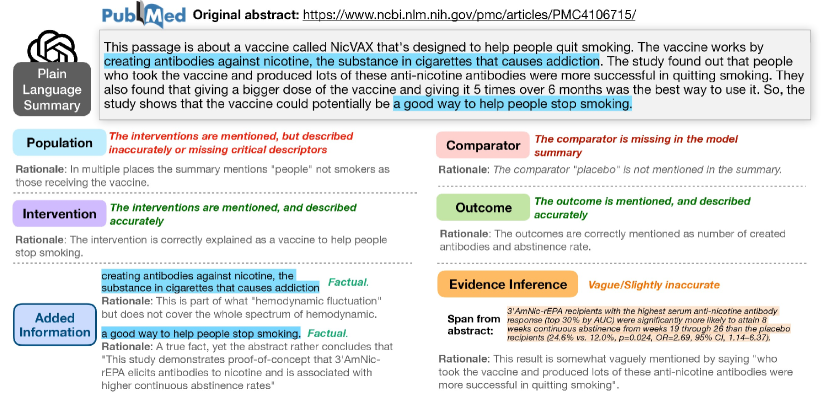
- Define a fine-grained factuality benchmark focused on PICO elements (Population, Intervention, Comparator, Outcome) and evidence inferences for RCT abstracts.
- Provide expert rationales to contextualize factuality judgments and evaluate added information in summaries.
- Assess how existing automatic metrics and LLM-based evaluators align with expert judgments on instance-level factuality.
- Offer insights into the trade-offs between simplicity and factuality in generated medical summaries.
Proposed method
- Construct FactPICO from 345 plain-language summaries of 115 RCT abstracts generated by three LLMs (GPT-4, Llama-2-Chat, Alpaca) in zero-shot prompts.
- Use expert annotations to rate factuality of PICO elements, evidence inference, and added information, with natural language rationales.
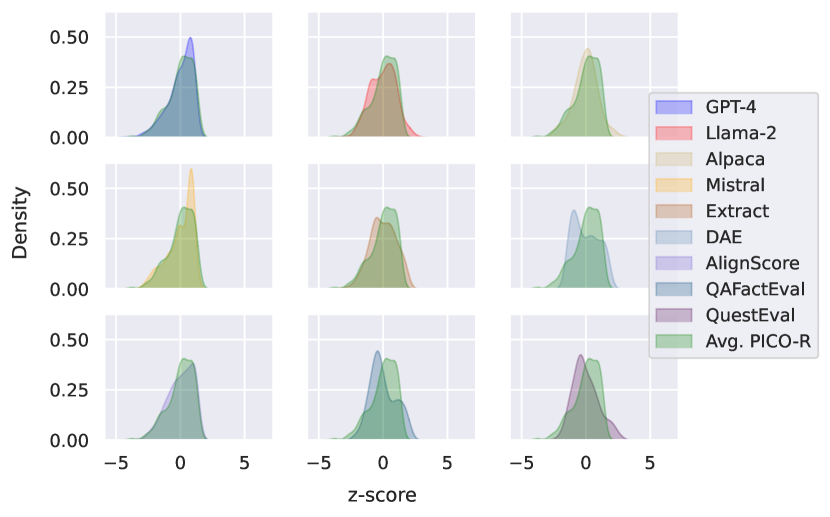
- Evaluate existing factuality metrics (DAE, QuestEval, QAFactEval, AlignScore) and LLM-based evaluators on instance- and system-level correlations with expert judgments.
- Analyze LLM-generated rationales to assess explanation quality and potential misalignment with evaluation criteria.
- Compare pipeline approaches (LLM-based evaluation vs explicit PICO-R extraction) to determine which best tracks expert judgments.
Experimental results
Research questions
- RQ1How factual are plain-language summaries of RCT abstracts with respect to PICO elements and evidence inferences?
- RQ2Do existing automatic factuality metrics correlate with expert judgments when evaluating medical plain-language summaries?
- RQ3Can LLM-based evaluations (with or without explicit PICO extraction) reliably assess factuality at the instance level?
- RQ4What is the impact of added explanatory content on the factuality and trustworthiness of medical plain-language summaries?
- RQ5Do expert rationales provide useful guidance for evaluating and improving factuality in plain-language medical summaries?
Key findings
- Plain-language summaries of medical evidence show higher factuality for Interventions and Outcomes than for Populations and Comparators, with notable omissions and overgeneralizations.
- Non-factual additions are present in a substantial share of summaries, including GPT-4 outputs (around one-third of additions), raising trust concerns for zero-shot use.
- Existing automatic factuality metrics correlate with expert judgments at the system level but poorly at the instance level; LLM-based evaluations with PICO localization yield the strongest instance-level correlations.
- A PICO-R extraction pipeline (using GPT-4 to extract PICO-R and then evaluate) provides the strongest alignment with expert ratings among evaluated methods.
- Rationales produced by LLMs often misjustify evaluations, highlighting limitations of using free-text rationale as a sole reliability signal.
- Alpaca tends to produce more extractive (high ROUGE-L) but lower-quality, less-factual summaries, whereas GPT-4 and Llama-2 show more simplification but more factuality challenges and hallucinations.
Read this paper
Open the full text in the Nubint reader and ask about any passage as you read.
Read this paper on NubintThis review was generated by AI from the original paper. Please check the paper before citing it.