
[Paper Review] Factually Consistent Summarization via Reinforcement Learning with Textual Entailment Feedback
This paper proposes Reinforcement Learning with Entailment Feedback (RLEF), a method that improves factual consistency in abstractive summarization by using textual entailment models as reference-free rewards during RL fine-tuning. The approach significantly enhances summary faithfulness, salience, and conciseness without requiring reference summaries, outperforming strong baselines on XSum via both automatic metrics and human evaluation.
Despite the seeming success of contemporary grounded text generation systems, they often tend to generate factually inconsistent text with respect to their input. This phenomenon is emphasized in tasks like summarization, in which the generated summaries should be corroborated by their source article. In this work, we leverage recent progress on textual entailment models to directly address this problem for abstractive summarization systems. We use reinforcement learning with reference-free, textual entailment rewards to optimize for factual consistency and explore the ensuing trade-offs, as improved consistency may come at the cost of less informative or more extractive summaries. Our results, according to both automatic metrics and human evaluation, show that our method considerably improves the faithfulness, salience, and conciseness of the generated summaries.
Motivation & Objective
- To address factual inconsistency in abstractive summarization, where models generate hallucinated or unsupported claims.
- To improve factual consistency without relying on reference summaries, enabling training on data without human-annotated references.
- To balance factual consistency with salience and coherence, avoiding degenerate or overly extractive summaries.
- To leverage pre-trained textual entailment models as a scalable, generic reward signal for factuality in text generation.
- To explore trade-offs between consistency, informativeness, and model behavior under different regularization and decoding strategies.
Proposed method
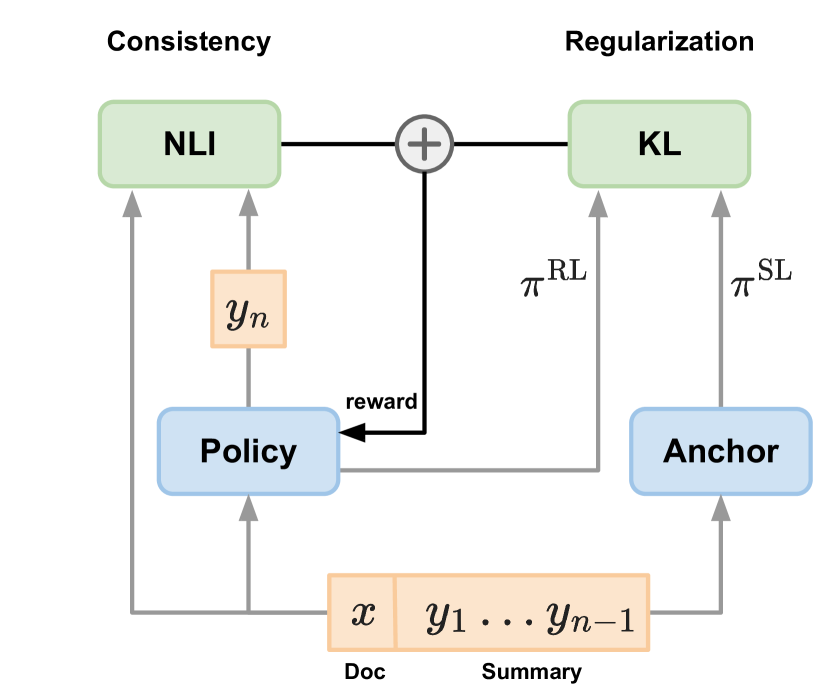
- Fine-tune a pre-trained summarization model using reinforcement learning (RL) with a reward signal derived from textual entailment between the input document and generated summary.
- Use a pre-trained natural language inference (NLI) model to compute entailment scores as a factual consistency reward, treating entailment as a proxy for factual correctness.
- Apply KL regularization between the RL policy and a pre-trained anchor model to prevent distributional shift and preserve salience and coherence.
- Optimize the policy using a regularized RL objective that combines entailment reward and KL regularization, with the policy gradient theorem applied to the combined reward.
- Train the model end-to-end using policy gradient methods, where the reward signal is computed directly from input-document and generated-summary pairs without reference summaries.
- Use a hyperparameter α to balance the trade-off between factual consistency (entailment reward) and retention of original model capabilities (KL regularization).

Experimental results
Research questions
- RQ1Can textual entailment models serve as an effective, reference-free reward signal to improve factual consistency in abstractive summarization?
- RQ2How does RL fine-tuning with entailment feedback affect the trade-off between factual consistency, salience, and conciseness in generated summaries?
- RQ3To what extent can KL regularization with an anchor model preserve the original summarization model’s strengths while improving factual faithfulness?
- RQ4How do model scale, regularization strength, and decoding strategies interact in determining the final performance of RL-optimized summarization models?
- RQ5Does the proposed method outperform strong baselines in both automatic metrics and human evaluation for factual consistency and summary quality?
Key findings
- The RLEF method achieves significant improvements in factual consistency over strong baselines, as measured by automatic metrics and human evaluation.
- Human evaluation confirms that RLEF-generated summaries are more faithful, salient, and concise than those from baseline models.
- The method effectively reduces hallucinations without relying on reference summaries, making it applicable to low-resource or reference-free settings.
- Properly tuned regularization (via KL divergence to the anchor model) prevents the model from becoming overly extractive or less informative.
- The trade-off between consistency and informativeness is highly dependent on hyperparameters such as the regularization weight α and decoding strategies.
- The results demonstrate that entailment-based rewards are a viable and effective alternative to human feedback or reference-based rewards for improving factual consistency in text generation.
Read this paper
Open the full text in the Nubint reader and ask about any passage as you read.
Read this paper on NubintThis review was generated by AI from the original paper. Please check the paper before citing it.