
[Paper Review] Fair Diffusion: Instructing Text-to-Image Generation Models on Fairness
The paper introduces Fair Diffusion, a deployment-stage method that guides text-to-image models toward fairness via textual instructions, enabling arbitrarily adjustable fairness notions without extra data filtering or training.
Generative AI models have recently achieved astonishing results in quality and are consequently employed in a fast-growing number of applications. However, since they are highly data-driven, relying on billion-sized datasets randomly scraped from the internet, they also suffer from degenerated and biased human behavior, as we demonstrate. In fact, they may even reinforce such biases. To not only uncover but also combat these undesired effects, we present a novel strategy, called Fair Diffusion, to attenuate biases after the deployment of generative text-to-image models. Specifically, we demonstrate shifting a bias, based on human instructions, in any direction yielding arbitrarily new proportions for, e.g., identity groups. As our empirical evaluation demonstrates, this introduced control enables instructing generative image models on fairness, with no data filtering and additional training required.
Motivation & Objective
- Identify and audit biases in Stable Diffusion, LAION-5B, and CLIP related to gender and occupations.
- Propose a deployment-time strategy to mitigate biases in diffusion models without data filtering or retraining.
- Show that user-guided fairness can achieve different notions of fairness in generated images.
- Demonstrate that fairness can be controlled post-deployment while revealing limitations and ethical implications.
Proposed method
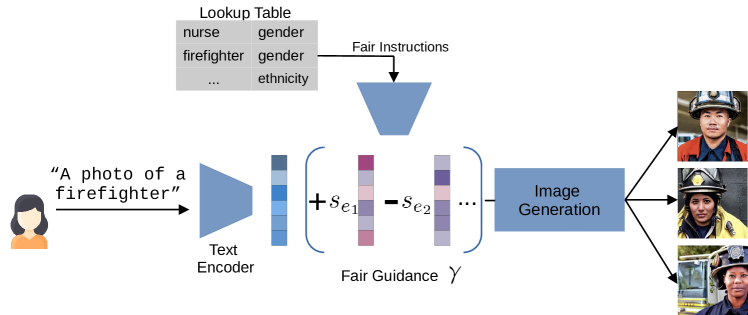
- Propose Fair Diffusion, an instruction-based fairness mechanism that adds a fair guidance term to classifier-free guidance during image generation.
- Use a textual interface (via a lookup table and edit expressions) to map bias concepts to targeted guidance vectors.
- Extend classifier-free guidance with a fair guidance term gamma and scale it by s_e to steer outputs.
- Randomly sample the direction of guidance for each attribute from a specified probability distribution P to achieve desired fairness proportions.
- Evaluate fairness by measuring attribute proportions in generated outputs with a classifier to check alignment with user-defined fairness goals.
- Demonstrate applicability with Semantic Guidance (Sega) as the editing mechanism and analyze multiple occupations and gender attributes.
Experimental results
Research questions
- RQ1Can deployment-time textual guidance steer diffusion model outputs toward defined fairness notions without retraining or data filtering?
- RQ2What is the impact of Fair Diffusion on gender-occupation biases present in LAION-5B, CLIP, and Stable Diffusion outputs?
- RQ3How flexible is Fair Diffusion in realizing different fairness notions (e.g., outcome impartiality) across occupations and demographics?
Key findings
- LAION-5B and CLIP exhibit gender-occupation biases and intersectional biases that influence downstream diffusion models.
- Stable Diffusion outputs show mirrored or amplified gender biases relative to LAION-5B for several occupations, indicating biases are present across components.
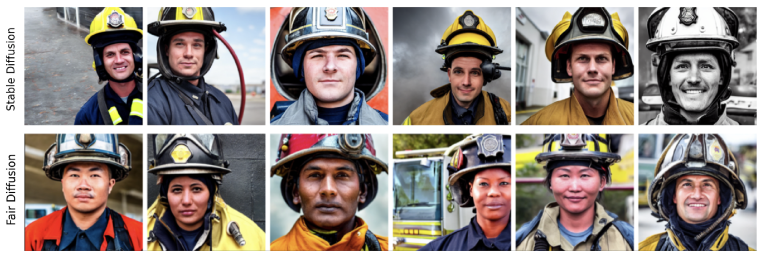
- Fair Diffusion can shift generated outputs toward a fair boundary (statistical parity) for examined occupations, mitigating biases without altering the input prompts or data.
- The effect of Fair Diffusion is robust across occupations where biases are amplified, reflected, or mitigated in the baseline SD outputs.
- Fairness achieved by Fair Diffusion aligns with Def. 1 (statistical parity) on model outcomes, though some variance remains due to non-binary gender considerations and data/encoding limitations.
Better researchstarts right now
From reading papers to final review, dramatically reduce your research time.
No credit card · Free plan available
This review was created by AI and reviewed by human editors.