
[Paper Review] Fairness and Bias in Algorithmic Hiring: a Multidisciplinary Survey
This multidisciplinary survey provides a comprehensive, integrated analysis of fairness and bias in algorithmic hiring, synthesizing systems, biases, fairness measures, mitigation strategies, datasets, and legal frameworks. It offers practitioners and researchers a balanced, context-aware guide to reducing bias and advancing equitable, trustworthy hiring technologies.
Employers are adopting algorithmic hiring technology throughout the recruitment pipeline. Algorithmic fairness is especially applicable in this domain due to its high stakes and structural inequalities. Unfortunately, most work in this space provides partial treatment, often constrained by two competing narratives, optimistically focused on replacing biased recruiter decisions or pessimistically pointing to the automation of discrimination. Whether, and more importantly what types of, algorithmic hiring can be less biased and more beneficial to society than low-tech alternatives currently remains unanswered, to the detriment of trustworthiness. This multidisciplinary survey caters to practitioners and researchers with a balanced and integrated coverage of systems, biases, measures, mitigation strategies, datasets, and legal aspects of algorithmic hiring and fairness. Our work supports a contextualized understanding and governance of this technology by highlighting current opportunities and limitations, providing recommendations for future work to ensure shared benefits for all stakeholders.
Motivation & Objective
- To address the polarized discourse on algorithmic hiring by providing a balanced, integrated overview of fairness and bias across technical, legal, and social dimensions.
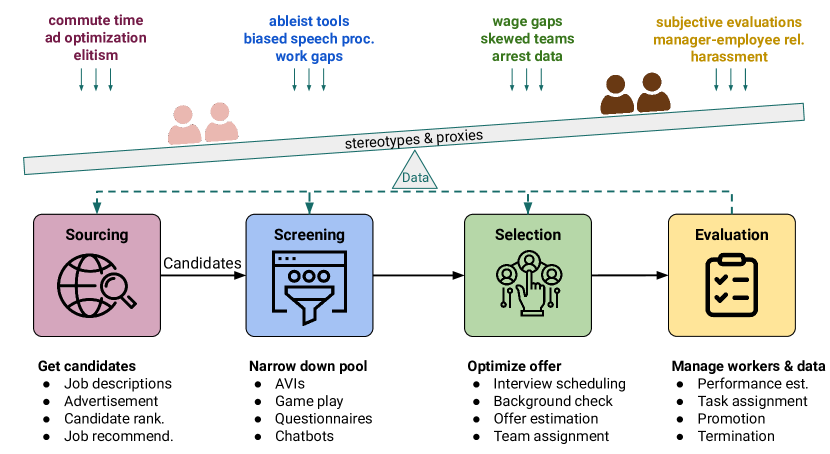
- To identify and systematize bias-conducive factors (BCFs) in the hiring pipeline, including labor market, recruitment, and technology sector influences.
- To offer practitioners actionable guidance on bias mitigation and legal compliance, particularly under EU and US regulations.
- To compile and evaluate existing datasets, fairness measures, and mitigation techniques to support reproducible research.
- To highlight critical research gaps—especially in data diversity, sensitive attribute coverage, and legal-technical alignment—while recommending future directions.
Proposed method
- Conducted a systematic literature review across computer science, law, and social sciences to map systems, biases, fairness measures, mitigation strategies, and datasets in algorithmic hiring.
- Categorized bias-conducive factors (BCFs) across three domains: labor market structures, recruitment practices, and technology design and deployment.
- Reviewed and unified fairness metrics (e.g., demographic parity, equal opportunity, predictive parity) and mitigation techniques (e.g., adversarial debiasing, reweighting, adversarial training).
- Evaluated 15+ publicly available datasets used in algorithmic hiring research, assessing their representativeness, sensitive attribute coverage, and limitations.
- Analyzed legal frameworks in the EU (e.g., AI Act) and the US, identifying tensions between data privacy, non-discrimination, and fairness research.
- Proposed technical and policy recommendations, including IP-friendly auditing protocols and use of privacy-preserving techniques like multiparty computation and noise injection.
Experimental results
Research questions
- RQ1What are the key bias-conducive factors (BCFs) in the algorithmic hiring pipeline, and how do they emerge across labor market, recruitment, and technology domains?
- RQ2How do existing fairness measures and mitigation strategies perform in real-world hiring contexts, and what are their limitations in addressing structural inequalities?
- RQ3What are the major gaps in current datasets used for algorithmic hiring research, particularly regarding geographical, linguistic, and sensitive attribute diversity?
- RQ4How can legal frameworks such as the EU AI Act support or constrain the development of fair algorithmic hiring systems, especially concerning processing of special category data?
- RQ5What multidisciplinary strategies can reconcile technical fairness, data privacy, and anti-discrimination law in the design and governance of hiring algorithms?
Key findings
- The algorithmic hiring pipeline is vulnerable to bias at every stage—from job description generation to resume parsing and video interview analysis—due to structural inequalities and flawed data or design choices.
- Current fairness metrics often prioritize proxy reduction over substantive fairness, and many mitigation techniques fail to address root causes of systemic discrimination in hiring.
- Most datasets used in research lack diversity in geography, language, and sensitive attributes such as disability status and sexual orientation, limiting the validity of fairness evaluations.
- Legal frameworks like the EU AI Act may allow limited processing of sensitive data for bias mitigation in high-risk scenarios, but broader exceptions are needed to enable equitable algorithmic development.
- There is a critical need for IP-friendly auditing mechanisms and privacy-preserving techniques (e.g., multiparty computation, noise injection) to enable transparency without compromising data security or commercial interests.
- Despite growing research, significant gaps remain in aligning technical fairness with legal and ethical standards, particularly in balancing non-discrimination, privacy, and innovation in HR technology.
Read this paper
Open the full text in the Nubint reader and ask about any passage as you read.
Read this paper on NubintThis review was generated by AI from the original paper. Please check the paper before citing it.