
[Paper Review] Fairness-guided Few-shot Prompting for Large Language Models
This paper introduces a predictive-bias (fairness) metric to evaluate prompts and proposes two prompt-search strategies, T-fair-Prompting and G-fair-Prompting, to improve in-context learning in LLMs.
Large language models have demonstrated surprising ability to perform in-context learning, i.e., these models can be directly applied to solve numerous downstream tasks by conditioning on a prompt constructed by a few input-output examples. However, prior research has shown that in-context learning can suffer from high instability due to variations in training examples, example order, and prompt formats. Therefore, the construction of an appropriate prompt is essential for improving the performance of in-context learning. In this paper, we revisit this problem from the view of predictive bias. Specifically, we introduce a metric to evaluate the predictive bias of a fixed prompt against labels or a given attributes. Then we empirically show that prompts with higher bias always lead to unsatisfactory predictive quality. Based on this observation, we propose a novel search strategy based on the greedy search to identify the near-optimal prompt for improving the performance of in-context learning. We perform comprehensive experiments with state-of-the-art mainstream models such as GPT-3 on various downstream tasks. Our results indicate that our method can enhance the model's in-context learning performance in an effective and interpretable manner.
Motivation & Objective
- Motivate improved in-context learning (ICL) by addressing prompt-induced predictive bias in LLMs.
- Introduce a development-set-free metric (predictive bias) to assess prompt quality.
- Propose two efficient prompt-search strategies (T-fair-Prompting and G-fair-Prompting) to find near-optimal prompts.
- Validate the approach across multiple LLMs and downstream text classification tasks.
- Highlight the interpretability and practicality of bias-guided prompting without model fine-tuning.
Proposed method
- Define a content-free input and measure the predictive distribution to compute a fairness score via entropy (Eq. 2).
- Show that higher prompt bias correlates with poorer predictive quality, motivating bias-based prompt search.
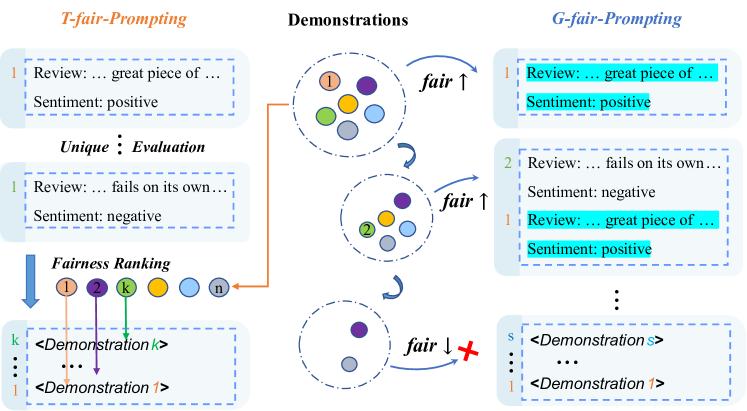
- Propose two search strategies: T-fair-Prompting (linear-time, selects top-k fairest single demonstrations) and G-fair-Prompting (greedy, O(N^2) with improved search quality).
- Formalize the fair metric as fair(ρ) = - sum_y p(y|ρ ⊕ η) log p(y|ρ ⊕ η).
- Use a content-free input to evaluate prompts without a development set, enabling development-set independent assessment.
- Demonstrate local-to-global bias reduction by inserting demonstrations that increase fairness at each step.
Experimental results
Research questions
- RQ1Does predictive bias (fairness) of a fixed prompt correlate with downstream ICL performance across tasks and models?
- RQ2Can bias-guided search strategies identify near-optimal prompts efficiently in the original (text) space without fine-tuning?
- RQ3How do T-fair-Prompting and G-fair-Prompting compare to existing diversity/similarity-based prompt-search methods and calibration-based approaches?
- RQ4What are the trade-offs between search cost and performance gains for the proposed strategies across multiple LLMs?
Key findings
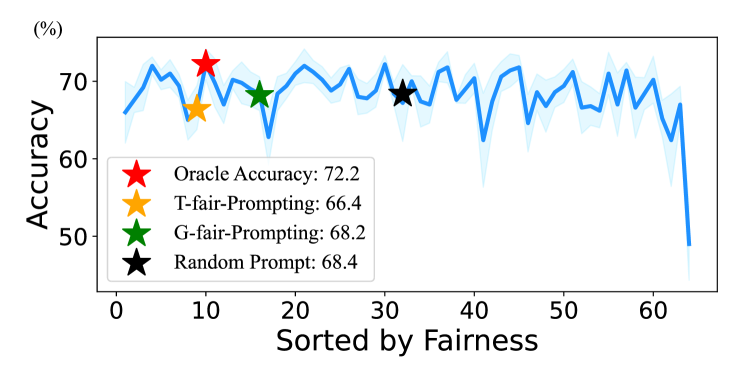
- Fairness scores computed from a content-free input correlate with higher task performance across models and datasets.
- G-fair-Prompting closely approximates enumeration of all prompts and consistently outperforms T-fair-Prompting.
- Both G-fair-Prompting and, to a lesser extent, T-fair-Prompting outperform diversity- and similarity-guided baselines on several tasks and models.
- Post-calibration can help some prompts but may harm performance for poor-quality prompts, underscoring the value of bias-guided prompt search.
- The proposed methods achieve consistent relative improvements over SOTA prompting strategies across GPT-series and LLaMA-family models.
Read this paper
Open the full text in the Nubint reader and ask about any passage as you read.
Read this paper on NubintThis review was generated by AI from the original paper. Please check the paper before citing it.