
[Paper Review] Fast offset corrected in-memory training
This paper proposes two new in-memory training algorithms, Chopped-TTv2 (c-TTv2) and Analog Gradient Accumulation with Dynamic Reference (AGAD), that correct for device offset errors in resistive crossbar arrays using choppers and on-the-fly reference estimation. Both algorithms maintain O(n) runtime complexity while enabling accurate training with as few as 20 conductance states, even under device non-idealities and offset variations.
In-memory computing with resistive crossbar arrays has been suggested to accelerate deep-learning workloads in highly efficient manner. To unleash the full potential of in-memory computing, it is desirable to accelerate the training as well as inference for large deep neural networks (DNNs). In the past, specialized in-memory training algorithms have been proposed that not only accelerate the forward and backward passes, but also establish tricks to update the weight in-memory and in parallel. However, the state-of-the-art algorithm (Tiki-Taka version 2 (TTv2)) still requires near perfect offset correction and suffers from potential biases that might occur due to programming and estimation inaccuracies, as well as longer-term instabilities of the device materials. Here we propose and describe two new and improved algorithms for in-memory computing (Chopped-TTv2 (c-TTv2) and Analog Gradient Accumulation with Dynamic reference (AGAD)), that retain the same runtime complexity but correct for any remaining offsets using choppers. These algorithms greatly relax the device requirements and thus expanding the scope of possible materials potentially employed for such fast in-memory DNN training.
Motivation & Objective
- Address the critical challenge of device offset errors in in-memory deep learning training, which limit the practicality of resistive crossbar arrays.
- Overcome the reliance on perfect symmetry points (SP) in state-of-the-art TTv2, which is sensitive to programming inaccuracies and material instabilities.
- Reduce the stringent requirements on device materials by enabling robust training under offset variations and non-ideal switching behavior.
- Maintain high computational efficiency by preserving O(n) runtime complexity while improving gradient update accuracy.
- Enable training with fewer conductance states (e.g., 20 states) to make in-memory training feasible with current and emerging resistive memory technologies.
Proposed method
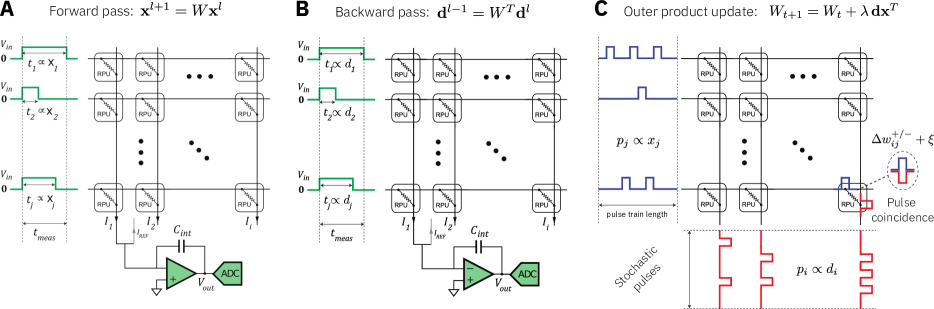
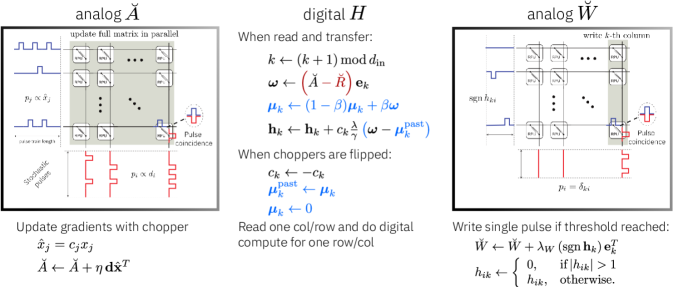
- c-TTv2 uses choppers to flip the sign of gradient signals during readout, enabling offset correction without requiring a stable symmetry point.
- AGAD dynamically estimates the reference value on-the-fly using a running average of recent gradient signals, eliminating the need for a dedicated reference crossbar.
- Both algorithms retain the core TTv2 architecture for in-memory forward and backward passes and outer product gradient computation using pulse coincidence.
- Gradient accumulation is performed digitally on a column-by-column basis, with noise filtering applied to stabilize updates.
- The algorithms use a digital hidden matrix H to store accumulated gradients, with weight updates triggered only when a threshold is reached.
- c-TTv2 corrects for offset by reversing the sign of the gradient signal before digital accumulation, while AGAD computes a dynamic reference to normalize the signal.
Experimental results
Research questions
- RQ1Can in-memory training be made robust to device offset errors without requiring perfect symmetry points?
- RQ2Can the number of required conductance states be reduced while maintaining high training accuracy?
- RQ3How do offset variations and material instabilities affect the performance of existing in-memory training algorithms like TTv2?
- RQ4Can dynamic reference estimation eliminate the need for a dedicated reference crossbar and improve robustness?
- RQ5To what extent can c-TTv2 and AGAD achieve near-floating-point accuracy with only 20 conductance states under realistic device non-idealities?
Key findings
- c-TTv2 effectively corrects for reference offset errors up to a certain threshold, significantly improving robustness compared to TTv2.
- AGAD is completely insensitive to reference offsets and consistently outperforms both TTv2 and c-TTv2 across all tested DNNs and device models.
- With 20 conductance states, both c-TTv2 and AGAD achieve test errors close to or below the floating-point baseline, especially when the symmetry point of the weight crossbar is corrected.
- The performance of AGAD improves with higher numbers of conductance states, indicating scalability to more advanced materials.
- Even without offset errors, both new algorithms outperform TTv2, demonstrating their inherent advantages in gradient computation and update accuracy.
- The results confirm that 20 states are sufficient for high-accuracy in-memory training when combined with offset correction, expanding the viable material space for resistive crossbar arrays.
Better researchstarts right now
From reading papers to final review, dramatically reduce your research time.
No credit card · Free plan available
This review was created by AI and reviewed by human editors.