
[Paper Review] Fast quantum algorithm for differential equations
This paper presents a fast quantum algorithm for solving a large class of inhomogeneous partial differential equations (PDEs) with polylogarithmic complexity in the system size $N$ and independence from the condition number $\kappa$. By using a wavelet basis as a coordinate system, the method enables a diagonal preconditioner that bounds the condition number uniformly, allowing efficient quantum linear system solving via quantum singular value transformation (QSVT) with sublinear scaling in $\kappa$. The key contribution is a quantum algorithm that achieves exponential speedup over classical methods for ill-conditioned PDEs.
Partial differential equations (PDEs) are ubiquitous in science and engineering. Prior quantum algorithms for solving the system of linear algebraic equations obtained from discretizing a PDE have a computational complexity that scales at least linearly with the condition number $κ$ of the matrices involved in the computation. For many practical applications, $κ$ scales polynomially with the size $N$ of the matrices, rendering a polynomial complexity in $N$ for these algorithms. Here we present a quantum algorithm with a complexity that is polylogarithmic in $N$ but is independent of $κ$ for a large class of PDEs. Our algorithm generates a quantum state from which features of the solution can be extracted. Central to our methodology is using a wavelet basis as an auxiliary system of coordinates in which the condition number of associated matrices becomes independent of $N$ by a simple diagonal preconditioner. We present numerical simulations showing the effect of the wavelet preconditioner for several differential equations. Our work could provide a practical way to boost the performance of quantum simulation algorithms where standard methods are used for discretization.
Motivation & Objective
- To overcome the limitation of existing quantum algorithms for solving PDEs, which scale linearly with the condition number $\kappa$, rendering them inefficient for ill-conditioned systems.
- To develop a quantum algorithm that achieves polylogarithmic complexity in the system size $N$ while being independent of $\kappa$, thereby enabling exponential speedup for a broad class of PDEs.
- To leverage the mathematical properties of wavelets to construct a preconditioner that bounds the condition number of discretized PDE matrices uniformly, regardless of $N$.
- To demonstrate that wavelet-based preconditioning enables efficient quantum matrix inversion via quantum singular value transformation (QSVT), even for non-symmetric or variable-coefficient differential operators.
Proposed method
- The method uses a wavelet basis as an alternative coordinate system for discretized PDEs, transforming the system matrix into a form where the condition number is bounded independently of $N$.
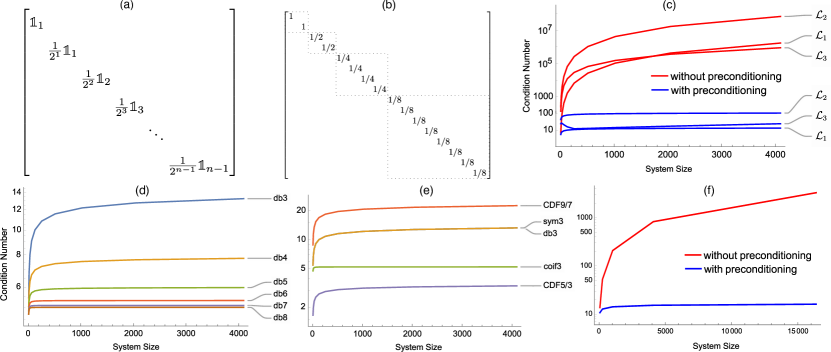
- A diagonal wavelet preconditioner is applied, which maintains uniformly bounded condition numbers (e.g., constant for Haar wavelets) across matrix sizes, effectively stabilizing the system.
- The preconditioned matrix is then processed using quantum singular value transformation (QSVT), which enables efficient quantum linear system solving via polynomial approximations to matrix inversion.
- Polynomial approximations for the inverse and step functions are constructed on intervals bounded away from zero, ensuring accuracy within $\varepsilon$ while maintaining bounded operator norms.
- The algorithm uses a composite polynomial $P_{\varepsilon/c,I_c}^{\textsc{mi}}(x)$ to approximate $1/(2cx)$, combining inverse and step function approximations to achieve $\varepsilon/c$-accuracy.
- The method is applicable to a wide class of PDEs, including second-order and variable-coefficient differential operators, provided the wavelet preconditioner yields uniformly bounded condition numbers.
Experimental results
Research questions
- RQ1Can a quantum algorithm solve a large class of PDEs with complexity that is polylogarithmic in $N$ and independent of $\kappa$?
- RQ2Can wavelet-based preconditioning ensure that the condition number of the discretized PDE matrix remains uniformly bounded regardless of system size $N$?
- RQ3Is it possible to achieve efficient quantum matrix inversion for ill-conditioned PDE systems using QSVT with polynomial approximations, even when $\kappa$ scales as $N^2$?
- RQ4Does the use of structured diagonal preconditioners in wavelet coordinates enable sublinear scaling in $\kappa$ while remaining consistent with known quantum complexity lower bounds?
Key findings
- The wavelet preconditioner ensures that the condition number of the discretized PDE matrix remains uniformly bounded (e.g., constant for Haar wavelets), independent of the system size $N$.
- Numerical simulations confirm that the wavelet preconditioner effectively reduces the condition number for operators such as $\mathcal{L}_1 = d^2/dx^2$, $\mathcal{L}_2 = d^2/dx^2 - d/dx + 1$, and $\mathcal{L}_3 = -d/dx(\cosh(x/4)d/dx) + e^x$, with condition numbers remaining bounded even as $N$ increases.
- The quantum algorithm achieves a computational complexity that is polylogarithmic in $N$ and independent of $\kappa$, enabling exponential speedup over classical methods for ill-conditioned PDEs.
- The method avoids violating known quantum complexity lower bounds because it applies only to a specific class of PDEs—those that are 'fast-solvable'—analogous to 'fast-forwardable' Hamiltonians.
- The use of QSVT with polynomial approximations to the inverse and step functions allows for accurate and bounded matrix inversion on a quantum computer, with error controlled to $\varepsilon$.
- The algorithm is applicable to a broad class of inhomogeneous PDEs, including second-order and variable-coefficient differential operators, provided the wavelet preconditioner yields uniformly bounded condition numbers.

Read this paper
Open the full text in the Nubint reader and ask about any passage as you read.
Read this paper on NubintThis review was generated by AI from the original paper. Please check the paper before citing it.