
[Paper Review] FastComposer: Tuning-Free Multi-Subject Image Generation with Localized Attention
FastComposer enables tuning-free, subject-specific, multi-subject image generation with localized cross-attention and delayed conditioning, achieving large speedups and zero extra storage for new subjects.
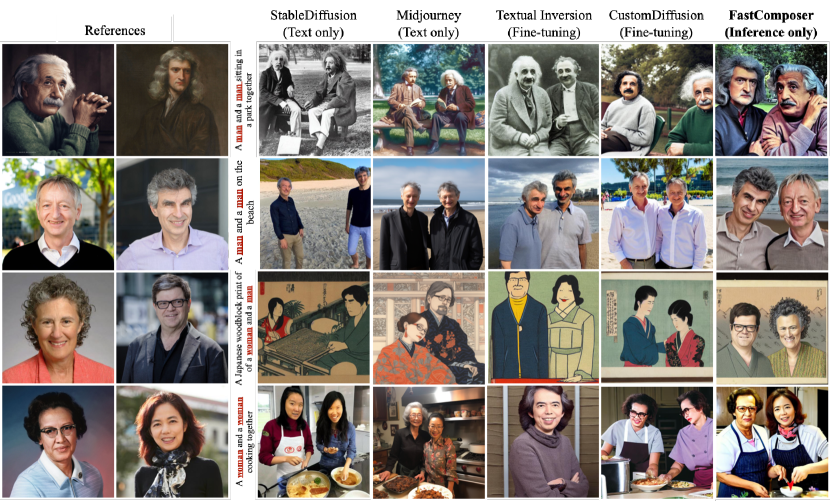
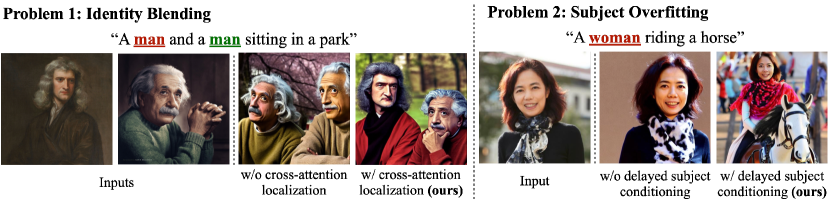
Diffusion models excel at text-to-image generation, especially in subject-driven generation for personalized images. However, existing methods are inefficient due to the subject-specific fine-tuning, which is computationally intensive and hampers efficient deployment. Moreover, existing methods struggle with multi-subject generation as they often blend features among subjects. We present FastComposer which enables efficient, personalized, multi-subject text-to-image generation without fine-tuning. FastComposer uses subject embeddings extracted by an image encoder to augment the generic text conditioning in diffusion models, enabling personalized image generation based on subject images and textual instructions with only forward passes. To address the identity blending problem in the multi-subject generation, FastComposer proposes cross-attention localization supervision during training, enforcing the attention of reference subjects localized to the correct regions in the target images. Naively conditioning on subject embeddings results in subject overfitting. FastComposer proposes delayed subject conditioning in the denoising step to maintain both identity and editability in subject-driven image generation. FastComposer generates images of multiple unseen individuals with different styles, actions, and contexts. It achieves 300$ imes$-2500$ imes$ speedup compared to fine-tuning-based methods and requires zero extra storage for new subjects. FastComposer paves the way for efficient, personalized, and high-quality multi-subject image creation. Code, model, and dataset are available at https://github.com/mit-han-lab/fastcomposer.
Motivation & Objective
- Replace per-subject fine-tuning with subject embeddings derived from reference images to personalize generation.
- Mitigate identity blending in multi-subject generation through cross-attention localization during training.
- Maintain subject identity while allowing text-driven edits via delayed subject conditioning during inference.
- Enable inference-only generation for multiple unseen subjects with high fidelity and efficiency.
Proposed method
- Augment text prompts with subject embeddings derived from reference images using an image encoder and an MLP to fuse visual features with text embeddings.
- Train with subject-augmented conditioning and a localization loss that aligns cross-attention maps with reference segmentation masks to prevent identity blending.
- Localize cross-attention maps by supervising them to resemble subject segmentation masks during training.
- Introduce delayed subject conditioning in denoising, applying text-only conditioning early to establish layout, then subject-conditioned refinement later in the process.
- Construct a subject-augmented image-text dataset from FFHQ with panoptic masks and noun-phrase alignment; train Stable Diffusion-based model while masking subject backgrounds to improve generalization.
Experimental results
Research questions
- RQ1Can tuning-free subject embeddings enable personalized generation without fine-tuning?
- RQ2Does cross-attention localization reduce identity blending in multi-subject generation?
- RQ3Does delaying subject conditioning preserve identity while maintaining editability during inference?
- RQ4What are the efficiency gains of inference-only multi-subject generation compared to fine-tuning-based methods?
Key findings
- FastComposer achieves 300× to 1200× speedup and 2.8× memory reduction compared with fine-tuning-based methods.
- Zero extra storage is required for new subjects.
- Single-subject generation with FastComposer attains higher identity preservation and competitive prompt consistency versus baselines.
- Multi-subject generation maintains higher identity preservation than tuning-based baselines, with prompt consistency comparable to them.
- Cross-attention localization improves identity separation among subjects (ablation shows lower identity preservation without localization).
- Delayed subject conditioning balances identity preservation with editability, with optimum results when conditioning ratio lies roughly between 0.6 and 0.8.
Read this paper
Open the full text in the Nubint reader and ask about any passage as you read.
Read this paper on NubintThis review was generated by AI from the original paper. Please check the paper before citing it.