
[Paper Review] FastRLAP: A System for Learning High-Speed Driving via Deep RL and Autonomous Practicing
FastRLAP is a system that enables a small-scale RC car to autonomously learn high-speed driving from visual observations using deep reinforcement learning (RL) and self-practicing in the real world. It leverages pre-trained representations from diverse prior navigation data and a single low-speed demonstration to bootstrap sample-efficient online RL, achieving expert-level performance in under 20 minutes of real-world training with no human intervention.
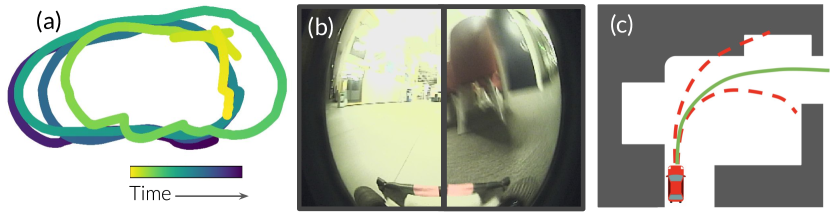
We present a system that enables an autonomous small-scale RC car to drive aggressively from visual observations using reinforcement learning (RL). Our system, FastRLAP (faster lap), trains autonomously in the real world, without human interventions, and without requiring any simulation or expert demonstrations. Our system integrates a number of important components to make this possible: we initialize the representations for the RL policy and value function from a large prior dataset of other robots navigating in other environments (at low speed), which provides a navigation-relevant representation. From here, a sample-efficient online RL method uses a single low-speed user-provided demonstration to determine the desired driving course, extracts a set of navigational checkpoints, and autonomously practices driving through these checkpoints, resetting automatically on collision or failure. Perhaps surprisingly, we find that with appropriate initialization and choice of algorithm, our system can learn to drive over a variety of racing courses with less than 20 minutes of online training. The resulting policies exhibit emergent aggressive driving skills, such as timing braking and acceleration around turns and avoiding areas which impede the robot's motion, approaching the performance of a human driver using a similar first-person interface over the course of training.
Motivation & Objective
- To develop a system that enables autonomous, real-world learning of high-speed driving policies from visual observations without human demonstrations or simulation.
- To overcome the sample inefficiency and failure-prone nature of online RL in real-world robotic control by enabling autonomous recovery and continuous practice.
- To investigate whether pre-trained representations from diverse robotic navigation data can effectively bootstrap real-world RL for aggressive driving behaviors.
- To demonstrate that emergent high-performance driving skills—such as drifting and optimal racing lines—can emerge from minimal human supervision and real-world online interaction.
Proposed method
- Pre-train policy and value function representations on a large, diverse dataset of low-speed navigation from other robots and environments, capturing generalizable visual features like obstacles and free space.
- Use a single low-speed human demonstration to extract navigational checkpoints and define the target course, which guides the goal-conditioned RL policy.
- Implement an autonomous practicing framework that resets the robot after collisions or failures, enabling continuous online training without human intervention.
- Apply a sample-efficient online RL algorithm that leverages the pre-trained representations to rapidly adapt to the target environment and improve performance over multiple laps.
- Use a critic network to evaluate actions based on visual observations, assigning higher values to paths that avoid obstacles and maintain optimal trajectories.
- Integrate a state estimator to provide real-time vector-to-next-checkpoint information, enabling goal-conditioned navigation during training.

Experimental results
Research questions
- RQ1Can a vision-based RL policy learn high-speed driving behaviors autonomously in the real world without any human demonstrations or simulation?
- RQ2To what extent can pre-trained representations from diverse robotic navigation data improve sample efficiency in real-world online RL for aggressive driving?
- RQ3Can autonomous recovery from collisions and failures enable continuous, uninterrupted learning in real-world RL without human intervention?
- RQ4Do emergent driving behaviors such as drifting and optimal racing line selection arise from minimal human supervision and online RL in real-world settings?
Key findings
- FastRLAP achieves performance within 40% of a human expert driver using a similar first-person interface, after only 5 to 20 minutes of real-world online training.
- The system learns aggressive driving behaviors such as timing braking and acceleration around turns, drifting, and selecting high-speed terrain, despite being initialized with low-speed data and a single slow demonstration.
- The critic network demonstrates meaningful correlation between visual cues (e.g., obstacles, open paths) and action values, indicating that policies learn to reason about the environment rather than memorize actions.
- Ablation studies confirm that task-relevant pre-training is critical for success, supporting the role of pre-trained representations as a strong foundation for downstream RL in vision-based control.
- The system autonomously recovers from collisions and continues practicing without human intervention, enabling continuous learning in the real world.
- The method achieves high performance with minimal online data, suggesting that deep RL can be viable for real-world policy learning when combined with appropriate pre-training and autonomous recovery mechanisms.
Read this paper
Open the full text in the Nubint reader and ask about any passage as you read.
Read this paper on NubintThis review was generated by AI from the original paper. Please check the paper before citing it.