
[Paper Review] FEANet: Feature-Enhanced Attention Network for RGB-Thermal Real-time Semantic Segmentation
FEANet proposes a two-stage Feature-Enhanced Attention Network for real-time RGB-T semantic segmentation, using a novel Feature-Enhanced Attention Module (FEAM) to enhance multi-level features from both RGB and thermal streams by modeling channel and spatial dependencies. The method achieves +2.6% mAcc and +0.8% mIoU over SOTA on urban datasets while maintaining real-time inference at 35 FPS on a single RTX 2080 Ti.
The RGB-Thermal (RGB-T) information for semantic segmentation has been extensively explored in recent years. However, most existing RGB-T semantic segmentation usually compromises spatial resolution to achieve real-time inference speed, which leads to poor performance. To better extract detail spatial information, we propose a two-stage Feature-Enhanced Attention Network (FEANet) for the RGB-T semantic segmentation task. Specifically, we introduce a Feature-Enhanced Attention Module (FEAM) to excavate and enhance multi-level features from both the channel and spatial views. Benefited from the proposed FEAM module, our FEANet can preserve the spatial information and shift more attention to high-resolution features from the fused RGB-T images. Extensive experiments on the urban scene dataset demonstrate that our FEANet outperforms other state-of-the-art (SOTA) RGB-T methods in terms of objective metrics and subjective visual comparison (+2.6% in global mAcc and +0.8% in global mIoU). For the 480 x 640 RGB-T test images, our FEANet can run with a real-time speed on an NVIDIA GeForce RTX 2080 Ti card.
Motivation & Objective
- To address the challenge of poor performance in RGB-T semantic segmentation under low-light or complex backgrounds.
- To improve feature extraction from low-quality thermal images by modeling modality-specific characteristics.
- To enhance boundary detection and small object segmentation (e.g., color cones) in urban scenes.
- To maintain real-time inference speed without sacrificing spatial resolution.
Proposed method
- Introduces a two-stage network: stage 1 applies the FEAM module to refine multi-level features in both RGB and thermal streams.
- Designs the FEAM module to model inter-channel and spatial attention, enhancing discriminative low-level features and suppressing background noise.
- Applies progressive refinement to extract and enhance features across multiple levels, preserving high-resolution details.
- Fuses RGB and thermal features via element-wise summation after FEAM enhancement, improving modality compatibility.
- Uses a dual-stream encoder with FEAM applied independently to RGB and thermal branches to preserve modality-specific representations.
- Employs a decoder with skip connections to reconstruct high-resolution segmentation maps while maintaining real-time speed.
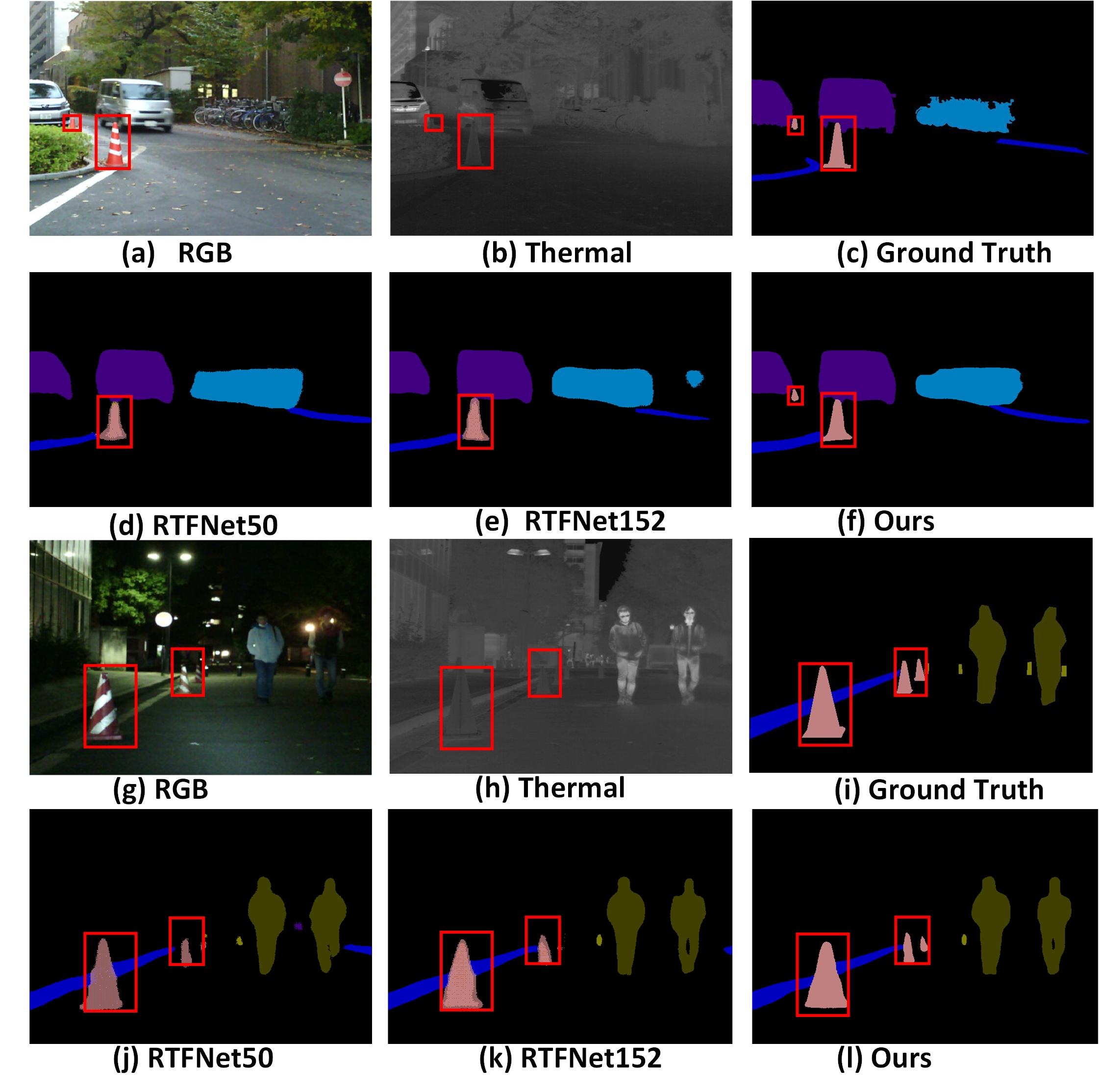
Experimental results
Research questions
- RQ1Can a dedicated attention module improve feature representation in RGB-T semantic segmentation without reducing spatial resolution?
- RQ2How does modality-specific feature enhancement (especially for low-quality thermal data) affect small object detection?
- RQ3To what extent can attention mechanisms improve boundary accuracy in challenging lighting conditions?
- RQ4Can a lightweight, attention-based module maintain real-time inference speed while outperforming SOTA methods?
Key findings
- FEANet achieves 73.2% mAcc and 55.3% mIoU on the test set, outperforming SOTA methods by +2.6% mAcc and +0.8% mIoU.
- The Guardrail class sees a +7.1% accuracy and +0.2% IoU improvement over FuseSeg-161, demonstrating strong small-object segmentation.
- The Color Cone class achieves a +5.4% accuracy and +8.4% IoU gain, indicating superior boundary detection on tiny targets.
- FEANet runs at 35.06 FPS (28.52 ms per image) on an RTX 2080 Ti, confirming real-time inference capability.
- Ablation studies confirm that FEAM in both streams, especially the thermal stream, significantly improves performance.
- The FEAM module enhances feature quality across all levels, with the most notable gains in low-level feature refinement and boundary sharpness.

Read this paper
Open the full text in the Nubint reader and ask about any passage as you read.
Read this paper on NubintThis review was generated by AI from the original paper. Please check the paper before citing it.