
[Paper Review] FeatUp: A Model-Agnostic Framework for Features at Any Resolution
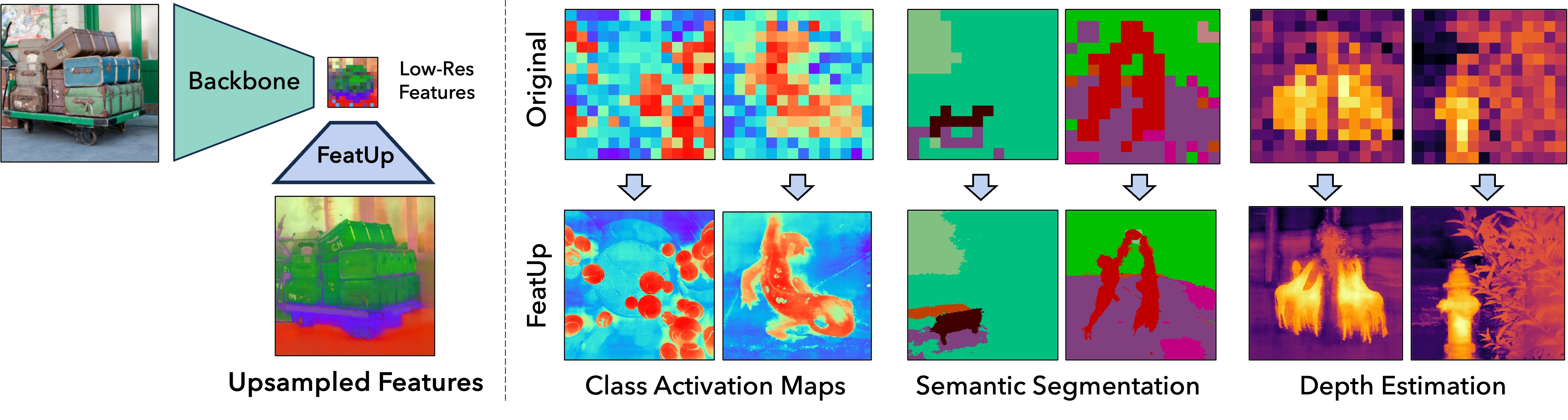
FeatUp upscales deep features to higher spatial resolution without altering their semantics, using either a fast JBU-based upsampler or an implicit per-image model, guided by multi-view consistency.
Deep features are a cornerstone of computer vision research, capturing image semantics and enabling the community to solve downstream tasks even in the zero- or few-shot regime. However, these features often lack the spatial resolution to directly perform dense prediction tasks like segmentation and depth prediction because models aggressively pool information over large areas. In this work, we introduce FeatUp, a task- and model-agnostic framework to restore lost spatial information in deep features. We introduce two variants of FeatUp: one that guides features with high-resolution signal in a single forward pass, and one that fits an implicit model to a single image to reconstruct features at any resolution. Both approaches use a multi-view consistency loss with deep analogies to NeRFs. Our features retain their original semantics and can be swapped into existing applications to yield resolution and performance gains even without re-training. We show that FeatUp significantly outperforms other feature upsampling and image super-resolution approaches in class activation map generation, transfer learning for segmentation and depth prediction, and end-to-end training for semantic segmentation.
Motivation & Objective
- Motivate the need to recover spatial resolution lost in deep feature representations without retraining or changing semantics.
- Propose FeatUp as a framework that enforces multi-view consistency to reconstruct high-resolution features from low-resolution views.
- Present two variants: a fast feedforward JBU-based upsampler and an implicit per-image upsampler.
- Demonstrate that FeatUp improves downstream tasks such as semantic segmentation, depth estimation, and CAM explanations.
Proposed method
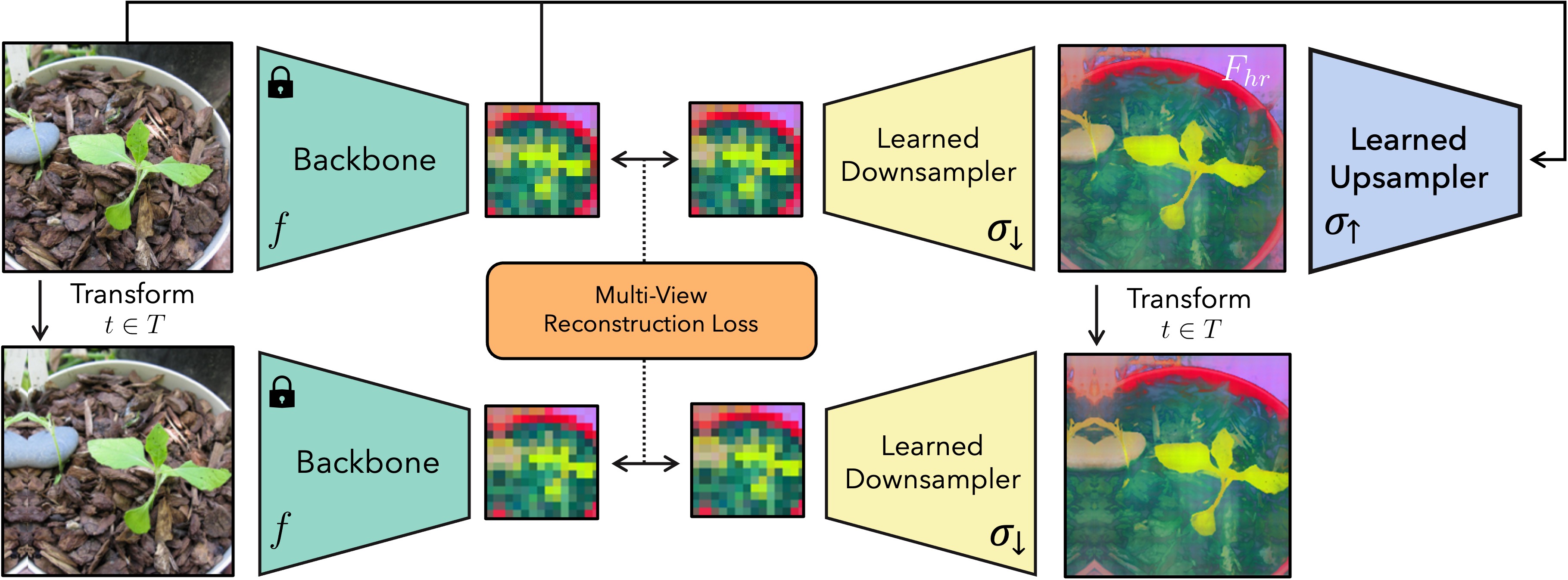
- Upsample deep features via multiview consistency across jittered input transformations (pads, scales, flips).
- Provide two upsampling architectures: (i) Joint Bilateral Upsampler (JBU) as a fast, guided feedforward module; (ii) Implicit FeatUp that overfits an MLP to a single image for arbitrary resolution outputs.
- Introduce a learned downsampler (simple blur or attention-based) to map high-res features down to low-res views.
- Use a multi-view reconstruction loss that matches downsampled high-res features to low-res backbone outputs with an adaptive uncertainty term.
- Offer a CUDA-accelerated JBU implementation for efficiency, and optional Fourier-based features in the implicit model to boost convergence.
- Apply a small total-variation prior to stabilize the implicit feature magnitudes.
Experimental results
Research questions
- RQ1Can the spatial resolution of deep features be significantly improved without changing their semantics or retraining the backbone?
- RQ2Does multi-view consistency across image jitters provide a robust supervision signal for high-resolution feature reconstruction?
- RQ3How do the fast JBU-based and implicit per-image upsampling approaches compare in quality, speed, and memory footprint across backbones and tasks?
- RQ4Can FeatUp features serve as drop-in replacements to improve downstream dense prediction and model explainability?
- RQ5Do FeatUp-derived features yield measurable gains in CAM quality for model interpretability?
Key findings
- FeatUp consistently outperforms baseline upsampling methods (bilinear, resize-conv, DIP, etc.) across CAM faithfulness, semantic segmentation, and depth estimation.
- Both FeatUp variants (JBU and Implicit) deliver higher-quality high-resolution features, with the implicit variant achieving the strongest downstream improvements in several metrics.
- In transfer-learning experiments, FeatUp features improve linear-probe performance for semantic segmentation (mIoU) and depth estimation (RMSE, delta>1.25).
- FeatsUp upsampling can be used as a drop-in replacement in end-to-end segmentation models, yielding better mean IoU, mean accuracy, and pixel accuracy with competitive FLOPs/parameters.
- A CUDA-accelerated JBU implementation provides up to ~10x speedups and significantly lower memory usage compared to naive implementations.
- Implicit FeatUp benefits from Fourier color features, enabling faster convergence and higher-frequency detail capture.
Read this paper
Open the full text in the Nubint reader and ask about any passage as you read.
Read this paper on NubintThis review was generated by AI from the original paper. Please check the paper before citing it.