
[Paper Review] Feature Completion Transformer for Occluded Person Re-identification
This paper proposes Feature Completion Transformer (FCFormer), a novel self-supervised framework for occluded person re-identification that implicitly completes missing features in occluded regions using a learnable transformer decoder. By introducing Occlusion Instance Augmentation (OIA) to generate diverse occlusion pairs and a dual-stream shared-encoder architecture, FCFormer trains a Feature Completion Decoder (FCD) to reconstruct holistic features from occluded inputs, achieving state-of-the-art performance across five benchmark datasets with a 71.3% R-1 accuracy on Market-1501-Occluded.
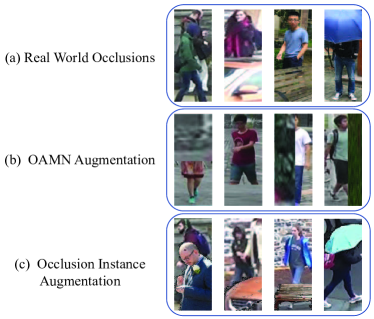
Occluded person re-identification (Re-ID) is a challenging problem due to the destruction of occluders. Most existing methods focus on visible human body parts through some prior information. However, when complementary occlusions occur, features in occluded regions can interfere with matching, which affects performance severely. In this paper, different from most previous works that discard the occluded region, we propose a Feature Completion Transformer (FCFormer) to implicitly complement the semantic information of occluded parts in the feature space. Specifically, Occlusion Instance Augmentation (OIA) is proposed to simulates real and diverse occlusion situations on the holistic image. These augmented images not only enrich the amount of occlusion samples in the training set, but also form pairs with the holistic images. Subsequently, a dual-stream architecture with a shared encoder is proposed to learn paired discriminative features from pairs of inputs. Without additional semantic information, an occluded-holistic feature sample-label pair can be automatically created. Then, Feature Completion Decoder (FCD) is designed to complement the features of occluded regions by using learnable tokens to aggregate possible information from self-generated occluded features. Finally, we propose the Cross Hard Triplet (CHT) loss to further bridge the gap between complementing features and extracting features under the same ID. In addition, Feature Completion Consistency (FC$^2$) loss is introduced to help the generated completion feature distribution to be closer to the real holistic feature distribution. Extensive experiments over five challenging datasets demonstrate that the proposed FCFormer achieves superior performance and outperforms the state-of-the-art methods by significant margins on occluded datasets.
Motivation & Objective
- To address the challenge of occluded person re-identification, where visible parts are often insufficient due to complex occlusions.
- To overcome the limitations of existing methods that rely on external cues like pose or segmentation, which are error-prone under severe occlusion.
- To reduce reliance on annotated semantic information by enabling self-supervised feature completion from occluded features alone.
- To improve model generalization and robustness by simulating realistic, diverse occlusion scenarios during training.
- To bridge the performance gap between holistic and occluded feature representations through a novel loss and completion mechanism.
Proposed method
- Occlusion Instance Augmentation (OIA) generates diverse occlusion samples by pasting patches from a curated library of 17 occlusion types onto pedestrian images, creating realistic holistic-occluded image pairs.
- A dual-stream encoder with shared weights processes both holistic and occluded images, learning aligned discriminative features without requiring additional semantic supervision.
- The Feature Completion Decoder (FCD) uses learnable tokens to aggregate contextual information from unoccluded regions and reconstruct features in occluded regions via self-attention mechanisms.
- Cross Hard Triplet (CHT) loss is introduced to minimize the margin between positive and negative feature pairs, enhancing discriminative capacity.
- Feature Completion Consistency (FC²) loss ensures the distribution of generated completion features matches that of real holistic features, improving fidelity.
- The framework is trained end-to-end using paired holistic-occluded images, enabling self-supervised completion without ground-truth occlusion masks or keypoint annotations.

Experimental results
Research questions
- RQ1Can a self-supervised feature completion mechanism improve performance in occluded person re-identification without relying on external semantic cues?
- RQ2How effective is a learnable, attention-based decoder in reconstructing missing features from occluded regions using only the visible parts?
- RQ3Does introducing diverse, realistic occlusion augmentations through OIA lead to better generalization and robustness in occluded Re-ID?
- RQ4To what extent can the combination of CHT and FC² losses close the domain gap between real holistic features and completed features?
- RQ5How does the proposed method compare to state-of-the-art approaches in terms of accuracy and robustness across multiple occluded Re-ID benchmarks?
Key findings
- FCFormer achieves a 71.3% Rank-1 accuracy on the Market-1501-Occluded dataset, significantly outperforming previous state-of-the-art methods.
- On the DukeMTMC-reID-Occluded dataset, FCFormer achieves 68.8% Rank-1 accuracy, demonstrating strong generalization across different occlusion patterns.
- The model achieves 60.9% mAP on the Market-1501-Occluded dataset using ViT-B backbone, showing the effectiveness of transformer-based encoders in occlusion scenarios.
- The ablation study confirms that both CHT and FC² losses contribute significantly to performance, with FC² improving feature distribution consistency.
- FCFormer outperforms ResNet-50-based models by 5.0% in Rank-1 accuracy and 1.9% in mAP, even without additional semantic supervision.
- Visualization results show that the FCD focuses on occluder edges and body parts, indicating effective attention to relevant context for feature completion.
Read this paper
Open the full text in the Nubint reader and ask about any passage as you read.
Read this paper on NubintThis review was generated by AI from the original paper. Please check the paper before citing it.