
[Paper Review] Feature Selection using Sparse Adaptive Bottleneck Centroid-Encoder
This paper proposes Sparse Adaptive Bottleneck Centroid-Encoder (SABCE), a novel deep learning-based feature selection method that uses a sparsity-promoting layer with ℓ₂,₁-norm regularization to identify discriminative features while reconstructing class centroids and minimizing within-class scatter. SABCE achieves state-of-the-art classification accuracy across 12 diverse datasets, outperforming methods like LassoNet, Stochastic Gates, FsNet, and Supervised CAE in most cases.
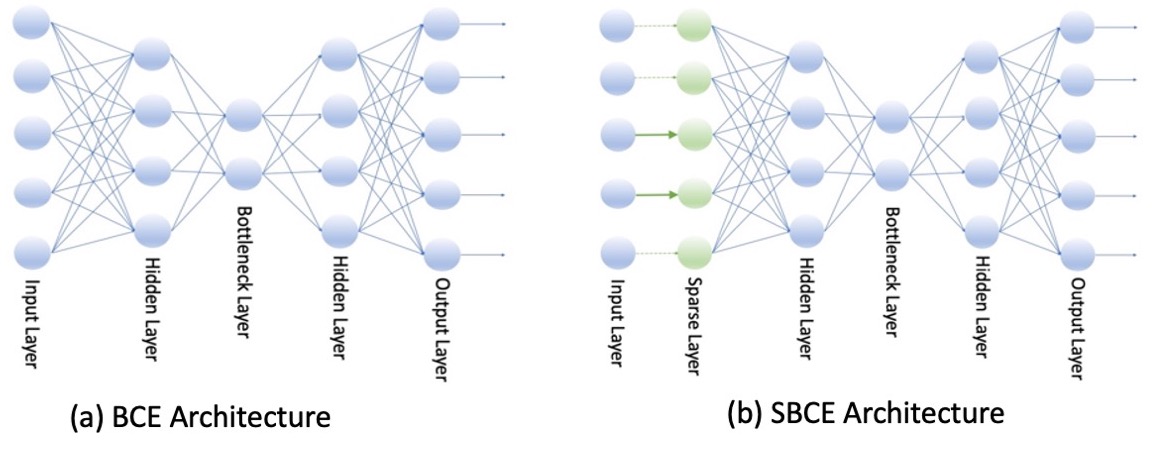
We introduce a novel nonlinear model, Sparse Adaptive Bottleneck Centroid-Encoder (SABCE), for determining the features that discriminate between two or more classes. The algorithm aims to extract discriminatory features in groups while reconstructing the class centroids in the ambient space and simultaneously use additional penalty terms in the bottleneck layer to decrease within-class scatter and increase the separation of different class centroids. The model has a sparsity-promoting layer (SPL) with a one-to-one connection to the input layer. Along with the primary objective, we minimize the $l_{2,1}$-norm of the sparse layer, which filters out unnecessary features from input data. During training, we update class centroids by taking the Hadamard product of the centroids and weights of the sparse layer, thus ignoring the irrelevant features from the target. Therefore the proposed method learns to reconstruct the critical components of class centroids rather than the whole centroids. The algorithm is applied to various real-world data sets, including high-dimensional biological, image, speech, and accelerometer sensor data. We compared our method to different state-of-the-art feature selection techniques, including supervised Concrete Autoencoders (SCAE), Feature Selection Networks (FsNet), Stochastic Gates (STG), and LassoNet. We empirically showed that SABCE features often produced better classification accuracy than other methods on the sequester test sets, setting new state-of-the-art results.
Motivation & Objective
- To develop a nonlinear, embedded feature selection method that identifies discriminative features while preserving class centroid structure in high-dimensional data.
- To address limitations of L1-regularized methods like LassoNet and Stochastic Gates, particularly in handling correlated features and low-sample-size, high-dimensional biological data.
- To improve generalization performance by jointly minimizing within-class scatter and maximizing inter-class separation through adaptive centroid updates.
- To enable data-driven feature selection without prior knowledge of the number of features or input distribution.
- To demonstrate superior performance over state-of-the-art methods across diverse real-world datasets, including genomics, image, and sensor data.
Proposed method
- SABCE employs a multi-layer perceptron encoder-decoder architecture with a sparsity-promoting layer (SPL) directly connected to the input layer, enforcing ℓ₂,₁-norm regularization to promote group sparsity.
- The model reconstructs class centroids in the ambient space using a bottleneck layer, with the objective of minimizing reconstruction error and within-class scatter.
- Class centroids are adaptively updated during training via the Hadamard product of the original centroid and the sparse layer weights, effectively ignoring irrelevant features.
- The loss function includes three components: centroid reconstruction loss, within-class scatter minimization, and ℓ₂,₁-norm penalty on the sparse layer to enforce feature selection.
- The method uses backpropagation to jointly optimize the network weights, sparse layer, and adaptive centroid updates, enabling end-to-end learning of discriminative features.
- Hyperparameters λ₁ and λ₂ are tuned via validation sets, with smaller values found to yield better classification performance.
Experimental results
Research questions
- RQ1Can a deep neural network with a sparsity-promoting layer and adaptive centroid learning outperform existing state-of-the-art feature selection methods in high-dimensional data?
- RQ2Does the ℓ₂,₁-norm regularization in the sparse layer effectively promote group sparsity without shrinking all features, especially in low-sample-size, high-dimensional biological datasets?
- RQ3How does the adaptive centroid update mechanism improve feature selection and classification generalization compared to fixed centroid models?
- RQ4To what extent does SABCE maintain stable and consistent feature detection across diverse data types, including genomics, image, and sensor data?
- RQ5Can SABCE achieve better classification accuracy than LassoNet, Stochastic Gates, FsNet, and Supervised CAE on benchmark datasets?
Key findings
- SABCE achieved new state-of-the-art classification accuracy on 10 out of 12 benchmark datasets, including in high-dimensional biological, image, and accelerometer sensor data.
- On the ALLAML dataset, SABCE demonstrated superior sparsity and feature stability, with Venn diagram analysis confirming consistent feature detection across runs.
- SABCE outperformed FsNet in most cases, particularly on high-dimensional biological data, and surpassed LassoNet in all six datasets where the number of samples exceeded the number of features.
- SABCE produced better classification results than Stochastic Gates on three out of the twelve datasets, indicating improved generalization in complex feature spaces.
- The ℓ₂,₁-norm regularization effectively induced sparsity without over-shrinking features, as confirmed by ablation and sparsity analysis, especially in low-sample-size scenarios.
- Adaptive centroid updates significantly enhanced model performance by dynamically focusing on relevant features, unlike fixed-centroid models such as the original Centroid-Encoder.
Read this paper
Open the full text in the Nubint reader and ask about any passage as you read.
Read this paper on NubintThis review was generated by AI from the original paper. Please check the paper before citing it.