
[Paper Review] Feature Splatting: Language-Driven Physics-Based Scene Synthesis and Editing
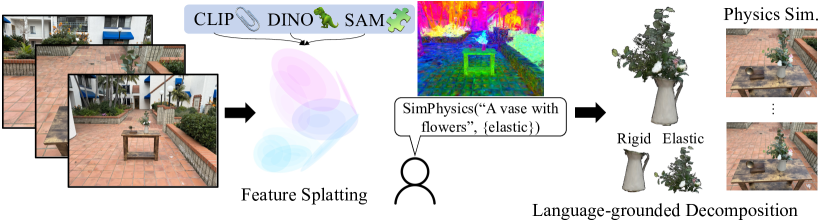
Feature Splatting introduces a unified framework that enhances 3D Gaussian splatting with language-grounded semantics and physics-based dynamics. By distilling vision-language features into Gaussians and integrating a particle-based physics simulator, it enables semi-automatic scene decomposition and realistic physical interactions via natural language prompts, achieving high-fidelity, editable 3D scenes with improved efficiency and reduced artifacts.
Scene representations using 3D Gaussian primitives have produced excellent results in modeling the appearance of static and dynamic 3D scenes. Many graphics applications, however, demand the ability to manipulate both the appearance and the physical properties of objects. We introduce Feature Splatting, an approach that unifies physics-based dynamic scene synthesis with rich semantics from vision language foundation models that are grounded by natural language. Our first contribution is a way to distill high-quality, object-centric vision-language features into 3D Gaussians, that enables semi-automatic scene decomposition using text queries. Our second contribution is a way to synthesize physics-based dynamics from an otherwise static scene using a particle-based simulator, in which material properties are assigned automatically via text queries. We ablate key techniques used in this pipeline, to illustrate the challenge and opportunities in using feature-carrying 3D Gaussians as a unified format for appearance, geometry, material properties and semantics grounded on natural language. Project website: https://feature-splatting.github.io/
Motivation & Objective
- To unify 3D scene representation with appearance, geometry, semantics, and physics-based dynamics in a single format.
- To enable language-driven scene editing by grounding object semantics and material properties in natural language queries.
- To address challenges in feature distillation and physics simulation within Gaussian-based representations.
- To reduce artifacts and improve efficiency in feature-carrying 3D Gaussians for dynamic scene synthesis.
Proposed method
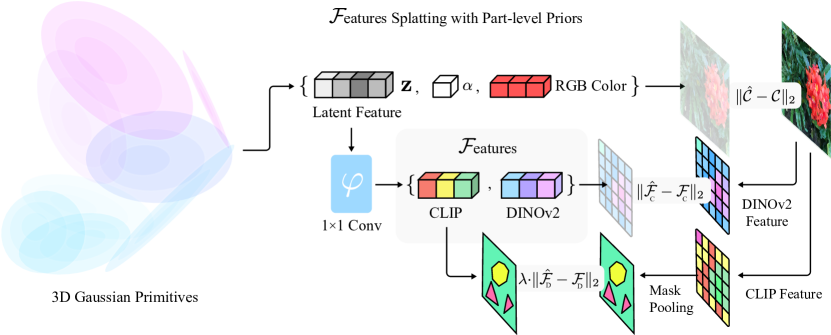
- Distills high-quality, object-centric vision-language features from 2D foundation models (e.g., CLIP, DINOv2, SAM) into 3D Gaussians using a novel distillation pipeline to reduce high-frequency noise.
- Introduces DINOv2 regularization to prevent overfitting to coarse reference features, improving boundary adherence and generalization.
- Augments static 3D Gaussian scenes with particle-based physics simulation using a modified MPM (Material Point Method) engine adapted to Gaussian primitives.
- Employs implicit volume preservation by infilling internal support particles to prevent collapse during deformation, especially under gravity.
- Rotates Gaussians based on deformation gradients to maintain surface continuity and reduce visual artifacts during large deformations.
- Fuses features from multiple vision foundation models (CLIP, DINOv2, SAM) to improve 2D localization accuracy and robustness in open-vocabulary scene decomposition.
Experimental results
Research questions
- RQ1Can 3D Gaussians be effectively enhanced with rich, language-grounded semantics from vision-language foundation models for scene editing?
- RQ2How can high-frequency noise in distilled 2D features be mitigated when projecting to 3D Gaussians without compromising detail?
- RQ3Can a particle-based physics simulator be effectively integrated with 3D Gaussian representations to enable realistic dynamic behavior?
- RQ4How can volume preservation and structural integrity be maintained during large deformations in Gaussian-based simulations?
- RQ5To what extent does fusing features from multiple vision models improve open-vocabulary localization and decomposition accuracy?
Key findings
- Feature splatting achieves a PSNR of 26.47 on color rendering, with a CLIP feature loss of 0.046 on validation views, outperforming baseline methods in feature fidelity.
- The inclusion of DINOv2 regularization reduces overfitting to high-frequency noise in reference features, improving generalization and boundary adherence.
- The method reduces training time to under one hour on average, outperforming Feature3DGS, which requires up to six hours.
- Volume preservation via internal particle infilling prevents collapse of elastic objects during collisions, enabling realistic bouncing behavior.
- Rotating Gaussians based on deformation gradients reduces surface artifacts compared to prior gradient-based rotation methods.
- Fusing features from CLIP, DINOv2, and SAM improves 2D localization accuracy on the LERF dataset, with performance dropping when any component is removed.
Read this paper
Open the full text in the Nubint reader and ask about any passage as you read.
Read this paper on NubintThis review was generated by AI from the original paper. Please check the paper before citing it.