
[Paper Review] Fed and Trump -- The Dirty Game
The paper analyzes doubly librating Plutinos, identifying a clustering of g librators in eccentricity–inclination space and linking it to periodic orbits of the third kind; it estimates about 16% of Plutinos are g librators.
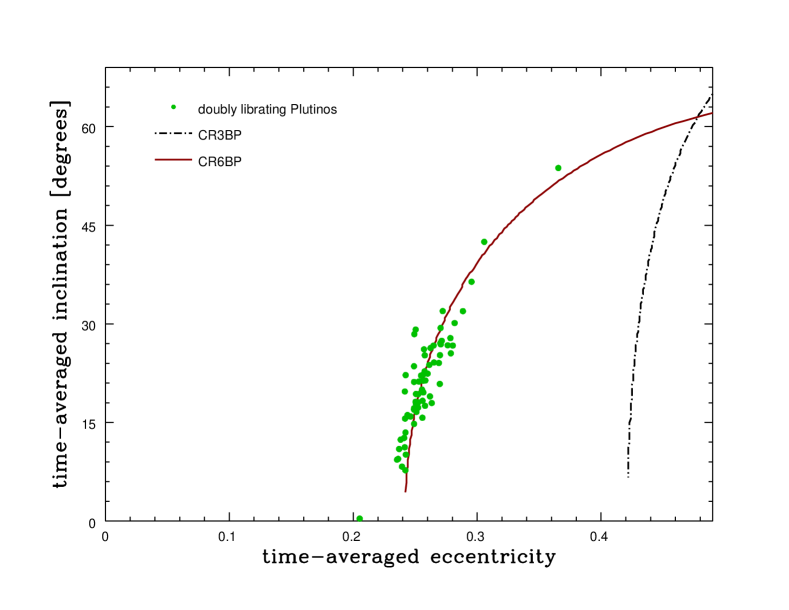
Named for orbital kinship with Pluto, the Plutinos are a prominent group of Kuiper Belt objects whose orbital periods are in libration about the 3/2 ratio with Neptune's. We investigate the long term orbital dynamics of known Plutinos, with attention to the additional libration (or lack thereof) of their argument of perihelion, $g$, a well-known characteristic of Pluto's orbit. We show that the $g$ librators amongst the Plutinos cluster around an arc in the eccentricity--inclination parameter plane. This previously unreported dynamical structure is owed to a family of periodic orbits of the third kind in the restricted problem of three bodies, identified by Poincaré at the end of the 19th century. Approximately sixteen percent of the currently known Plutinos exhibit $g$ librations, a far greater fraction than the ratios of the associated libration frequencies. These results may offer new constraints for theoretical models of the dynamical history of the Plutinos and of the orbital migration history of the giant planets.
Motivation & Objective
- Assess the long-term dynamics of known Plutinos with emphasis on g libration.
- Identify which Plutinos exhibit persistent g libration and characterize their distribution.
- Relate the g libration clustering to families of periodic orbits of the third kind in classical three-body problems.
- Provide an updated estimate of the fraction of g librators among Plutinos and discuss implications for Neptune–planet migration models.
Proposed method
- Compile Plutino list from Volk & Van Laerhoven (2024) and fetch orbital data from JPL Horizons.
- Propagate orbits for 100 Myr with SWIFT_RMVS3 treating Plutinos as test particles.
- Identify long-term stable Plutinos via the criterion max(sigma)-min(sigma) < 358 degrees over 100 Myr.
- Search for g libration centers (0, 90, 180, 270 degrees) with range of g less than 179 degrees.
- Compute time-averaged eccentricity and inclination; analyze clustering in the time-averaged e–i plane.
- Compute orbit-averaged disturbing function minima for Plutinos and compare with periodic orbits of the third kind in CR6BP and CR3BP to interpret the observed structure.

Experimental results
Research questions
- RQ1What fraction of Plutinos exhibit persistent g libration (g librators) within Neptune’s exterior 3:2 resonance?
- RQ2How are the g librators distributed in the time-averaged eccentricity–inclination plane, and what dynamical structure explains this distribution?
- RQ3How do the observed g-libration loci relate to families of periodic orbits of the third kind in reduced three-body problems?
- RQ4What is the impact of inner giant planets on the g-libration locus when comparing CR3BP and CR6BP models?
Key findings
- Out of 441 long-term stable Plutinos, 69 show g libration, about 16%.
- g librators cluster along an approximately hyperbolic arc in the time-averaged eccentricity–inclination plane.
- The local minima of the orbit-averaged disturbing function align with g = ±90° minima, consistent with a family of periodic orbits of the third kind; inner giants shift this locus to lower eccentricities compared to the pure CR3BP case.
- The clustering is not observed for g libration centers at 0° or 180°; g librators are roughly evenly split between centers at 90° and 270°.
- An exceptional object (2015 VR164) lies off the main cluster with very low e and i, likely due to a kinematic effect rather than resonance dynamics.
- The observed g-librator fraction exceeds simple phase-space volume estimates, suggesting an over-density likely due to dynamical stability and capture history during planetary migration.
Read this paper
Open the full text in the Nubint reader and ask about any passage as you read.
Read this paper on NubintThis review was generated by AI from the original paper. Please check the paper before citing it.