
[Paper Review] Fed3DGS: Scalable 3D Gaussian Splatting with Federated Learning
Fed3DGS proposes a federated learning framework for scalable 3D Gaussian Splatting (3DGS) reconstruction, enabling decentralized, large-scale scene modeling across millions of clients. It introduces a distillation-based model update scheme and appearance modeling to handle non-IID data and seasonal appearance variations, achieving image quality comparable to centralized baselines while reducing model size and training time.
In this work, we present Fed3DGS, a scalable 3D reconstruction framework based on 3D Gaussian splatting (3DGS) with federated learning. Existing city-scale reconstruction methods typically adopt a centralized approach, which gathers all data in a central server and reconstructs scenes. The approach hampers scalability because it places a heavy load on the server and demands extensive data storage when reconstructing scenes on a scale beyond city-scale. In pursuit of a more scalable 3D reconstruction, we propose a federated learning framework with 3DGS, which is a decentralized framework and can potentially use distributed computational resources across millions of clients. We tailor a distillation-based model update scheme for 3DGS and introduce appearance modeling for handling non-IID data in the scenario of 3D reconstruction with federated learning. We simulate our method on several large-scale benchmarks, and our method demonstrates rendered image quality comparable to centralized approaches. In addition, we also simulate our method with data collected in different seasons, demonstrating that our framework can reflect changes in the scenes and our appearance modeling captures changes due to seasonal variations.
Motivation & Objective
- To address the scalability and storage limitations of centralized 3D reconstruction for city-scale scenes.
- To enable continuous, maintainable 3D reconstruction by supporting iterative model updates in a decentralized manner.
- To handle non-Ideal Data (non-IID) arising from varying client capture conditions, such as lighting and seasonal changes.
- To maintain high image quality while reducing global model size and client training time compared to existing federated NeRF methods.
- To demonstrate the framework's ability to model dynamic scene changes, such as seasonal appearance variations.
Proposed method
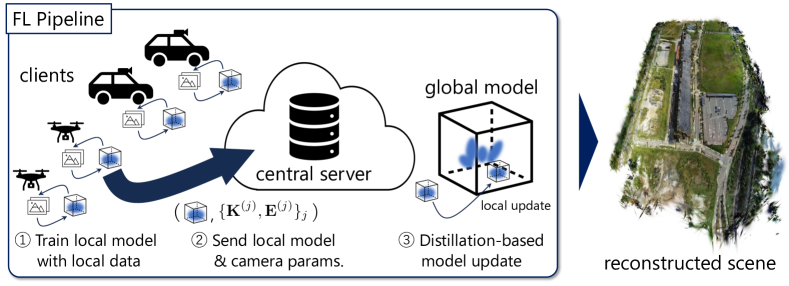
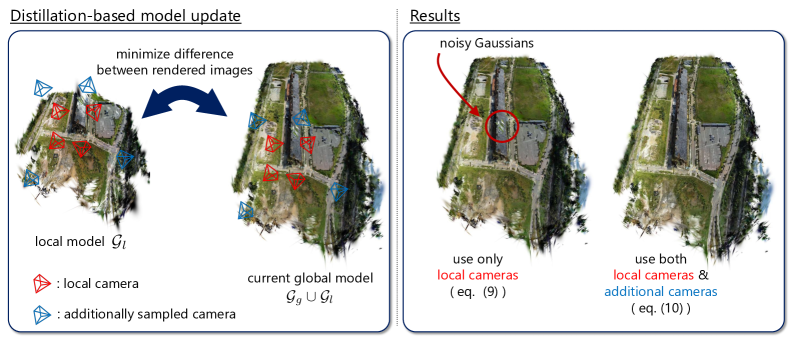
- A distillation-based model update protocol is designed specifically for 3DGS, enabling efficient global model aggregation without full model transmission.
- An appearance modeling component is introduced into 3DGS, allowing the model to adapt to varying camera exposures and lighting conditions across clients.
- The appearance model is jointly trained in a federated manner, enabling clients to update the global appearance representation without sharing raw data.
- Clients perform local 3D reconstruction from their own data and send distilled model updates to the central server for global aggregation.
- The framework supports iterative, continuous learning, allowing the global model to adapt to scene changes over time.
- The method is evaluated on large-scale benchmarks including Mill 19, UrbanScene3D, Quad 6k, and 4Seasons for seasonal adaptation.
Experimental results
Research questions
- RQ1Can a federated learning framework effectively scale 3D Gaussian Splatting for city-scale and beyond reconstruction without centralized data collection?
- RQ2How can model updates be efficiently aggregated in 3DGS under a federated setting, given the high-dimensional and non-uniform nature of 3D Gaussians?
- RQ3Can appearance modeling in 3DGS handle non-IID data caused by varying lighting, exposure, and seasonal changes across clients?
- RQ4Does the proposed framework maintain image quality comparable to centralized 3DGS baselines while reducing model size and training time?
- RQ5Can the framework reflect and adapt to dynamic scene changes, such as seasonal vegetation changes, through continuous learning?
Key findings
- Fed3DGS achieves rendered image quality comparable to centralized baselines, with SSIM and LPIPS scores on par with Mega-NeRF and Switch-NeRF on Mill 19 and UrbanScene3D.
- The method reduces global model size and training time per client compared to the federated NeRF baseline (FedNeRF), improving scalability.
- Appearance modeling improves PSNR by 7.4% on the building scene and 6.2% on the rubble scene, with corresponding gains in SSIM and reductions in LPIPS.
- In the 4Seasons benchmark, the model updated with summer data and then winter data (G_g^{S→W}) achieves higher PSNR in winter (14.78) than the model trained only on winter data (11.03), demonstrating dynamic adaptation.
- The model updated with winter data and then summer data (G_g^{W→S}) achieves higher PSNR in summer (17.28) than the model trained only on summer data (18.26), indicating effective appearance modeling despite structural changes.
- The framework successfully captures seasonal appearance changes, with the appearance model effectively adjusting for lighting and exposure variations across seasons.
Read this paper
Open the full text in the Nubint reader and ask about any passage as you read.
Read this paper on NubintThis review was generated by AI from the original paper. Please check the paper before citing it.