
[Paper Review] FedCG: Leverage Conditional GAN for Protecting Privacy and Maintaining Competitive Performance in Federated Learning
FedCG proposes a novel federated learning framework that uses conditional GANs to protect client data privacy by keeping local feature extractors private while sharing generators for knowledge aggregation. It achieves competitive model performance and strong resistance to gradient inversion attacks like DLG, outperforming FedSplit in accuracy by at least 2% while maintaining low privacy leakage (PSNR < 9 dB).
Federated learning (FL) aims to protect data privacy by enabling clients to build machine learning models collaboratively without sharing their private data. Recent works demonstrate that information exchanged during FL is subject to gradient-based privacy attacks, and consequently, a variety of privacy-preserving methods have been adopted to thwart such attacks. However, these defensive methods either introduce orders of magnitude more computational and communication overheads (e.g., with homomorphic encryption) or incur substantial model performance losses in terms of prediction accuracy (e.g., with differential privacy). In this work, we propose $ extsc{FedCG}$, a novel federated learning method that leverages conditional generative adversarial networks to achieve high-level privacy protection while still maintaining competitive model performance. $ extsc{FedCG}$ decomposes each client's local network into a private extractor and a public classifier and keeps the extractor local to protect privacy. Instead of exposing extractors, $ extsc{FedCG}$ shares clients' generators with the server for aggregating clients' shared knowledge, aiming to enhance the performance of each client's local networks. Extensive experiments demonstrate that $ extsc{FedCG}$ can achieve competitive model performance compared with FL baselines, and privacy analysis shows that $ extsc{FedCG}$ has a high-level privacy-preserving capability. Code is available at https://github.com/yankang18/FedCG
Motivation & Objective
- Address the vulnerability of federated learning to gradient-based privacy attacks such as Deep Leakage from Gradients (DLG), where shared gradients can reconstruct original training data.
- Overcome the limitations of existing privacy-preserving methods: homomorphic encryption (too costly) and differential privacy (causes significant accuracy loss).
- Maintain high model performance in non-IID and IID data settings while ensuring that clients' private data and local models remain protected from the server.
- Introduce a new FL paradigm that decouples private feature extraction from public classification, enabling secure knowledge sharing via shared generators instead of full models.
Proposed method
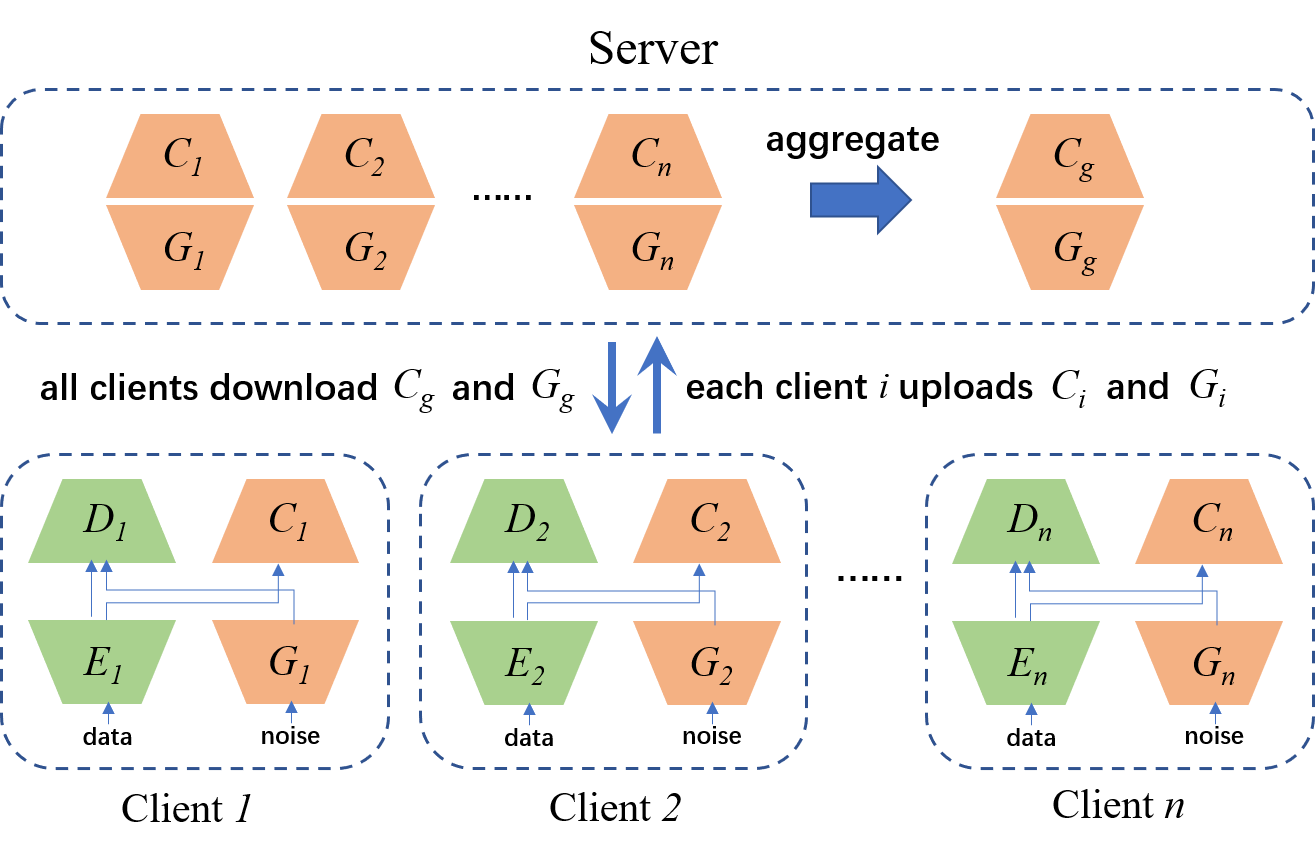
- Decompose each client’s local neural network into a private feature extractor (kept local) and a public classifier (shared with the server).
- Train a conditional GAN (cGAN) at each client, where the generator learns to map random noise to client-specific data distributions, and the discriminator ensures realistic sample generation.
- Share only the trained generators and public classifiers with the server, avoiding exposure of any model that directly processes raw data.
- Aggregate clients’ generators and classifiers on the server using knowledge distillation to form a global model that enhances local performance.
- Use the global generator to guide local training via distillation, improving local model accuracy without exposing private data or gradients.
- Apply a privacy evaluation protocol using DLG attacks to measure reconstruction quality (via PSNR) between original and recovered images, validating privacy protection strength.
Experimental results
Research questions
- RQ1Can a federated learning system achieve strong privacy protection against gradient inversion attacks like DLG without sacrificing model performance?
- RQ2Does sharing conditional GAN generators instead of full models or gradients reduce the risk of data reconstruction while maintaining competitive accuracy?
- RQ3How does FedCG compare to FedSplit and DP-augmented FedAvg in terms of both model accuracy and privacy leakage under DLG attacks?
- RQ4Can knowledge distillation from shared generators improve local model performance, especially in non-IID data settings where standard FL methods struggle?
- RQ5What is the trade-off between privacy and performance when using cGAN-based obfuscation compared to traditional defenses like differential privacy or homomorphic encryption?
Key findings
- FedCG achieves competitive model performance, outperforming FedSplit by at least 2% in accuracy across all three datasets (CIFAR10, FMNIST, Office), with gains of up to 4.35% over FedProx on Office.
- On the FMNIST dataset, FedCG achieves the highest accuracy among all baselines in IID settings, demonstrating strong generalization capability.
- In non-IID scenarios, FedCG outperforms local training on 12 out of 13 clients across three datasets, indicating effective handling of data heterogeneity.
- Privacy evaluation shows FedCG achieves a PSNR of 8.99 dB (CIFAR10), 7.85 dB (DIGIT5), and 7.57 dB (Office) under DLG attacks—significantly lower than FedAvg (24.14–26.82 dB), indicating minimal data reconstruction capability.
- FedCG maintains high privacy (low PSNR) while achieving better accuracy than FedSplit, which has similar privacy levels but lower performance.
- Adding differential privacy to FedAvg reduces accuracy by over 20% (e.g., from 47.23% to 35.4% on CIFAR10), whereas FedCG avoids such performance degradation while offering stronger privacy guarantees.

Read this paper
Open the full text in the Nubint reader and ask about any passage as you read.
Read this paper on NubintThis review was generated by AI from the original paper. Please check the paper before citing it.