
[Paper Review] Federated Learning for Smart Healthcare: A Survey
This survey presents a comprehensive analysis of Federated Learning (FL) in smart healthcare, proposing a decentralized AI framework that trains models across hospitals and IoT devices without sharing raw patient data. By leveraging privacy-preserving techniques like differential privacy and secure aggregation, FL enables scalable, accurate, and secure medical AI applications in electronic health records, remote monitoring, medical imaging, and pandemic response.
Recent advances in communication technologies and Internet-of-Medical-Things have transformed smart healthcare enabled by artificial intelligence (AI). Traditionally, AI techniques require centralized data collection and processing that may be infeasible in realistic healthcare scenarios due to the high scalability of modern healthcare networks and growing data privacy concerns. Federated Learning (FL), as an emerging distributed collaborative AI paradigm, is particularly attractive for smart healthcare, by coordinating multiple clients (e.g., hospitals) to perform AI training without sharing raw data. Accordingly, we provide a comprehensive survey on the use of FL in smart healthcare. First, we present the recent advances in FL, the motivations, and the requirements of using FL in smart healthcare. The recent FL designs for smart healthcare are then discussed, ranging from resource-aware FL, secure and privacy-aware FL to incentive FL and personalized FL. Subsequently, we provide a state-of-the-art review on the emerging applications of FL in key healthcare domains, including health data management, remote health monitoring, medical imaging, and COVID-19 detection. Several recent FL-based smart healthcare projects are analyzed, and the key lessons learned from the survey are also highlighted. Finally, we discuss interesting research challenges and possible directions for future FL research in smart healthcare.
Motivation & Objective
- Address the limitations of centralized AI in healthcare due to data privacy concerns and high communication latency.
- Overcome scalability and privacy issues in large-scale, distributed healthcare networks using a decentralized learning paradigm.
- Survey recent FL advancements tailored for smart healthcare, including resource-aware, secure, incentive-driven, and personalized FL.
- Examine real-world FL applications in electronic health records, remote monitoring, medical imaging, and COVID-19 detection.
- Identify key challenges such as non-iid data, security threats, and system heterogeneity, and propose future research directions.
Proposed method
- Survey and categorize recent FL techniques across four dimensions: resource management, security and privacy, incentive mechanisms, and personalization.
- Integrate differential privacy and secure aggregation to protect model updates and prevent data leakage during FL training.
- Analyze real-world FL-based healthcare projects to evaluate system performance, privacy guarantees, and deployment feasibility.
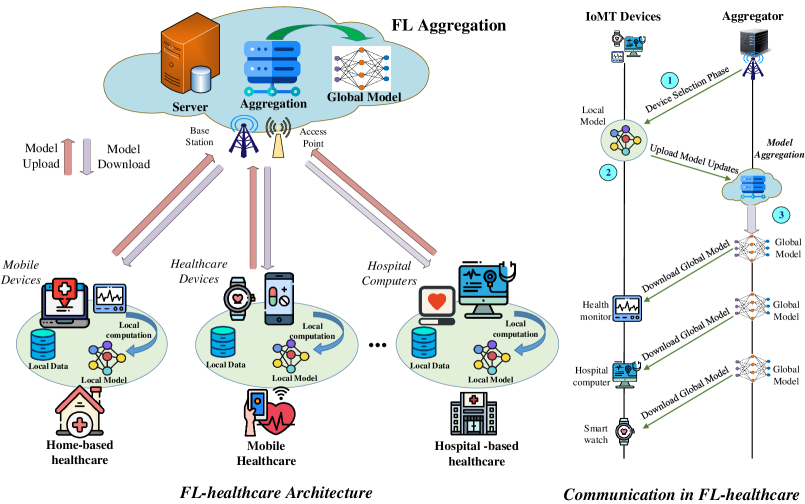
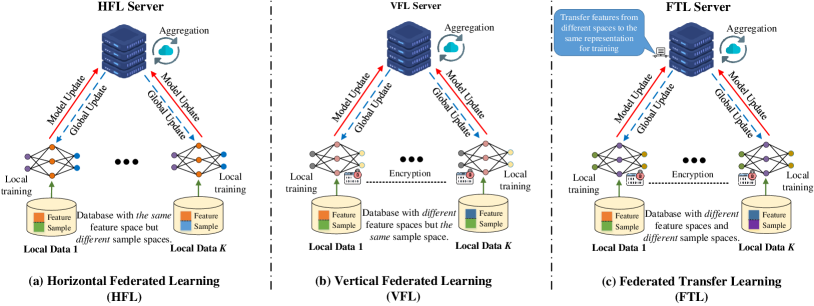
- Propose architectural frameworks that support federated training across heterogeneous clients (e.g., hospitals, wearables) with minimal data transfer.
- Use metrics like model accuracy, convergence speed, and privacy leakage risk to evaluate FL performance in medical settings.
- Address non-iid data challenges via feature normalization and data partitioning strategies to stabilize FL convergence in healthcare.
Experimental results
Research questions
- RQ1How can Federated Learning enable privacy-preserving, scalable AI in smart healthcare without centralizing sensitive medical data?
- RQ2What are the key technical challenges in deploying FL across heterogeneous healthcare clients, including non-iid data and resource constraints?
- RQ3How do security threats such as model poisoning and data leakage affect FL-based healthcare systems, and what defenses exist?
- RQ4What role do incentive mechanisms and personalization play in encouraging participation and improving model performance in real-world healthcare FL systems?
- RQ5What are the most promising applications of FL in specific healthcare domains such as medical imaging, EHR management, and pandemic detection?
Key findings
- Federated Learning significantly enhances privacy in smart healthcare by eliminating the need to transmit raw patient data to central servers.
- Secure aggregation and differential privacy techniques effectively reduce the risk of model inversion and data leakage in FL-based systems.
- Non-iid data distributions across hospitals and clinics remain a major challenge, causing model divergence and reduced accuracy if not addressed.
- Resource-aware FL designs improve system scalability and reduce communication overhead in large-scale IoMT networks.
- Personalized FL models achieve better performance on client-specific data by adapting global models to local data distributions.
- Real-world FL projects in medical imaging and remote monitoring demonstrate improved model accuracy and reduced latency compared to centralized approaches.
Read this paper
Open the full text in the Nubint reader and ask about any passage as you read.
Read this paper on NubintThis review was generated by AI from the original paper. Please check the paper before citing it.