
[Paper Review] FedLoGe: Joint Local and Generic Federated Learning under Long-tailed Data
FedLoGe proposes a unified federated learning framework that jointly optimizes global and personalized models under long-tailed data distributions by leveraging representation learning via a Sparse Equiangular Tight Frame Classifier (SSE-C) and adaptive feature realignment through Global and Local Adaptive Feature Realignment (GLA-FR). The method achieves state-of-the-art performance on CIFAR-10/100-LT, ImageNet, and iNaturalist by enhancing both global model accuracy and client-specific personalized performance through neural collapse-inspired design.
Federated Long-Tailed Learning (Fed-LT), a paradigm wherein data collected from decentralized local clients manifests a globally prevalent long-tailed distribution, has garnered considerable attention in recent times. In the context of Fed-LT, existing works have predominantly centered on addressing the data imbalance issue to enhance the efficacy of the generic global model while neglecting the performance at the local level. In contrast, conventional Personalized Federated Learning (pFL) techniques are primarily devised to optimize personalized local models under the presumption of a balanced global data distribution. This paper introduces an approach termed Federated Local and Generic Model Training in Fed-LT (FedLoGe), which enhances both local and generic model performance through the integration of representation learning and classifier alignment within a neural collapse framework. Our investigation reveals the feasibility of employing a shared backbone as a foundational framework for capturing overarching global trends, while concurrently employing individualized classifiers to encapsulate distinct refinements stemming from each client's local features. Building upon this discovery, we establish the Static Sparse Equiangular Tight Frame Classifier (SSE-C), inspired by neural collapse principles that naturally prune extraneous noisy features and foster the acquisition of potent data representations. Furthermore, leveraging insights from imbalance neural collapse's classifier norm patterns, we develop Global and Local Adaptive Feature Realignment (GLA-FR) via an auxiliary global classifier and personalized Euclidean norm transfer to align global features with client preferences. Extensive experimental results on CIFAR-10/100-LT, ImageNet, and iNaturalist demonstrate the advantage of our method over state-of-the-art pFL and Fed-LT approaches.
Motivation & Objective
- To address the gap in federated learning under long-tailed data where existing methods optimize only the global model or assume balanced data, neglecting personalized client performance.
- To jointly enhance both global model and personalized model performance in federated learning with long-tailed and heterogeneous client data.
- To design a representation learning mechanism that prunes noisy features and strengthens dominant features using a sparse, equiangular tight frame classifier.
- To enable fast, adaptive alignment of global and local features using norm-based realignment, preserving client-specific preferences.
- To validate the framework across diverse benchmarks including CIFAR-100-LT, ImageNet, and iNaturalist under realistic long-tailed settings.
Proposed method
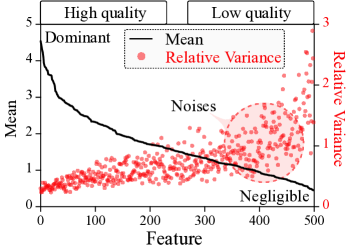
- Introduces the Static Sparse Equiangular Tight Frame Classifier (SSE-C), a sparse, structured classifier that enforces equiangularity and sparsity to suppress noisy features and enhance representation learning.
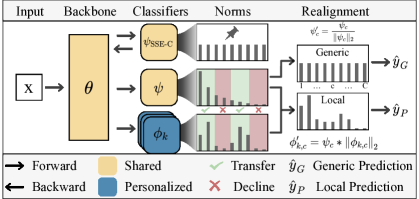
- Employs a shared backbone for global representation learning, while allowing client-specific classifiers to adapt to local data distributions.
- Applies neural collapse principles to enforce convergence of class means and feature prototypes, improving generalization and stability.
- Designs Global and Local Adaptive Feature Realignment (GLA-FR) using an auxiliary global classifier and personalized Euclidean norm transfer to align features with client preferences.
- Uses a norm-equal loss with a learnable scaling factor γ to control classifier vector norms, stabilizing training and improving convergence.
- Applies sparse pruning to classifier weights based on feature magnitude, selectively removing low-impact, high-variance features to improve robustness.
Experimental results
Research questions
- RQ1Can a shared backbone with a sparse, structured classifier improve representation learning in federated learning under long-tailed data?
- RQ2How can global and personalized model performance be jointly optimized in federated learning when data is both long-tailed and heterogeneous?
- RQ3To what extent does classifier sparsity and equiangularity reduce noise and improve feature quality in imbalanced federated settings?
- RQ4Can adaptive feature realignment via norm transfer effectively align global features with client-specific preferences without compromising global performance?
- RQ5Does the integration of SSE-C and GLA-FR lead to consistent performance gains across diverse long-tailed benchmarks?
Key findings
- FedLoGe achieves state-of-the-art performance on CIFAR-100-LT, outperforming all baselines in both global model and personalized model accuracy across all class groups.
- On ImageNet-LT and iNaturalist-160k, FedLoGe achieves significant accuracy gains, especially in middle and tail classes, demonstrating robustness to long-tailed distributions.
- The ablation study confirms that SSE-C improves both global and personalized model performance compared to dense ETF, with optimal performance when combined with GLA-FR.
- Pruning negligible features (low mean magnitude) in SSE-C has minimal impact on performance, while pruning dominant features causes sharp performance drops, confirming effective feature prioritization.
- Sensitivity analysis shows that a γ value of 1.0 is optimal for CIFAR-10/100-LT and 1.6 for ImageNet and iNaturalist, with performance peaking at around 60% sparsity in SSE-C.
- The model maintains strong performance even at high sparsity (up to 90%), indicating that sparsity enhances robustness rather than degrades it.
Read this paper
Open the full text in the Nubint reader and ask about any passage as you read.
Read this paper on NubintThis review was generated by AI from the original paper. Please check the paper before citing it.