
[Paper Review] FedMKT: Federated Mutual Knowledge Transfer for Large and Small Language Models
FedMKT proposes a federated, mutual knowledge transfer framework between a server-side LLM and multiple client-side SLMs, with token alignment and selective distillation to jointly improve both server and client models.
Recent research in federated large language models (LLMs) has primarily focused on enabling clients to fine-tune their locally deployed homogeneous LLMs collaboratively or on transferring knowledge from server-based LLMs to small language models (SLMs) at downstream clients. However, a significant gap remains in the simultaneous mutual enhancement of both the server's LLM and clients' SLMs. To bridge this gap, we propose FedMKT, a parameter-efficient federated mutual knowledge transfer framework for large and small language models. This framework is designed to adaptively transfer knowledge from the server's LLM to clients' SLMs while concurrently enriching the LLM with clients' unique domain insights. We facilitate token alignment using minimum edit distance (MinED) and then selective mutual knowledge transfer between client-side SLMs and a server-side LLM, aiming to collectively enhance their performance. Through extensive experiments across three distinct scenarios, we evaluate the effectiveness of FedMKT using various public LLMs and SLMs on a range of NLP text generation tasks. Empirical results demonstrate that FedMKT simultaneously boosts the performance of both LLMs and SLMs.
Motivation & Objective
- Bridge the gap between server-side LLMs and client-side SLMs by enabling mutual knowledge transfer.
- Develop a parameter-efficient method using LoRA adapters to reduce communication and computation costs.
- Address model heterogeneity with token alignment and selective knowledge transfer to ensure performance gains for both sides.
- Evaluate FedMKT across heterogeneous, homogeneous, and one-to-one settings using public LLMs/SLMs on multiple NLP tasks.
Proposed method
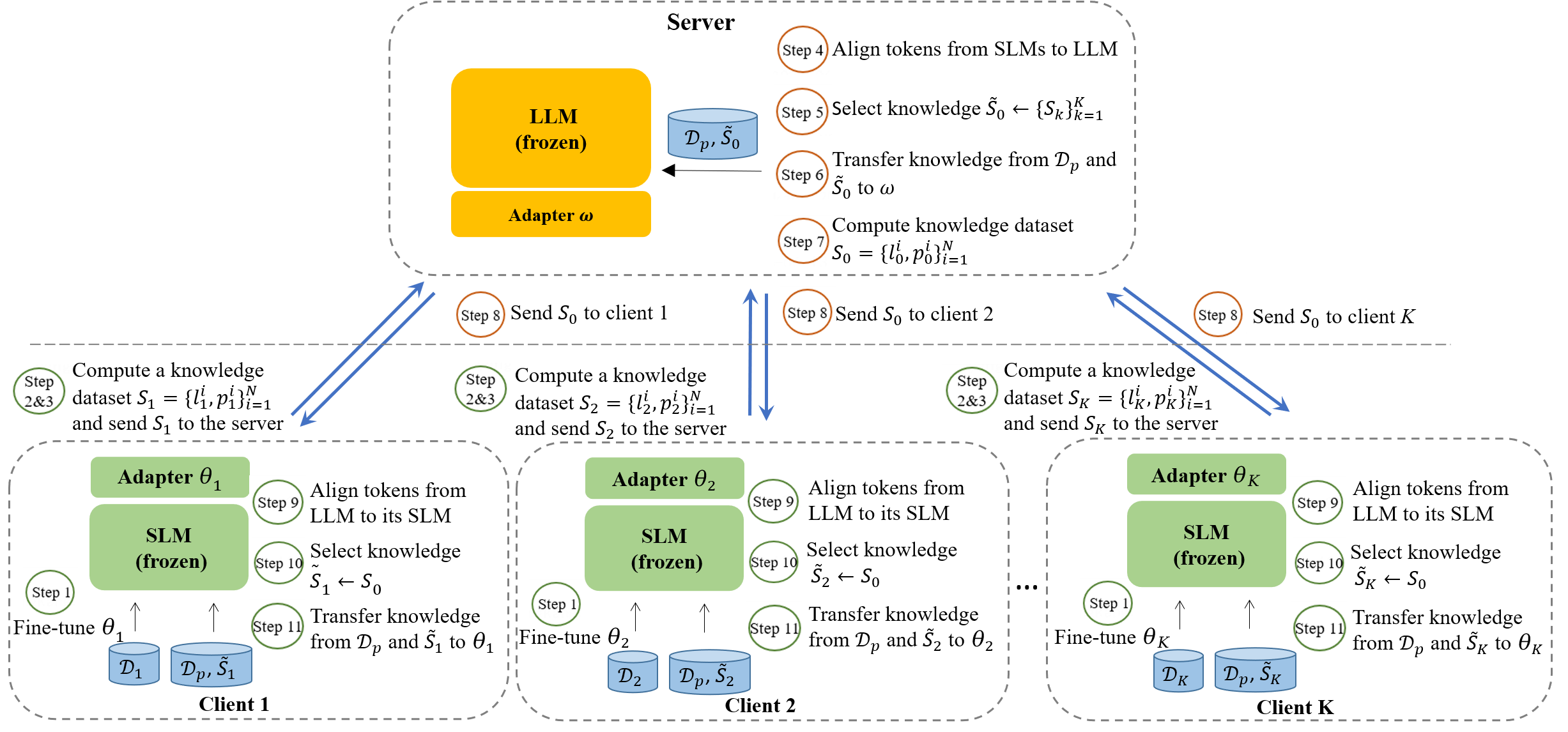
- Two-key modules: Bidirectional Token Alignment and Selective Mutual Knowledge Transfer.
- Use minimum edit distance (MinED) based token mapping to align logits between LLM and SLM vocabularies.
- Employ LoRA adapters for both server (omega) and clients (theta) to enable parameter-efficient updates.
- Centralized public dataset based double-distillation objective (DualMinCE) to select positive knowledge for mutual transfer.
- Alternate training: clients fine-tune locally on private data, then exchange logits on public data; server distills from client logits and redistributes to clients.
- Objective terms L2 and L3 combine fine-tuning losses and distillation losses with a balancing parameter lambda.
Experimental results
Research questions
- RQ1How can we enable effective mutual knowledge transfer between a server LLM and heterogeneous client SLMs in a federated setting?
- RQ2Can token alignment via MinED alleviate heterogeneity in tokenizers during logit-based knowledge transfer?
- RQ3Does selective mutual knowledge transfer improve both server LLM and client SLM performance compared to baselines across heterogeneous, homogeneous, and one-to-one settings?
Key findings
- FedMKT consistently outperforms zero-shot and standalone baselines for clients’ SLMs across eight tasks in the heterogeneous setting.
- The server LLM with FedMKT approaches centralized fine-tuning performance on several tasks, achieving around 96% of centralized performance on RTE in one scenario.
- In homogeneous settings, FedMKT yields superior server LLM gains over zero-shot and competitive results versus centralized, while also boosting SLMs.
- One-to-one settings show FedMKT surpassing zero-shot and rivaling centralized performance for server LLMs and improving SLM performance via guidance from the LLM.
- Experiments cover multiple model pairs (server LLM plus diverse client SLMs) and three settings, demonstrating the framework’s generality.
Read this paper
Open the full text in the Nubint reader and ask about any passage as you read.
Read this paper on NubintThis review was generated by AI from the original paper. Please check the paper before citing it.