
[Paper Review] FedSpeed: Larger Local Interval, Less Communication Round, and Higher Generalization Accuracy
FedSpeed introduces a prox-corrected prox-term and gradient perturbation to reduce local biases and over-fitting in federated learning, enabling larger local intervals and faster convergence with improved generalization. Empirical results show state-of-the-art performance on CIFAR-10/100 and TinyImagenet under IID and non-IID settings, with low participation scenarios.
Federated learning is an emerging distributed machine learning framework which jointly trains a global model via a large number of local devices with data privacy protections. Its performance suffers from the non-vanishing biases introduced by the local inconsistent optimal and the rugged client-drifts by the local over-fitting. In this paper, we propose a novel and practical method, FedSpeed, to alleviate the negative impacts posed by these problems. Concretely, FedSpeed applies the prox-correction term on the current local updates to efficiently reduce the biases introduced by the prox-term, a necessary regularizer to maintain the strong local consistency. Furthermore, FedSpeed merges the vanilla stochastic gradient with a perturbation computed from an extra gradient ascent step in the neighborhood, thereby alleviating the issue of local over-fitting. Our theoretical analysis indicates that the convergence rate is related to both the communication rounds $T$ and local intervals $K$ with a upper bound $\small \mathcal{O}(1/T)$ if setting a proper local interval. Moreover, we conduct extensive experiments on the real-world dataset to demonstrate the efficiency of our proposed FedSpeed, which performs significantly faster and achieves the state-of-the-art (SOTA) performance on the general FL experimental settings than several baselines. Our code is available at \url{https://github.com/woodenchild95/FL-Simulator.git}.
Motivation & Objective
- Address local inconsistency and client-drifts caused by heterogeneous data in federated learning.
- Propose FedSpeed with prox-correction and gradient perturbation to reduce local biases and over-fitting.
- Establish convergence guarantees showing O(1/T) rate under non-convex smooth settings with large local intervals.
- Demonstrate empirical SOTA performance on CIFAR-10/100 and TinyImagenet across IID and non-IID distributions.
Proposed method
- Apply a prox-correction term to counteract biases from the prox-term during local updates.
- Merge vanilla stochastic gradient with a perturbation from an extra gradient ascent step to mitigate local over-fitting.
- Use a three-stage local update: compute gradient, perform an ascent step, compute a second gradient, merge into a quasi-gradient for descent.
- Update a prox-driven correction variable hat{g}^t to capture local offset momentum and reduce bias across rounds.
- Perform a global aggregation by averaging amended local models after K local steps per round.
- Provide convergence analysis showing an O(1/T) rate under appropriate choices of local interval K, perturbation, and learning rates.
Experimental results
Research questions
- RQ1How do prox-correction and gradient perturbation affect local inconsistency and client-drifts in FL?
- RQ2Can FedSpeed achieve faster convergence and better generalization with larger local intervals compared to existing baselines?
- RQ3What are the theoretical convergence guarantees of FedSpeed under non-convex smooth objectives with heterogeneous data?
- RQ4How does FedSpeed perform empirically on standard datasets under IID and non-IID settings and varying participation?
Key findings
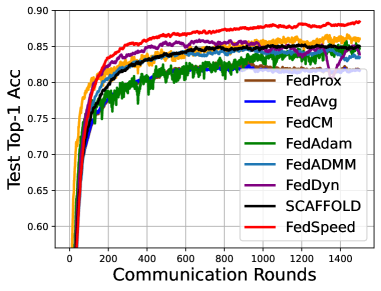
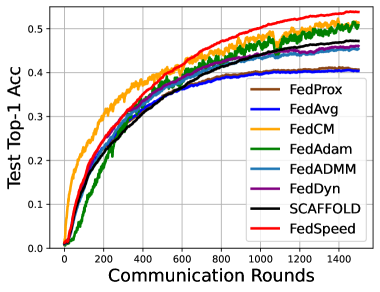
- FedSpeed achieves faster convergence and improved generalization compared to FedAvg, FedProx, FedCM, FedPD, SCAFFOLD, FedDyn, and FedADMM in experiments.
- With larger local intervals, FedSpeed maintains stability and improves test accuracy across CIFAR-10/100 and TinyImagenet.
- On 2% participation with 500 clients, FedSpeed attains the highest test accuracy across IID and Dirichlet(0.6) non-IID settings in CIFAR-10/100 and TinyImagenet (relative gains up to ~3% points over strong baselines).
- Theoretical results show a fast O(1/T) convergence rate when the local interval K is properly large and learning rates are tuned.
Read this paper
Open the full text in the Nubint reader and ask about any passage as you read.
Read this paper on NubintThis review was generated by AI from the original paper. Please check the paper before citing it.