
[Paper Review] Ferrari: Federated Feature Unlearning via Optimizing Feature Sensitivity
Ferrari is a novel federated feature unlearning framework that minimizes feature sensitivity via Lipschitz continuity to enable efficient, client-only unlearning of sensitive, backdoor, and biased features without retraining. It achieves high effectiveness with minimal utility loss and sub-epoch runtime, outperforming existing methods in accuracy, fairness, and efficiency across diverse unlearning scenarios.
The advent of Federated Learning (FL) highlights the practical necessity for the right to be forgotten for all clients, allowing them to request data deletion from the machine learning models service provider. This necessity has spurred a growing demand for Federated Unlearning (FU). Feature unlearning has gained considerable attention due to its applications in unlearning sensitive, backdoor, and biased features. Existing methods employ the influence function to achieve feature unlearning, which is impractical for FL as it necessitates the participation of other clients, if not all, in the unlearning process. Furthermore, current research lacks an evaluation of the effectiveness of feature unlearning. To address these limitations, we define feature sensitivity in evaluating feature unlearning according to Lipschitz continuity. This metric characterizes the model outputs rate of change or sensitivity to perturbations in the input feature. We then propose an effective federated feature unlearning framework called Ferrari, which minimizes feature sensitivity. Extensive experimental results and theoretical analysis demonstrate the effectiveness of Ferrari across various feature unlearning scenarios, including sensitive, backdoor, and biased features. The code is publicly available at https://github.com/OngWinKent/Federated-Feature-Unlearning
Motivation & Objective
- To address the lack of practical and privacy-preserving feature unlearning methods in federated learning that do not require participation from other clients.
- To define a new evaluation metric—feature sensitivity—based on Lipschitz continuity to assess unlearning effectiveness.
- To develop a scalable, efficient, and effective federated feature unlearning framework that supports unlearning of sensitive, backdoor, and biased features.
- To theoretically and empirically demonstrate that minimizing feature sensitivity leads to better model utility than exact unlearning.
- To meet regulatory 'right to be forgotten' requirements while preserving model accuracy and fairness.
Proposed method
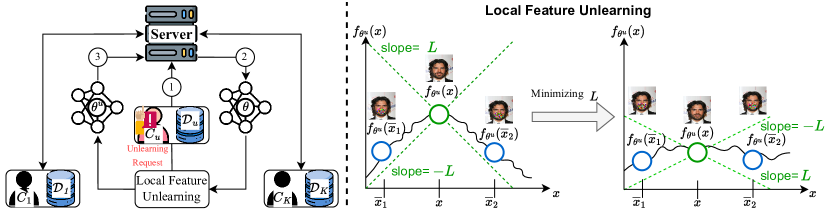
- Proposes a new evaluation metric—feature sensitivity—defined via Lipschitz continuity, measuring the rate of change in model output per input feature perturbation.
- Introduces Ferrari, a federated unlearning framework that minimizes feature sensitivity using only the local dataset of the unlearning client, avoiding global data access.
- Employs a loss function that bounds the Lipschitz constant of the model with respect to specific features, ensuring robustness to input perturbations.
- Applies a single-epoch optimization process on the unlearning client’s data to reduce sensitivity, enabling fast and efficient unlearning.
- Uses gradient-based optimization to fine-tune the global model such that the influence of targeted features is systematically reduced.
- Theoretical analysis proves that Ferrari achieves better model utility than exact unlearning due to bounded sensitivity and stable optimization.
Experimental results
Research questions
- RQ1Can feature sensitivity, defined via Lipschitz continuity, serve as a reliable and practical metric for evaluating federated feature unlearning?
- RQ2Can a federated unlearning method unlearn specific features without requiring participation from other clients?
- RQ3Does minimizing feature sensitivity lead to better model utility and fairness compared to exact unlearning?
- RQ4How effective is Ferrari in unlearning sensitive, backdoor, and biased features across diverse data domains?
- RQ5What is the impact of hyperparameters such as noise level and data completeness on Ferrari’s unlearning performance?
Key findings
- Ferrari achieves comparable or better accuracy on unbiased and biased datasets (Acc_r ≈ Acc_u), indicating successful unlearning of biased features, unlike Fine-tune and FedRecovery, which show significant performance gaps.
- In backdoor unlearning, Ferrari maintains high accuracy on clean data (Acc_r) while suppressing the trigger effect (low Acc_u), with performance stable across noise levels σ ∈ [0.05, 1.0].
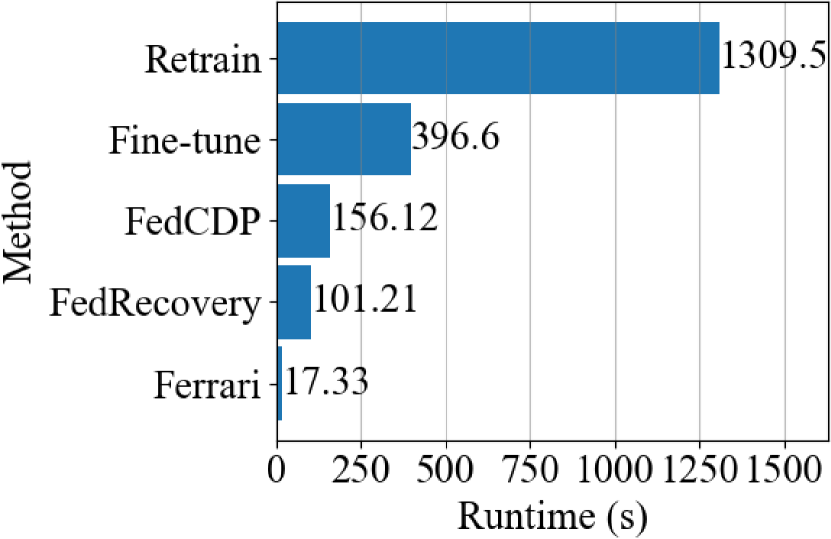
- Ferrari demonstrates superior time efficiency, completing unlearning in a single epoch with the shortest runtime, outperforming Retrain, Fine-tune, and methods requiring global data access.
- Ablation studies show that removing the Lipschitz constraint (non-Lipschitz method) causes catastrophic forgetting, with Acc_r dropping below 10%, proving the necessity of bounded sensitivity.
- Using only 70% of the unlearned client’s data still yields effective unlearning, demonstrating robustness to data loss and high practicality.
- Theoretical analysis confirms that Ferrari achieves better model utility than exact unlearning, as bounded sensitivity prevents overfitting and instability.
Read this paper
Open the full text in the Nubint reader and ask about any passage as you read.
Read this paper on NubintThis review was generated by AI from the original paper. Please check the paper before citing it.