
[Paper Review] Few-shot Classification via Ensemble Learning with Multi-Order Statistics
This paper proposes ELMOS, a novel few-shot classification method that uses ensemble learning with multi-order statistics to improve generalization on novel classes. By applying first-, second-, and third-order statistics pooling to features from a shared backbone, ELMOS creates diverse, parameter-free learners that are jointly trained, achieving state-of-the-art performance on miniImageNet, CIFAR-FS, and CUB with lower storage and computation costs than prior ensemble methods.
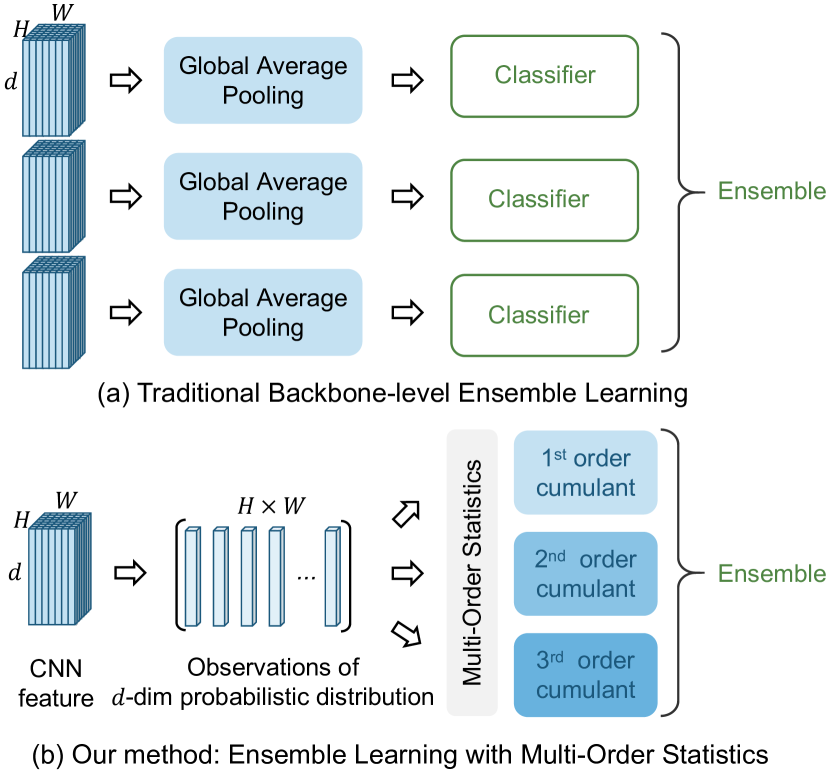
Transfer learning has been widely adopted for few-shot classification. Recent studies reveal that obtaining good generalization representation of images on novel classes is the key to improving the few-shot classification accuracy. To address this need, we prove theoretically that leveraging ensemble learning on the base classes can correspondingly reduce the true error in the novel classes. Following this principle, a novel method named Ensemble Learning with Multi-Order Statistics (ELMOS) is proposed in this paper. In this method, after the backbone network, we use multiple branches to create the individual learners in the ensemble learning, with the goal to reduce the storage cost. We then introduce different order statistics pooling in each branch to increase the diversity of the individual learners. The learners are optimized with supervised losses during the pre-training phase. After pre-training, features from different branches are concatenated for classifier evaluation. Extensive experiments demonstrate that each branch can complement the others and our method can produce a state-of-the-art performance on multiple few-shot classification benchmark datasets.
Motivation & Objective
- To theoretically justify how ensemble learning on base classes reduces generalization error on novel classes in few-shot learning.
- To address the high computational and storage cost of traditional ensemble methods in few-shot classification.
- To design a parameter-free ensemble mechanism that enhances diversity and performance using multi-order statistics of deep features.
- To validate the effectiveness of multi-order statistics in generating complementary learners for improved few-shot classification.
Proposed method
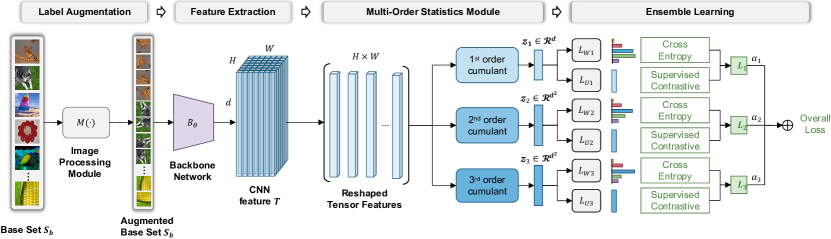
- The method employs a shared backbone network followed by multiple parallel branches, each applying a different order of statistical pooling (1st, 2nd, 3rd) to the feature maps.
- Each branch acts as an individual learner in an ensemble, with no additional parameters, enabling efficient joint training.
- The ensemble is trained using a combination of classification-based (CB) and similarity-based (SB) losses to improve feature discrimination and generalization.
- After pre-training, features from all branches are concatenated and fed into a classifier for evaluation on novel classes.
- The use of multi-order statistics ensures diversity among learners by capturing different aspects of feature distributions.
- The method is designed for transfer learning, leveraging the full base set without episodic sampling, thus avoiding information loss inherent in meta-learning.
Experimental results
Research questions
- RQ1Can ensemble learning on base classes theoretically reduce the true error on novel classes in few-shot classification?
- RQ2How do different orders of statistical pooling contribute to feature diversity and classification performance?
- RQ3Can a parameter-free ensemble with shared backbone outperform existing ensemble methods in few-shot learning with lower computational cost?
- RQ4What is the relative contribution of classification-based and similarity-based losses in the proposed framework?
Key findings
- ELMOS achieves 78.18% ± 0.41 accuracy on 1-shot 5-way miniImageNet, outperforming previous state-of-the-art methods.
- On 5-shot 5-way CIFAR-FS, ELMOS reaches 89.87% ± 0.31, surpassing the second-best method by 0.31%.
- On CUB, ELMOS achieves 95.02% ± 0.16 in 5-shot, exceeding the second-best model by 1.0%.
- Abllation studies confirm that combining 1st, 2nd, and 3rd-order statistics yields higher accuracy than any single order, proving their complementary nature.
- The combined CB and SB loss yields better performance than either loss alone, validating the importance of both supervision signals.
- ELMOS significantly outperforms the most related method EASY, with lower pre-training time and higher accuracy across all benchmarks.
Read this paper
Open the full text in the Nubint reader and ask about any passage as you read.
Read this paper on NubintThis review was generated by AI from the original paper. Please check the paper before citing it.