
[Paper Review] Few-shot Network Anomaly Detection via Cross-network Meta-learning
This paper proposes Meta-GDN, a few-shot network anomaly detection framework that leverages cross-network meta-learning to transfer meta-knowledge from multiple auxiliary networks with limited labeled anomalies. By introducing Graph Deviation Networks (GDN) to enforce statistical deviations between normal and abnormal nodes, Meta-GDN achieves state-of-the-art performance even in one-shot settings, outperforming baselines by up to 5.75% in AUC-ROC on the Yelp dataset.
Network anomaly detection aims to find network elements (e.g., nodes, edges, subgraphs) with significantly different behaviors from the vast majority. It has a profound impact in a variety of applications ranging from finance, healthcare to social network analysis. Due to the unbearable labeling cost, existing methods are predominately developed in an unsupervised manner. Nonetheless, the anomalies they identify may turn out to be data noises or uninteresting data instances due to the lack of prior knowledge on the anomalies of interest. Hence, it is critical to investigate and develop few-shot learning for network anomaly detection. In real-world scenarios, few labeled anomalies are also easy to be accessed on similar networks from the same domain as of the target network, while most of the existing works omit to leverage them and merely focus on a single network. Taking advantage of this potential, in this work, we tackle the problem of few-shot network anomaly detection by (1) proposing a new family of graph neural networks -- Graph Deviation Networks (GDN) that can leverage a small number of labeled anomalies for enforcing statistically significant deviations between abnormal and normal nodes on a network; and (2) equipping the proposed GDN with a new cross-network meta-learning algorithm to realize few-shot network anomaly detection by transferring meta-knowledge from multiple auxiliary networks. Extensive evaluations demonstrate the efficacy of the proposed approach on few-shot or even one-shot network anomaly detection.
Motivation & Objective
- Address the challenge of few-shot network anomaly detection where only a small number of labeled anomalies are available on the target network.
- Overcome the limitations of unsupervised methods that may misclassify noise or uninteresting instances as anomalies due to lack of prior knowledge.
- Leverage labeled anomalies from multiple auxiliary networks in the same domain to improve detection performance on the target network.
- Develop a robust and generalizable framework that transfers meta-knowledge across networks while minimizing negative transfer risks.
- Enable effective anomaly detection even with as few as one labeled anomaly on the target network, reducing reliance on extensive manual labeling.
Proposed method
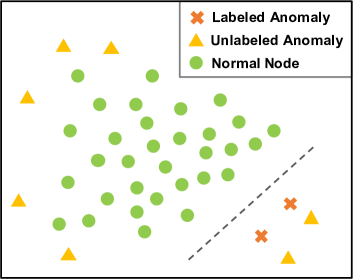
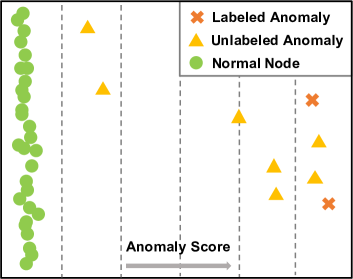
- Propose Graph Deviation Networks (GDN), a novel GNN architecture that learns to enforce statistically significant deviations between abnormal and normal nodes using only a few labeled anomalies.
- Design a cross-network meta-learning algorithm that distills meta-knowledge from multiple auxiliary networks sharing the same domain as the target network.
- Train the meta-learner to optimize a meta-loss that encourages the model to generalize well on the target network using few-shot support sets from auxiliary networks.
- Use a deviation loss function that compares the latent representations of labeled anomalies with the distribution of unlabeled nodes to highlight abnormal patterns.
- Integrate a GNN-based encoder to extract topological and feature-based representations, enhancing the expressiveness of node embeddings.
- Apply a two-stage training process: first pre-train the GDN on auxiliary networks, then fine-tune on the target network using few labeled anomalies.
Experimental results
Research questions
- RQ1Can a few labeled anomalies on the target network enable effective anomaly detection when combined with knowledge from multiple auxiliary networks?
- RQ2How does the number of auxiliary networks impact the performance and robustness of few-shot anomaly detection?
- RQ3To what extent can the proposed Meta-GDN framework generalize across different network types and contamination levels?
- RQ4How effective is the cross-network meta-learning strategy in transferring meta-knowledge without negative transfer?
- RQ5What is the contribution of each component (e.g., GNN encoder, meta-learning, deviation loss) to the overall detection performance?
Key findings
- Meta-GDN achieves state-of-the-art performance on all three benchmark datasets (Yelp, PubMed, Cora) under one-shot settings, outperforming all baselines.
- With only one labeled anomaly on the target network, Meta-GDN achieves an AUC-ROC of 0.892 on the Yelp dataset, significantly outperforming the next-best method by 5.75%.
- Performance improves monotonically with increasing numbers of labeled anomalies, demonstrating the scalability of the framework.
- Meta-GDN maintains strong robustness even under high contamination levels (up to 10% anomalies in unlabeled data), outperforming SemiGNN by a large margin.
- The ablation study confirms that both the GNN encoder and cross-network meta-learning are critical: removing either component reduces performance by up to 8.1% in Precision@100 on PubMed.
- Increasing the number of auxiliary networks from 2 to 6 improves AUC-ROC by less than 0.033 on Yelp, indicating strong performance even with minimal auxiliary data.
Read this paper
Open the full text in the Nubint reader and ask about any passage as you read.
Read this paper on NubintThis review was generated by AI from the original paper. Please check the paper before citing it.